Alkanes
Organic Chemistry
What happens
- In the presence of ultraviolet (UV) light, an alkane reacts with a halogen (chlorine or bromine) by a
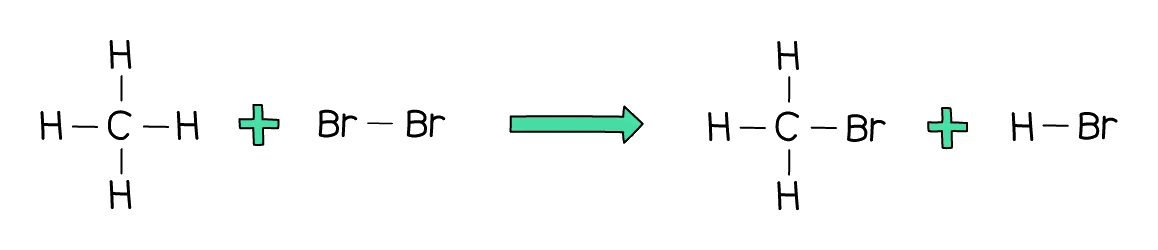
- A hydrogen atom on the alkane is swapped for a halogen atom; the displaced hydrogen leaves as a hydrogen halide (HCl or HBr)
- General word equation:
alkane + halogen → halogenoalkane + hydrogen halide
- UV light is needed to break the halogen–halogen bond and start the reaction; the reaction does not occur in the dark
Common exam question
The reaction of an alkane with bromine
Question: Complete the equation for an alkane and bromine, state the condition and name the type of reaction (1 mark per part).
Set in 8 of the 23 papers, always with bromine. The products are the halogenoalkane and hydrogen bromide, in either order: C₂H₆ + Br₂ → C₂H₅Br + HBr. In a two-mark equation the first mark is for the halogenoalkane, the second for the rest. Multiple substitution is accepted if the equation balances. Asked for the second product's formula, give HBr in the correct case: the name is ignored, wrong case rejected. The condition is ultraviolet radiation, or UV light (one scheme also took sunlight, so write ultraviolet); in the ethane-and-ethene comparison a mention of temperature or pressure was ignored. The reaction is substitution.
The tempting distractor is "addition", impossible for an alkane because it has no double bond. A five-mark version contrasts ethane and ethene: ethane needs UV, breaks a C–H bond and gives bromoethane and hydrogen bromide by substitution; ethene adds across its C=C bond to give dibromoethane.
Products: halogenoalkanes
- The organic product of an alkane–halogen substitution is called a (or haloalkane) — an alkane with one (or more) hydrogen atoms replaced by halogen atoms
- Naming follows the same stem-plus-ending rule as the parent alkane, but the halogen is named as a prefix:
- Methane + Cl2 → chloromethane (CH3Cl)
- Ethane + Br2 → bromoethane (C2H5Br)
- Propane + I2 → iodopropane (C3H7I)
- If more than one halogen has been substituted, prefixes like di-, tri- and a position number show how many and where (for example, 1,2-dichloroethane has one Cl on each of its two carbons)
Why this reaction matters
- Halogenoalkanes are useful as solvents, refrigerants, propellants and starting materials for pharmaceuticals
- A historically important sub-family was the chlorofluorocarbons (CFCs), once used in fridges and aerosol propellants
- CFCs were phased out under the Montreal Protocol because they migrate to the upper atmosphere and damage the ozone layer