Alkanes
Organic Chemistry
What an alkane is
- Alkanes are the simplest family of organic compounds: hydrocarbons (carbon and hydrogen only) in which every carbon–carbon bond is a single bond
- A molecule with only single bonds is described as saturated — every carbon atom carries as many hydrogens as it possibly can, so the molecule cannot take on any more atoms
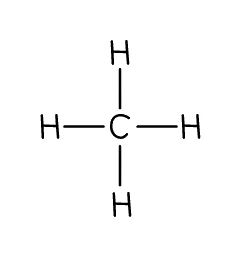
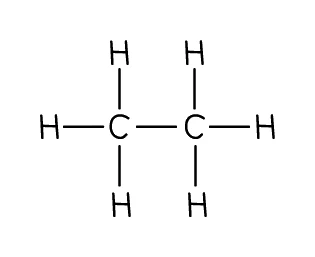
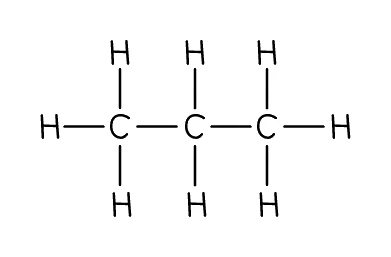
- Each alkane molecule consists of a chain of carbon atoms with hydrogen atoms filling all the spare bonds
- Alkanes form a homologous series — they share a single functional group (the absence of any double or triple bonds), a common general formula, and a steady gradation of physical properties as the chain grows
General formula
- The general formula of the alkane series is:
CnH2n+2
- where n is the number of carbon atoms in the molecule (n = 1, 2, 3, …)
- Plug in n to get the molecular formula:
- n = 1 → CH4 → methane
- n = 2 → C2H6 → ethane
- n = 3 → C3H8 → propane
- The +2 accounts for the extra hydrogen at each end of the chain that has no neighbouring carbon to bond to
Exam tip
Use the general formula to recognise an alkane
No paper asked you to write CₙH₂ₙ₊₂. One printed it in a table beside butane's structural formula and C₄H₁₀, and two of the four marks were for naming those as the "general formula" and the "molecular formula", so know each type of formula by name; other questions need the formula itself. A molecular formula with two more hydrogens than twice its carbons is an alkane: C₄H₁₀ is one, C₂H₅ is not, and CH₃CH₂CH₃ is a structural formula, not a molecular one.
CₙH₂ₙ (empirical formula CH₂) is the alkene pattern, yet two papers asked for the saturated compound with it among a set of displayed formulae. It was a ring of carbon atoms joined only by single bonds: saturated means single bonds only, whatever the formula.
The first five alkanes
The first five members of the series are the ones that show up most often in exam questions:
| n | Name | Molecular formula | State at room temperature |
|---|---|---|---|
| 1 | Methane | CH4 | Gas |
| 2 | Ethane | C2H6 | Gas |
| 3 | Propane | C3H8 | Gas |
| 4 | Butane | C4H10 | Gas |
| 5 | Pentane | C5H12 | Liquid |
The names follow a fixed pattern: the stem counts the carbons (meth-, eth-, prop-, but-, pent-) and the -ane ending signals the alkane family. Both pieces are needed in exam answers.
Common exam question
Naming an alkane and giving its formulae
Question: Give the name, molecular formula, empirical formula or relative formula mass of an alkane from one of its other formulae (1 mark each).
Some part of this is set in 5 of the 23 papers. Count the carbons for the stem and add -ane: CH₃CH₂CH₂CH₃ is butane, a five-carbon chain is pentane, and the spelling has to be exact. The molecular formula totals the atoms (C₄H₁₀), and the relative formula mass follows from it: C₅H₁₂ gives 5 × 12 + 12 × 1 = 72.
The empirical formula is the molecular formula divided down as far as it goes: C₂H₆ becomes CH₃ and C₄H₁₀ becomes C₂H₅, but C₃H₈ cannot be divided, so propane was the answer when a paper asked which alkane has the same empirical and molecular formula. That is also why a three-mark question could ask why alkanes have different empirical formulae while every alkene reduces to CH₂.
Common exam question
Drawing the isomers of butane or pentane
Question: Draw the displayed formulae of the two isomers of C₄H₁₀, or of the two isomers of C₅H₁₂ that are not shown (2 marks, one per isomer).
Set in 3 of the 23 papers, always in the same question as the two-mark definition of isomers (same molecular formula, different structural or displayed formulae). One mark is for each correct structure, in either order. C₄H₁₀ has the unbranched chain of four carbons (butane) and a chain of three with the fourth carbon attached to the middle one. C₅H₁₂ has pentane, a four-carbon chain with a branch on its second carbon, and a three-carbon chain with two branches on its middle carbon.
Draw every atom and every bond: one scheme rejected a structure that wrote part of the molecule as a formula, such as a CH₃ group, instead of showing its bonds. Check that each carbon shows four bonds and that the hydrogens total ten or twelve.
Trends down the homologous series
- As the chain lengthens (methane → pentane → hexane → …):
- Boiling point rises steadily — bigger molecules have stronger
- falls — the heavier alkanes do not evaporate as readily
- rises — longer-chain liquid alkanes are stickier
- Flammability falls — heavier alkanes are harder to ignite, although they all still burn
Chemistry of the alkanes
- Alkanes are described as generally unreactive — their molecules have only strong C–C and C–H single bonds that do not break readily under everyday conditions
- The three reactions of alkanes worth memorising are:
- in oxygen (the basis of their use as fuels — see topic 22 section 2)
- when heated with a catalyst (the basis of converting long-chain into short-chain — see topic 22 section 4)
- Substitution by halogens in the presence of ultraviolet light — covered next in section 2
Common exam question
Explaining why an alkane is saturated
Question: Explain why ethane is described as a saturated compound, or give a reason why it does not undergo an addition reaction with bromine (1–2 marks).
Set in 2 of the 23 papers. For two marks, the first is for the bonding: the molecule has only single bonds, with no double or multiple bonds between its carbon atoms. The second is for what follows: no more atoms can be added to it, so it cannot take part in addition reactions. Saying that it already holds the maximum number of hydrogen atoms, or that it only undergoes substitution reactions, is also credited for the second mark.
For the one-mark version any one of "saturated", "no double bonds" or "only single bonds" is enough. In the two-mark version both marks are for reasons: the bonding first, then its consequence.
Worked example
Finding an alkane from its combustion products
An alkane burns completely according to the equation alkane + xO₂ → yCO₂ + zH₂O. Burning one mole of it gives 484 g of carbon dioxide and 216 g of water. Find y and z, then the alkane's molecular formula and x. (Mr of CO₂ = 44, Mr of H₂O = 18.)
Solution:
- y is the number of moles of CO₂ made from one mole of alkane: 484 ÷ 44 = 11
- z is the number of moles of H₂O: 216 ÷ 18 = 12
- Every carbon atom in the alkane ends up in its own CO₂, so the alkane has 11 carbon atoms; every two hydrogen atoms end up in one H₂O, so it has 2 × 12 = 24 hydrogen atoms
- Molecular formula = C₁₁H₂₄ (check with the general formula: n = 11 gives 2n + 2 = 24, so this is an alkane)
- Count the oxygen atoms on the right: 11 × 2 + 12 = 34, so x = 34 ÷ 2 = 17
- Full equation: C₁₁H₂₄ + 17O₂ → 11CO₂ + 12H₂O
The formula mark is given only for the formula of an alkane, so check that your hydrogen count is two more than twice your carbon count before you balance the oxygen. If y or z is wrong, the later marks can still be earned by follow-through from your own values.