PhysicsExam code: 4PH1
Radioactivity, Uses & Dangers
Radioactivity & Particles
What activity means
- A radioactive source is any object containing unstable nuclei that emit ionising radiation as they decay
- The of a source is defined as:
the rate at which the unstable nuclei in the source decay
- Activity is measured in becquerels (Bq), where:
1 Bq = 1 decay per second (one unstable nucleus in the source breaks down each second)
- A source with an activity of 1000 Bq has 1000 nuclei decaying per second; a source of 1 MBq has a million decays per second
Common exam question
Giving the unit of activity
Question: Give the unit of activity, or pick it out from a list of units (1 mark).
Asked in 4 of the 24 papers, twice as a multiple-choice item. The answer is the becquerel (Bq): one decay per second. Any prefix is accepted (kBq, for example), and so is a recognisable misspelling; one scheme also allowed the curie. The multiple-choice distractors are other SI units (the kilogram, newton, pascal, coulomb, joule and watt), so you only need to recognise the one unit that counts decays.
Activity decreases over time
- Every time a nucleus decays, it disappears from the pool of unstable nuclei
- So the number of unstable nuclei left in the sample is always falling
- Fewer unstable nuclei means fewer decays per second, so the falls with time as well
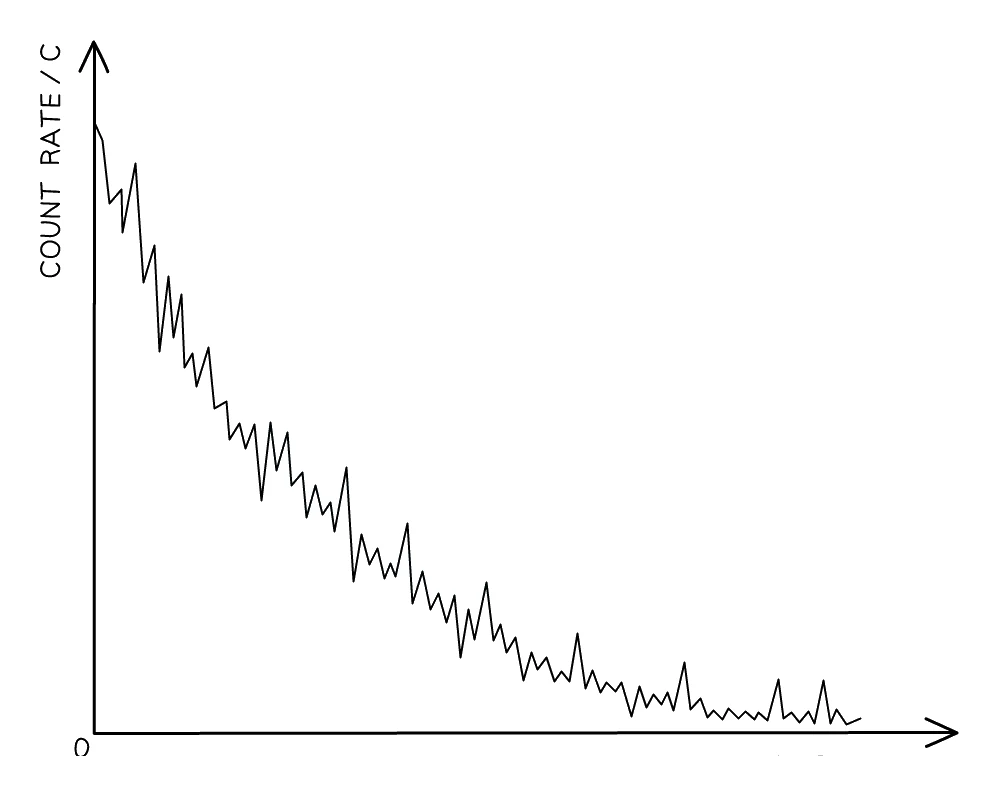
- The fall is not linear; it is faster at the start (when many unstable nuclei are present) and slower as time goes on. The shape is an curve
Decay is random
- Radioactive decay is a random process: it is impossible to predict which nucleus will decay next, or exactly when any one nucleus will break down
- All you can say is the probability that a given nucleus will decay in the next second
- The randomness can be seen by measuring the of a source using a Geiger–Müller (GM) tube
- The count rate is the number of decays the detector registers per second. When count rate is plotted against time the trace fluctuates up and down rather than following a perfectly smooth curve
- These fluctuations are direct evidence that decay is random. If decay were a steady, clockwork process the count rate would lie exactly on a smooth curve
Activity vs count rate (don't mix them up)
- Activity = rate at which unstable nuclei in the source actually decay (Bq)
- Count rate = rate at which the detector registers radiation
- Count rate is usually smaller than activity, because:
- The detector does not surround the source completely, so much of the radiation flies off and misses it
- Some radiation is absorbed by air, the GM tube wall, or any object in between
- Count rate is the practical, measurable quantity; activity is the theoretical quantity