Radioactivity, Uses & Dangers
Radioactivity & Particles
Definition
- Because individual decays are random, you cannot say "this particular nucleus will decay at 3:42 pm"
- What you can measure precisely is how long it takes for a large sample to halve. This is the half-life:
the of a radioactive isotope is the time taken for the number of unstable nuclei in a sample to fall to half of its original value
- Equivalently, since activity is proportional to the number of unstable nuclei, half-life is the time for the of the sample to drop to half its starting value
- Half-life is a property of the isotope itself. Every nucleus of a given isotope has the same probability of decaying per second, so the half-life is constant, and temperature, pressure and chemistry have no effect
Common exam question
Defining half-life
Question: State, describe or explain what is meant by the term half-life (2 marks).
Asked in 6 of the 24 papers, once as a multiple-choice item. The two marks are two separate ideas: the time taken ("how long it takes" is accepted; one scheme writes "average time") for the activity to halve, or for half of the unstable nuclei to decay. Count rate is accepted for activity and atoms for nuclei. Some schemes also allow the mass of the isotope, but one ignores it, so activity or nuclei is the safe choice.
Four of the five written schemes explicitly reject "half the time", so begin with "the time taken for". Name what halves: "the substance" or "the sample" is ignored, so say the activity, the count rate or the number of nuclei. A time with nothing halving, or a halving with no time, earns one mark of the two.
Half-lives vary enormously
- Different isotopes have wildly different half-lives:
| Isotope | Half-life | Use |
|---|---|---|
| Polonium-214 | ≈ 0.0002 s | Found in radon decay chains |
| Technetium-99m | ≈ 6 hours | Medical tracer |
| Iodine-131 | ≈ 8 days | Treating thyroid cancer |
| Carbon-14 | 5700 years | Carbon dating |
| Uranium-235 | 704 million years | Nuclear fuel |
| Uranium-238 | 4.5 billion years | Dating rocks |
- Short half-lives mean a very high for a short time; long half-lives mean a much lower activity but lasting far longer than any human timescale
Halving step by step
- After each half-life, the number of unstable nuclei (and the activity) is halved:
| Number of half-lives elapsed | Fraction of original isotope remaining |
|---|---|
| 0 | 1 (100%) |
| 1 | 1/2 (50%) |
| 2 | 1/4 (25%) |
| 3 | 1/8 (12.5%) |
| 4 | 1/16 (6.25%) |
| 5 | 1/32 (3.125%) |
- The pattern: after n half-lives, the fraction remaining is (1/2)ⁿ
Common exam question
Calculating an activity or a time with half-lives
Question: Given the half-life, calculate the activity after a stated time, show that a stated time is needed to fall below a given activity, or show the ratio of daughter to parent nuclei (3–5 marks; also set as multiple choice).
Set in 5 of the 24 papers. Write every halving down. In the three-mark version one mark is for halving the starting activity, one for showing the right number of half-lives (write the division, such as 36 ÷ 9 = 4) and one for the final value. For a "show that" time, halve until below the target, then turn that number of half-lives into years. For a ratio, find the parent nuclei left, subtract from the original total for the daughter nuclei (the total stays constant) and divide.
If a multiple-choice time is only half a half-life, more than half of the atoms remain: the answer lies between the starting number and half of it.
Worked example
Activity remaining after several half-lives
A radioactive source has an initial activity of 960 Bq. Its half-life is 4 hours. Find the activity after 20 hours.
Solution:
- Number of half-lives elapsed: 20 ÷ 4 = 5
- Halve the activity once for each half-life:
- After 1 half-life (4 h): 960 ÷ 2 = 480 Bq
- After 2 half-lives (8 h): 480 ÷ 2 = 240 Bq
- After 3 half-lives (12 h): 240 ÷ 2 = 120 Bq
- After 4 half-lives (16 h): 120 ÷ 2 = 60 Bq
- After 5 half-lives (20 h): 60 ÷ 2 = 30 Bq
Common exam question
Sketching the decay curve over three half-lives
Question: On the axes, sketch the decay of the sample during its first three half-lives, or draw crosses showing the number of atoms left after each of three half-lives (3 marks).
Set in 2 of the 24 papers. Most of the marks are for specific points, not a general shape. The sketch must start at the given initial activity at time zero, pass through half of it at one half-life (a plotted point is accepted as the evidence) and be a smooth curve that falls ever more slowly, so a straight line cannot earn the shape mark. For the crosses, each is a mark: at one, two and three half-lives, at a half, a quarter and an eighth of the starting number. If the next part asks for a curve of best fit through your crosses, the crosses may be read off that curve, so draw it smoothly through all of them.
Reading a half-life from a graph
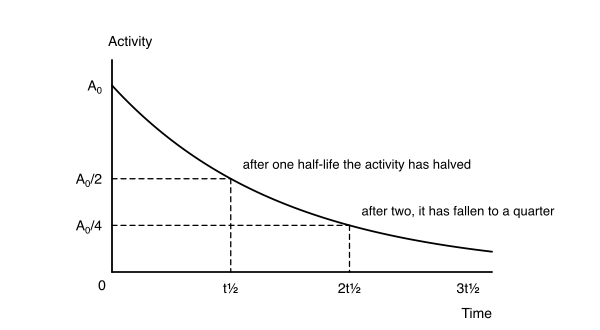
- To find the half-life from an activity-time graph:
- Read off the initial A₀ from the y-axis at t = 0
- Halve it to get A₀/2
- Draw a horizontal line from A₀/2 across to the curve, then drop straight down to the time axis
- The reading on the time axis is the
- It is a good idea to do this a second time (read at A₀/4) and divide the resulting time by 2 to check; you should get the same answer
Common exam question
Finding the half-life from a decay graph
Question: Use the graph to determine the half-life, or use a curve of best fit to estimate the time for the amount left to fall to a stated value (2 marks).
Asked in 6 of the 24 papers. One mark is for showing your method: a line across from half the starting activity (or count rate), or from the stated value, to the curve and down to the time axis, or the halving written in your working. Any halving along the curve is accepted, though the starting value is easiest. The second mark is for the reading, accepted within a small tolerance, so read carefully, with the axis unit.
When the points are given, draw the smooth curve of best fit first: the reading mark then follows your own curve even if it is slightly off. If asked why the points do not lie exactly on the curve, say that decay is random (a varying background count is also accepted).
Worked example
Reading a half-life from a decay curve
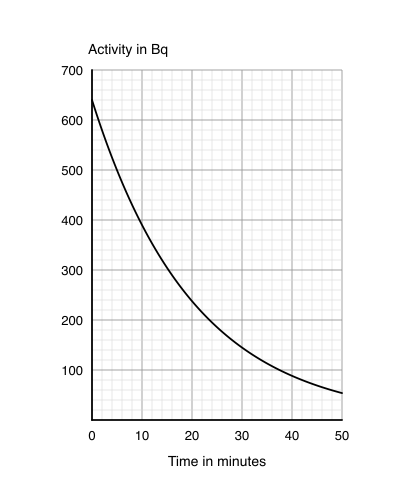
The graph is the decay curve of a radioactive sample whose activity at the start is 640 Bq. Use it to find the half-life of the sample.
Solution:
- Half of the starting activity: 640 ÷ 2 = 320 Bq
- Draw a line across from 320 Bq to the curve, then straight down to the time axis
- Read the time: the line meets the axis 2 small squares after the 10-minute line, and each small square is 2 minutes, so the time is 10 + 2 × 2 = 14 minutes
- Check with a quarter of the starting activity: 640 ÷ 4 = 160 Bq is reached at 28 minutes, and 28 ÷ 2 = 14 minutes
- Half-life = 14 minutes