Radioactivity, Uses & Dangers
Radioactivity & Particles · 1 question type
There are three guiding principles for reducing the dose anyone receives from a source: time, distance and shielding.
Time
- The shorter the time you spend near a source, the smaller the total dose you receive
- Workers handling sources keep their tasks brief and the source out of its container only as long as needed
Distance
- Radiation spreads out from a source, so the further away you are, the lower the intensity at your position
- For a point source, the intensity follows an inverse-square law: doubling the distance from the source divides the dose rate by 4
- That is why sources are handled with tongs rather than fingers; the extra distance dramatically reduces the dose to the hand
Shielding
- A barrier between the source and the worker absorbs much of the radiation
- The right shielding depends on the radiation:
- Alpha: a sheet of paper or even a few cm of air is enough
- Beta: a few mm of aluminium
- Gamma: several cm of lead, or thick concrete; never fully stopped, only reduced
- X-ray rooms have lead-lined walls and lead aprons for the patient; nuclear waste is stored in thick concrete-and-steel casks
Practical safety rules in a school or hospital
- Keep sources in a lead-lined box when not in use
- Use tongs to lift and move sources; never touch with bare hands
- Point the source away from people
- Wear gloves, lab coats and (where appropriate) lead aprons or full lead-lined suits
- Where the source is a powder, dust or gas, wear an airtight suit to prevent contamination, keeping the radioactive material out of the eyes, nose and mouth
- Record how long the source is out, and how it has been used
- Wear a film badge (dosemeter), see below, so that any over-exposure is detected
State one safety precaution when handling a radioactive source
What comes up: "State one precaution the teacher/student should take to work safely" — asked across multiple papers for 1 mark.
Write: any one of: use tongs to handle the source; store the source in a lead-lined box when not in use; keep exposure time as short as possible; point the source away from people; wear gloves; wear a lead apron.
Watch out: vague answers such as "be careful" or "stand far away" without specifying a named action score nothing. The mark scheme credits specific named precautions only — name the action clearly (e.g. "use tongs", not just "don't touch it").
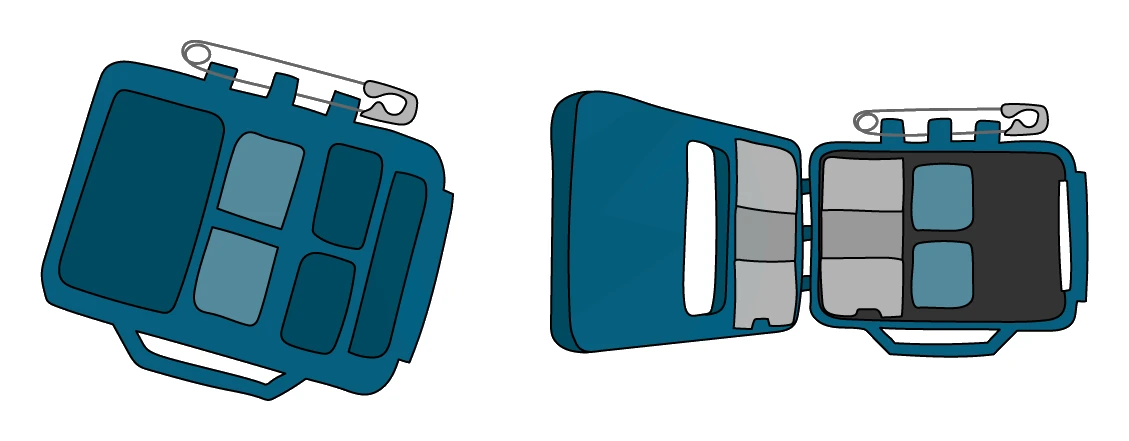
The film badge / dosemeter
- A dosemeter is a small badge clipped to the clothing of anyone working with radiation
- The badge contains photographic film (or a modern equivalent), partly covered by strips of different absorber materials, typically paper, aluminium and lead, each of varying thickness
- Over a week or month the badge is removed and processed. The amount of darkening behind each absorber shows the dose of each type of radiation the wearer has received:
- Darkening behind no absorber but not behind the paper window ⇒ alpha (or low-energy radiation)
- Darkening behind paper but not aluminium ⇒ beta
- Darkening even behind lead ⇒ gamma or X-rays
- If the total dose exceeds the safe limit, the worker is taken off radiation work until the dose drops