4PH1
Radioactivity, Uses & Dangers
Radioactivity & Particles · 1 question type
Radioactive waste from power stations, hospitals and research labs has to be stored safely for as long as it remains active. How it is stored depends on the type of radiation and the .
Low-level waste
- Materials with only alpha or weak beta activity (used gloves, paper, syringes from hospitals)
- Sealed inside plastic bags or metal canisters and buried in shallow, monitored landfill sites
- The packaging easily absorbs the alpha and beta emissions
Intermediate-level waste
- More strongly active beta and gamma waste (reactor parts, contaminated tools)
- Sealed inside steel drums, often surrounded by concrete to form a heavy block
- Stored in concrete-lined silos above ground or in shallow burial sites
High-level waste
- Spent nuclear fuel rods and the products of fission
- Strongly gamma-emitting, with very long half-lives (thousands to millions of years)
- Storage strategy:
- First cooled in water-filled ponds for several years next to the reactor; water shields the gamma and removes the heat of decay
- Then encased in vitrified glass blocks (mixing the waste into molten glass that solidifies into a solid, leach-resistant form)
- Then sealed inside lead-lined, thick concrete casks
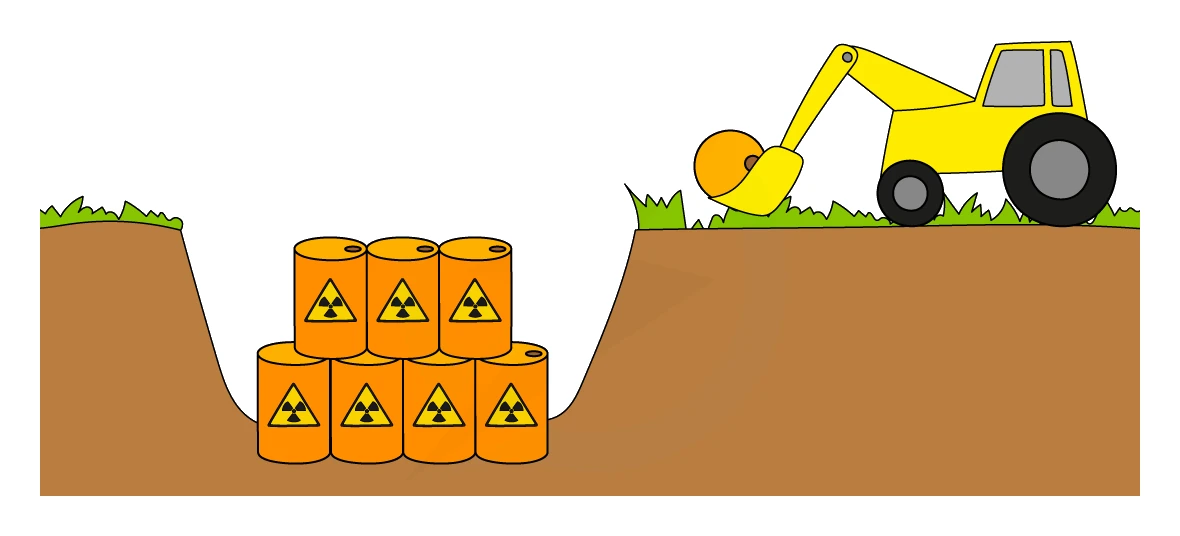
- Finally buried deep underground in geologically stable sites such as old salt mines or stable rock formations where there is no groundwater movement
Why it is so hard
- Storage must last as long as the waste is active. For some isotopes this is tens of thousands of years, far longer than any civilisation has lasted
- Containers must:
- Resist corrosion for centuries (stainless steel with copper outer layers; expensive to manufacture)
- Survive earthquakes, floods and accidental impact
- Stop water reaching the waste (water carries dissolved radioactive atoms into the environment)
- The chosen burial site must have:
- Low risk of earthquakes and other natural disasters
- No groundwater flow that could transport radioactivity to lakes, rivers or aquifers
- High security so the waste cannot be stolen or accidentally exposed
- For very low-activity liquid waste, dilution in large volumes of seawater is sometimes used. This works only because the radioactivity is spread so thinly that any single point in the sea is at or near background level; it relies on the radioactivity being too diffuse to harm anything, not on it disappearing