4PH1
Radioactivity, Uses & Dangers
Radioactivity & Particles · 1 question type
The choice of radiation for any application depends on its range (how far it travels and what it can penetrate) and its ionising power.
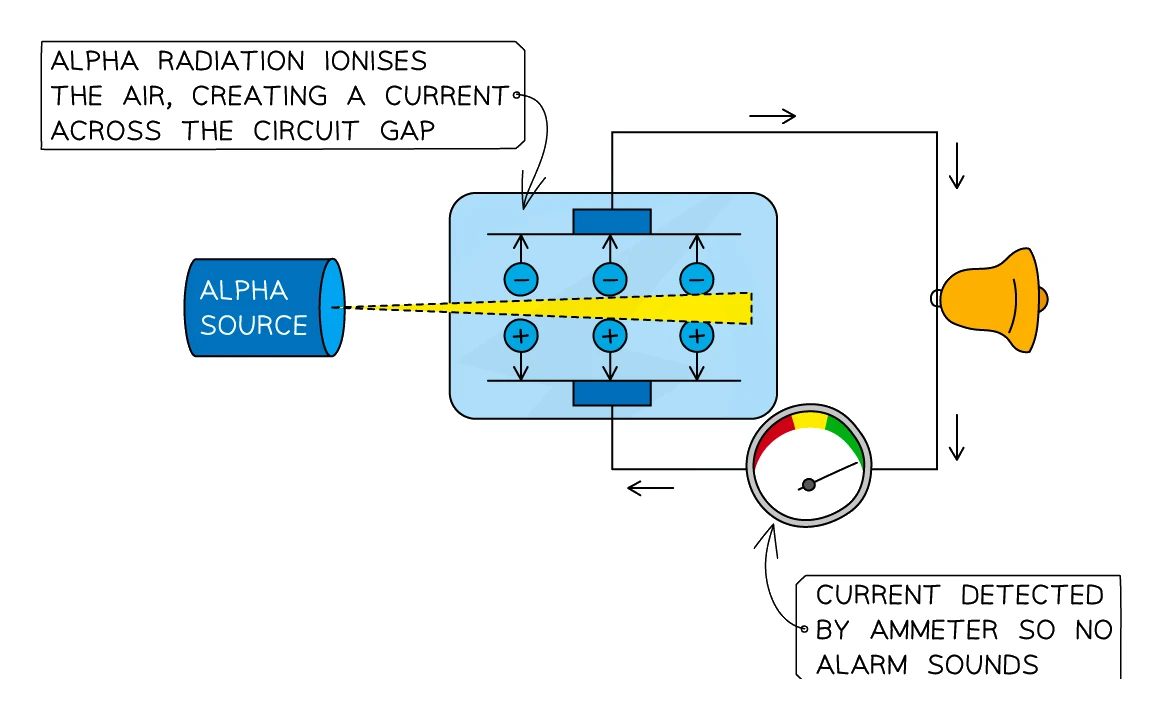
Smoke detectors: alpha
- A small alpha source (typically americium-241) sits inside the detector
- Inside a small chamber, the alpha particles ionise the air between two electrodes, creating a steady tiny current that flows through a circuit
- When smoke enters the chamber, the smoke particles absorb the alpha radiation before it can ionise the air
- The current drops sharply, and the microchip triggers the alarm
Why alpha is the right choice:
- Alpha is the most strongly ionising radiation, so it creates plenty of ions in the chamber and a strong baseline current
- Alpha is the least penetrating, so it cannot escape the detector, meaning there is no radiation hazard to the person standing under it
- Smoke is dense enough to absorb alpha but not beta or gamma. Beta and gamma radiation would slip through any normal puff of smoke unchanged, so the current would never drop and the alarm would never trip
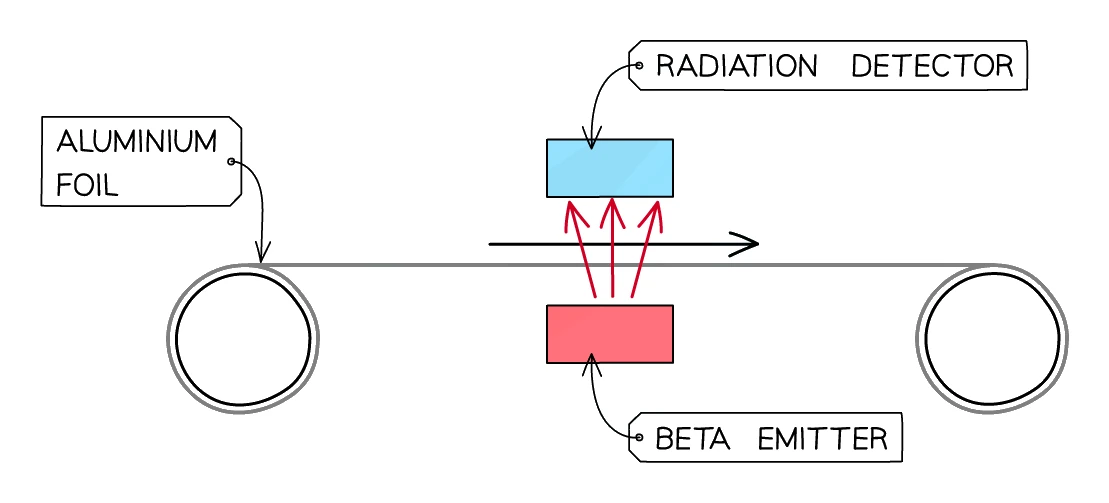
Measuring the thickness of materials: beta
- A beta source is placed on one side of a moving sheet of paper, cardboard or thin aluminium foil; a GM tube sits on the other side
- Some beta particles are absorbed by the sheet; the rest pass through and are counted by the GM tube
- If the sheet is too thick, more beta particles are absorbed and the count rate falls
- If the sheet is too thin, fewer beta particles are absorbed and the count rate rises
- A control system reads the count rate and adjusts the rollers to keep the thickness constant
Why beta is the right choice:
- Alpha would be stopped completely by even the thinnest paper, so the count rate would be zero no matter what thickness the sheet was
- Gamma would pass through almost unchanged, so changes in thickness would not register
- Beta is partially absorbed, which is exactly what is needed for the count rate to be sensitive to small changes in thickness
- The source must have a long (typically strontium-90, 28 years) so the count rate does not drift during the working life of the gauge
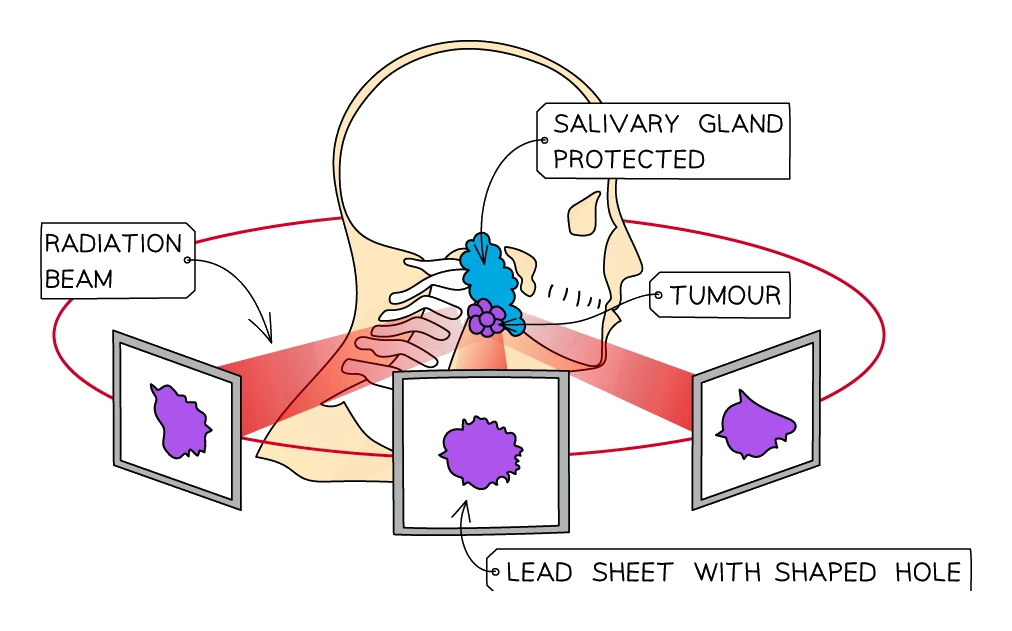
Treating cancer: gamma
- Radiotherapy uses high-energy gamma rays directed at a cancerous tumour
- The gamma beam is aimed from several different directions, all crossing at the tumour. The healthy tissue along any one beam path receives only a small dose, but the tumour at the focus receives the full combined dose from every beam
- The beam is often produced by a rotating cobalt-60 source
Why gamma is the right choice:
- Gamma is highly penetrating, so it can reach a tumour deep inside the body from an external source
- Alpha and beta would be absorbed by the skin and surface tissue before reaching the tumour
Diagnosing cancer: tracers and PET scans
- A radioactive tracer is a small amount of a short-half-life radioisotope (often technetium-99m, half-life 6 hours) that is swallowed, inhaled or injected into the patient
- The tracer is chemically attached to a substance the body takes up, glucose for example. The substance carries the tracer to the organ being studied
- A detector (PET scanner) outside the body picks up the gamma emissions and builds up a map showing where the tracer has gone
- Bright spots show areas of high in the body. For example, fast-growing tumour cells take up far more glucose than healthy ones, so a tumour shows up as a bright spot
What makes a good tracer:
- Gamma emitter: gamma is the only radiation that can escape the body to reach the external detector
- Short half-life: the tracer should decay quickly so the patient is not radioactive for very long, but not so quickly that it decays before the scan is finished. A few hours is ideal
Sterilising medical equipment: gamma
- Surgical instruments are sealed inside their plastic packaging and exposed to a strong gamma source
- The gamma radiation kills any bacteria, viruses or spores on the instruments
- Because gamma is highly penetrating, it passes straight through the packaging. The instrument is sterilised without opening the seal, so it remains sterile until the surgeon opens the packet
- This method does not need high temperatures, so heat-sensitive instruments (plastics, electronics) can be sterilised this way
Irradiating food: gamma
- Food is exposed to gamma rays before being sold. The radiation kills bacteria, moulds and insects that would spoil the food or cause illness
- The food does not become radioactive (this is irradiation, not contamination; see Section 4)
- The food lasts longer on the shelf and is safer to eat
- Irradiated food is labelled with the Radura symbol, a stylised flower inside a broken circle
Carbon dating: beta
- Living things absorb carbon-14 continuously while they are alive, so the carbon-14 fraction in their tissues stays at the atmospheric level
- When the organism dies, no new carbon-14 is taken in. The carbon-14 already present decays (by beta emission) with a half-life of 5700 years
- The age of an ancient object (wood, bone, charcoal) can be worked out by measuring the remaining carbon-14 activity and counting how many half-lives have passed
- Useful for objects up to about 50 000 years old; for older rocks, uranium dating is used instead