Properties of Radiation
Radioactivity & Particles
Atomic Structure
What an atom is
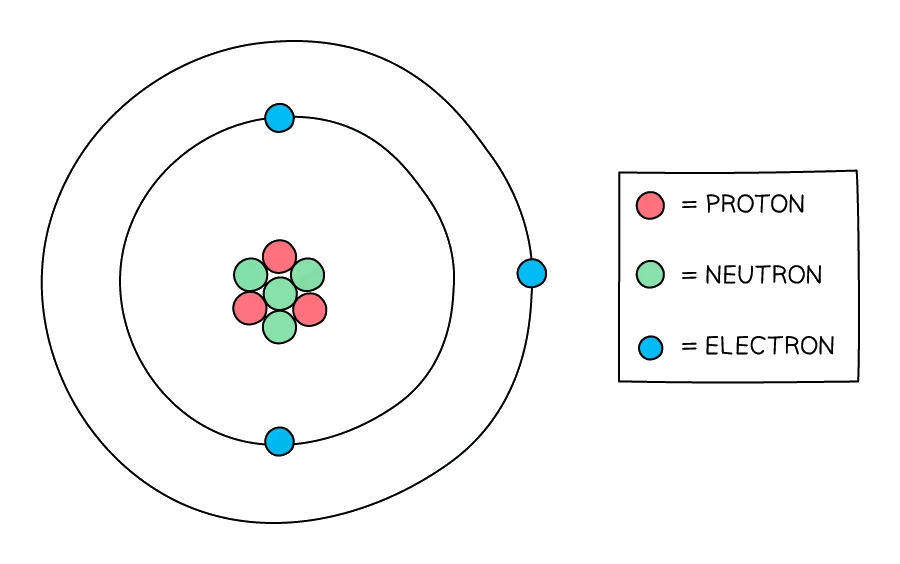
- An atom is the basic building block of all matter. Atoms are tiny (about 1 × 10⁻¹⁰ m in radius), so around 100 million atoms could sit side by side across a thumbnail
- Every atom has two parts:
- a tiny dense at the centre
- a cloud of orbiting the nucleus
- The nucleus is about 10 000 times smaller than the whole atom but contains almost all of the mass. If the atom were scaled up so the nucleus was a marble in the middle of a football stadium, the electrons would be orbiting the seats in the back row
The three sub-atomic particles
| Particle | Location | Relative charge | Relative mass |
|---|---|---|---|
| Proton | In the nucleus | +1 | 1 |
| Neutron | In the nucleus | 0 | 1 |
| Electron | Orbiting the nucleus | −1 | 1/2000 (effectively zero) |
- Together protons and neutrons make up the nucleus and are called
- In a neutral atom, the number of electrons equals the number of protons, so the positive nuclear charge is exactly cancelled by the negative electron charge
- If an atom loses or gains electrons, the charges no longer balance and the atom becomes an ion: positive if electrons have been lost, negative if extra electrons have been gained
Atomic and mass numbers
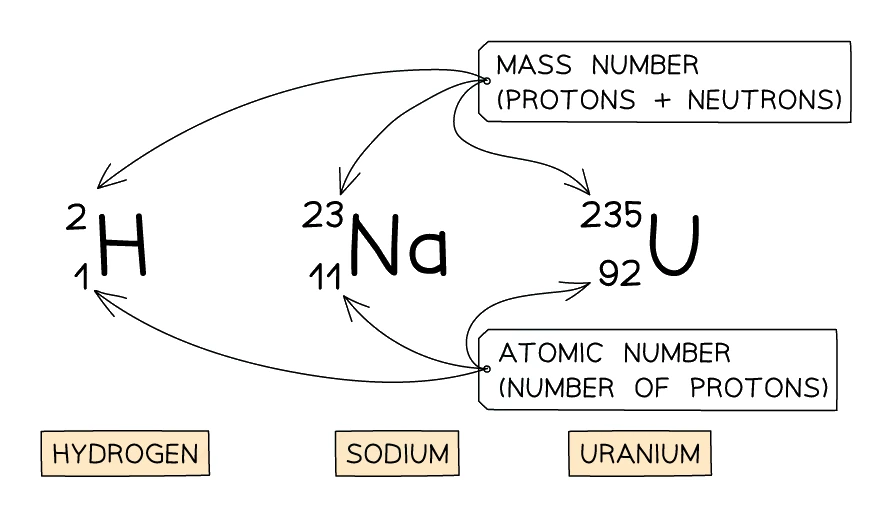
- Atomic number (Z) = the number of in the nucleus. This single number defines which element an atom is:
- Hydrogen: Z = 1
- Carbon: Z = 6
- Sodium: Z = 11
- Uranium: Z = 92
- Mass number (A) = the total number of nucleons (protons + neutrons) in the nucleus
- The number of in an atom can therefore be found by subtraction:
number of neutrons = mass number − atomic number = A − Z
Nuclear notation
- A nucleus is described by writing its element symbol together with its mass number and atomic number:
ᴬ_Z X
- where:
- A = mass number (top, total nucleons)
- Z = atomic number (bottom, protons)
- X = the element's chemical symbol
- Some examples:
- ¹₁H is hydrogen (1 proton, 0 neutrons, 1 electron)
- ²³₁₁Na is sodium (11 protons, 12 neutrons, 11 electrons)
- ²³⁸₉₂U is uranium-238 (92 protons, 146 neutrons, 92 electrons)
Common exam question
Counting neutrons from a nuclear symbol
Question: Given the symbol of a nucleus, with its mass number above and its atomic number below, how many neutrons does the nucleus contain? (1 mark, multiple choice)
Asked in 3 of the 24 papers. Subtract the bottom number from the top one: the mass number counts protons and neutrons together and the atomic number counts the protons, so cobalt-60 (atomic number 27) has 60 − 27 = 33 neutrons. The three wrong options are built from the expected slips: the atomic number on its own, the mass number on its own, and the two added together. Electron counts are asked the same way: a neutral atom has as many electrons as protons, a positive ion has fewer because it has lost electrons, and a negative ion has gained electrons. Saying that a positive ion has gained protons is rejected.