Properties of Radiation
Radioactivity & Particles
Photographic film
- Photographic film darkens when ionising radiation hits it, just as it darkens when visible light hits it
- The more radiation absorbed, the darker the film when developed
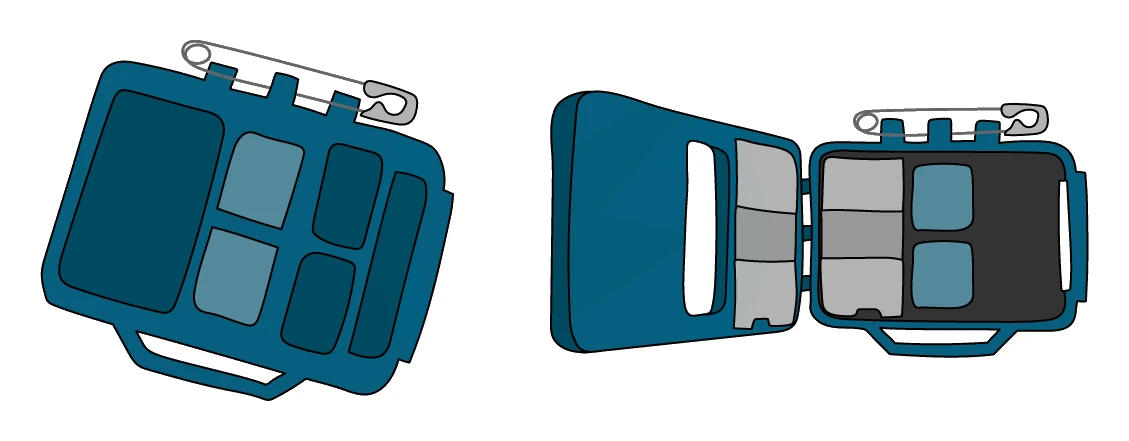
- Radiation workers (radiographers, nuclear-medicine staff, lab technicians) wear film badges with several layers of absorber inside them:
- paper to filter out alpha
- aluminium to slow beta
- lead and copper windows to gauge how much gamma got through
- The patchwork of darkening on the developed film tells the health-and-safety team how much of each kind of radiation the wearer was exposed to over the badge's wearing period
Geiger–Müller tube (GM tube / Geiger counter)
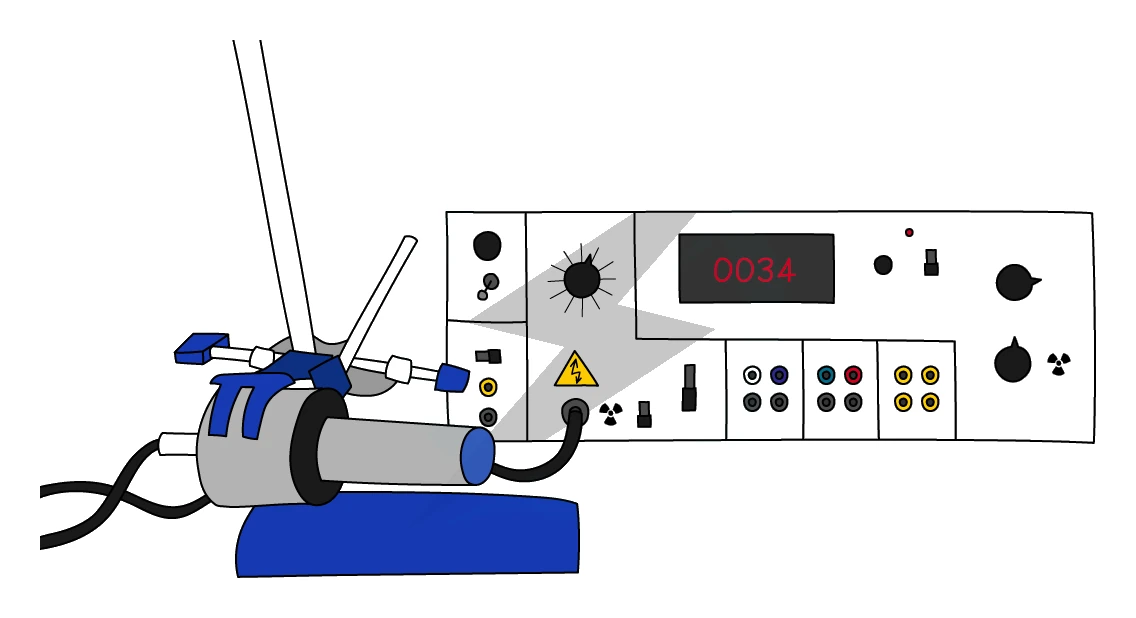
- A Geiger–Müller tube is a sealed glass tube filled with low-pressure gas. A thin mica window at one end lets in alpha, beta and gamma (alpha only if the window is thin enough)
- Whenever a radioactive particle enters the tube, it ionises the gas inside, producing a short electrical pulse that the connected counter records as a single "count"
- The counter either makes an audible click for every pulse or shows a digital count rate display
- Count rate is just counts divided by time. Convert to counts per second (cps, or Hz) by dividing the per-minute total by 60
Common exam question
Naming a detector of ionising radiation
Question: Name a piece of apparatus that can detect ionising radiation, or fill the gap in "the count rate is measured with a ... and a counter" (1 mark).
Asked in 4 of the 24 papers. Give Geiger–Müller tube (GM tube is accepted) or photographic film; one scheme also allowed a scintillator, another a spark counter, and "Geiger counter" was condoned. Name the instrument: in one paper the vague answer "radiation detector", which only restates the question, was ignored. When the gap is followed by "and a counter", the word wanted is the GM tube itself.
Background radiation
- Some level of radioactivity is always present in the surroundings, even with no laboratory sources nearby. This is called background radiation and it has to be subtracted from any measurement to find the true contribution of the source
- The biggest sources of natural background radiation:
- Radon gas seeping from rocks and building materials. Radon is an alpha emitter; it accumulates in basements and poorly ventilated buildings and is the single largest contributor in most homes
- Cosmic rays from the Sun and from beyond the Solar System, which strike the upper atmosphere and produce showers of high-energy particles that reach the ground
- Foods like bananas (potassium-40), Brazil nuts, and root vegetables naturally contain trace radioactive isotopes
- Carbon-14 present in all living tissue
- Artificial (human-made) sources are smaller in everyday life but include:
- Medical procedures (X-rays, CT scans, radioactive tracers, radiotherapy)
- Nuclear waste from power stations and weapons programmes
- Fallout from past nuclear-weapons testing or accidents (Chernobyl, Fukushima)
- Background level varies with location (higher at altitude because of more cosmic rays; higher in areas of granite-rich rock because of more radon) and with time (small spikes during severe space weather)
Common exam question
Sources and meaning of background radiation
Question: State one source of background radiation, give another naturally occurring source, or describe what is meant by the term background radiation (1–2 marks).
Asked in 4 of the 24 papers. For a source, any one of: the Sun or cosmic rays, rocks or soil, radon gas, food, medical equipment, weapons testing or a named nuclear accident; a named radioactive isotope such as carbon-14 is also accepted when a natural source is wanted. Give one answer, not a list: a list containing a wrong item is rejected. "Space" on its own is ignored, and the cosmic microwave background is rejected because it is a different phenomenon from the ionising radiation meant here. For the two-mark description, say that background radiation is always present, all around us, that it comes from sources in the environment rather than from the sample being measured, and name one of those sources: each scheme credited two of these three ideas.
Subtracting background from a measurement
- The correct workflow for a radiation experiment:
- With no source present, take a long background count (several minutes)
- Calculate the background count rate
- With the source in place, take the apparent count
- The corrected count rate is the apparent rate minus the background rate
Common exam question
Correcting a count rate for background
Question: Describe how to measure the count rate from a source and correct it for background radiation, or state how a method should be changed to allow for background (1–4 marks).
Asked in 3 of the 24 papers. The four-mark version has four separate points: use a GM tube with a counter and a timer; take a reading with the source removed from the room, or before it is brought in; measure that background count several times and take a mean; then subtract the background count from every reading taken with the source. The shorter versions credit the same idea in fewer steps: get the source out of the way (point it away, return it to its box, or move it far off), count for a minute, and subtract. When the question only asks how to correct a reading, "subtract the background count rate" is the whole mark.
Improving the accuracy
- Background levels fluctuate randomly, so a one-minute reading is noisy. To get a more reliable corrected rate:
- Take readings over a long period: counting for 10 minutes and dividing gives a more stable rate than counting for 30 s
- Repeat the experiment and average the results
- Use a strong source so the source's contribution dominates the background fluctuation