4PH1
Properties of Radiation
Radioactivity & Particles · 2 question types
Why radiation is emitted
- An unstable nucleus can become more stable by emitting radiation: a high-energy particle or wave that carries away mass, charge or energy from the nucleus
- This process is called . It happens spontaneously and at a random moment for any given nucleus: you can predict the average behaviour of a large sample, but you can never say when one particular nucleus will decay
The three main types of radiation
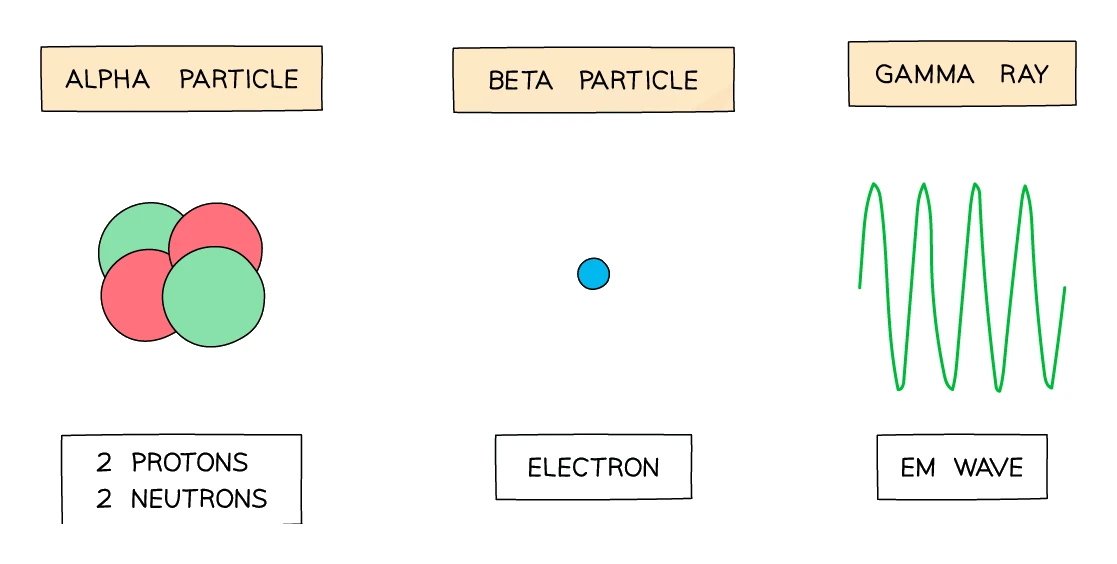
- Alpha (α) particles are emitted from very large unstable nuclei
- Beta (β⁻) particles are emitted when a neutron in the nucleus converts into a proton and an electron
- Gamma (γ) rays are emitted as a high-energy electromagnetic wave when a nucleus needs to shed surplus energy without changing its composition
- A fourth, less common process is neutron emission: a single neutron is ejected without any change in proton number
What each one is made of
| Radiation | Symbol | Nature | Charge | Relative mass |
|---|---|---|---|---|
| Alpha | α (⁴₂He) | Two protons + two neutrons (a helium nucleus) | +2 | 4 |
| Beta | β⁻ (⁰₋₁e) | A high-speed electron ejected from the nucleus | −1 | 1/2000 (negligible) |
| Gamma | γ | A high-energy electromagnetic wave (photon) | 0 | 0 |
Penetrating power
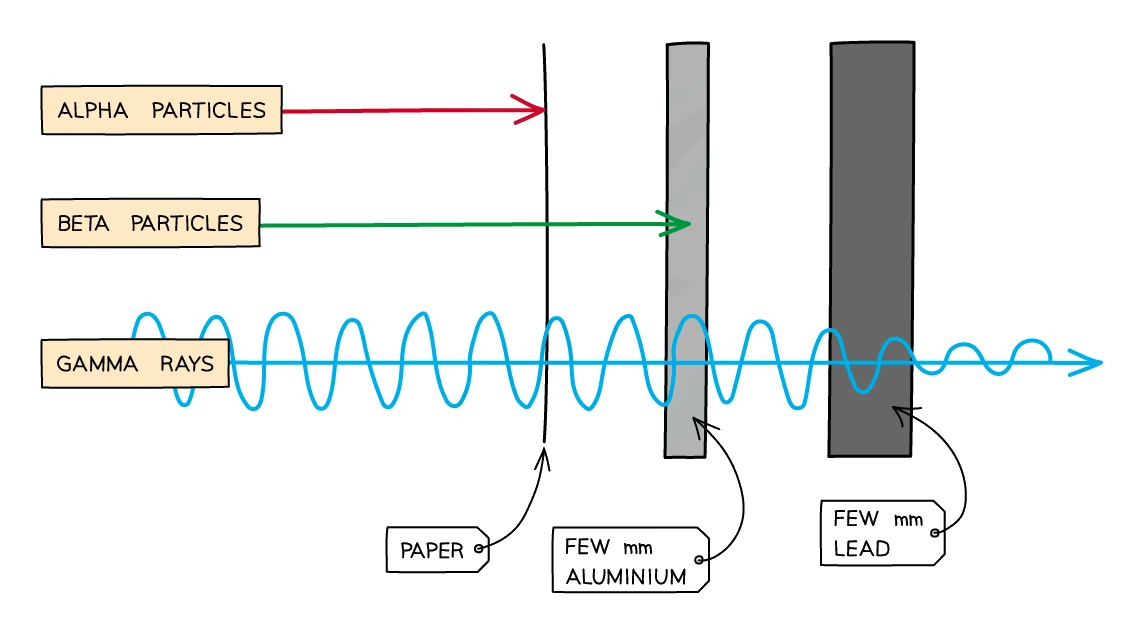
- Alpha is the most massive and most highly charged, so it interacts strongly with matter. It ionises everything it meets very effectively but is stopped after only a few centimetres of air or by a single sheet of paper
- Beta is light and singly charged. It penetrates several tens of centimetres of air and is stopped by a few millimetres of aluminium foil. Its ionising effect is moderate
- Gamma has no charge and no mass, just energy. It penetrates the furthest (effectively infinite range in air; only reduced, never fully blocked, by even a few centimetres of lead). Its ionising effect on a given molecule is the weakest of the three because it interacts least
Ionising power (the flip side)
- The same property that makes alpha stop quickly is what makes it ionise heavily: a charged particle that loses its energy in a short path knocks lots of electrons off molecules on its way
- A useful summary:
- alpha: short range, strongly ionising
- beta: medium range, moderately ionising
- gamma: very long range, weakly ionising
- Inside the body, the dangers run in the opposite order: alpha is most dangerous inside the body (because it ionises heavily over a short range and damages nearby cells) but harmless outside (the skin stops it). Gamma is most dangerous outside the body because it can reach internal organs
Exam tip
Properties of alpha, beta and gamma
Matching α/β/γ to their nature, charge and penetration comes up (table or MCQ), so you need to know: alpha = helium nucleus, charge +2, stopped by paper, most ionising; beta = electron, charge −1, stopped by a few mm of aluminium; gamma = EM wave, charge 0, reduced (never fully stopped) by thick lead/concrete, least ionising. Say helium nucleus (not atom), and gamma is reduced by lead, not "stopped".