Properties of Radiation
Radioactivity & Particles
Definition
- An isotope is a form of an element whose atoms have the same number of but a different number of
- Because the atomic number is unchanged, isotopes of an element are chemically identical. They sit in the same place on the periodic table and form the same compounds. The difference shows up in their mass and in their nuclear stability
- Most elements have several naturally occurring isotopes:
- Hydrogen has three: ¹₁H (protium, no neutrons), ²₁H (deuterium, 1 neutron) and ³₁H (tritium, 2 neutrons). Of these, only tritium is radioactive
- Carbon has three common isotopes: ¹²₆C, ¹³₆C, and the radioactive ¹⁴₆C used in radiocarbon dating
- Uranium has two common isotopes: ²³⁵₉₂U (used in nuclear fuel) and ²³⁸₉₂U (the more abundant one)
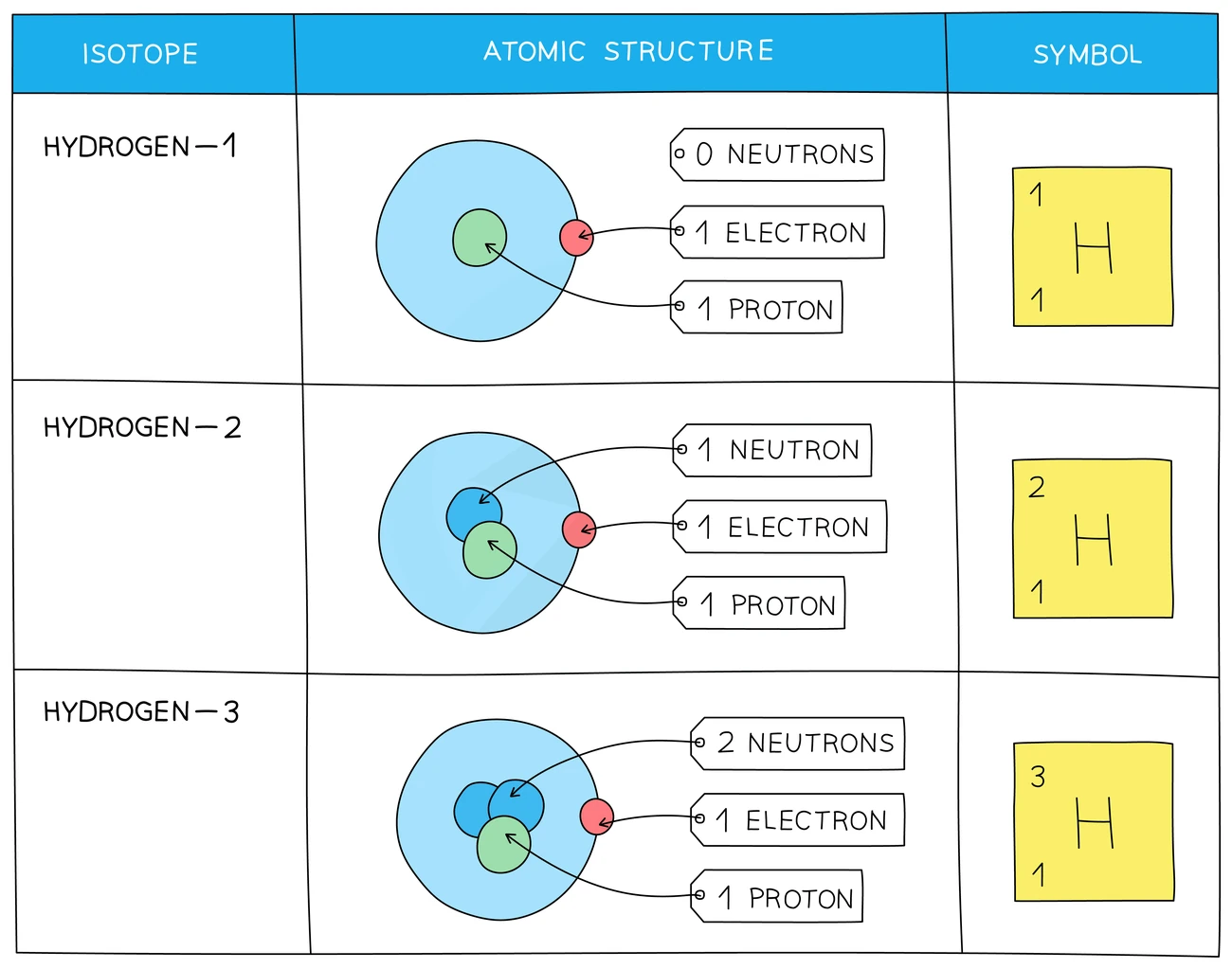
Common exam question
Defining or recognising an isotope
Question: Describe what is meant by the term isotope, or pick out the nucleus in a table that is a different isotope of a given element (1–2 marks).
Asked in 3 of the 24 papers. The written definition carries two separate marks: nuclei with the same number of protons (the same atomic number is accepted) and a different number of neutrons (a different mass number is accepted). Give both halves. In the table version, keep the proton number fixed and change only the neutron number: a row with a different number of protons is a different element, and a row identical to the given nucleus is the same isotope, not a different one. The multiple-choice definition reads the same way (equal proton numbers, unequal neutron numbers), and the options that swap in electrons or keep the neutron number fixed are wrong.
Why some isotopes are stable and others aren't
- The nucleus is held together by the strong nuclear force, which acts only over very short distances. Protons repel each other electrically, so a stable nucleus needs the right ratio of neutrons to protons to balance these effects
- Stable isotopes have a nucleon balance the nuclear forces can hold together indefinitely
- Unstable isotopes have too many neutrons (or in some cases, too few) and the nucleus will eventually emit a particle or a burst of energy to settle into a more stable arrangement. We call this
- A few examples:
- ¹²₆C is stable. ¹⁴₆C is unstable (it has two extra neutrons) and decays by beta emission
- Heavy nuclei like ²³⁸₉₂U are unstable simply because they are large. They shed mass and charge in a chain of alpha and beta decays until they reach lead