Magnetism & Electromagnetism
Magnetism & Electromagnetism · 1 question type
Magnetism
Poles and the law of magnetism
- Every magnet has two poles: a north pole and a south pole
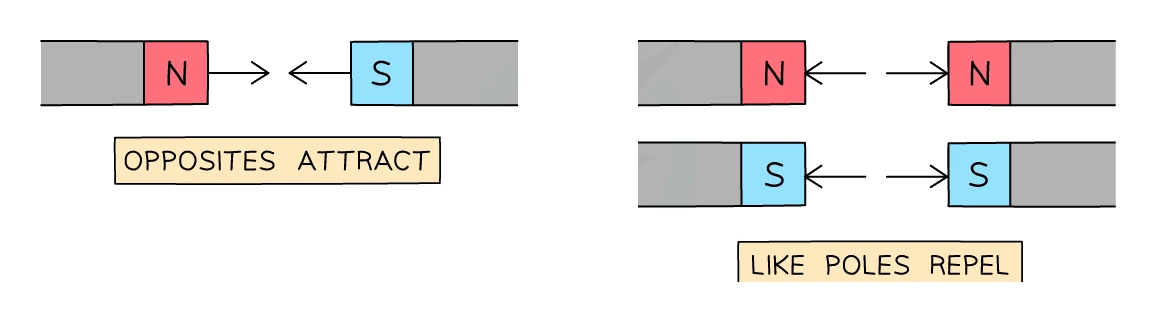
- Bringing two magnets close together produces a force between them. The direction of the force follows the law of magnetism:
- Like poles repel: N–N pushes apart; S–S pushes apart
- Opposite poles attract: N–S pulls together
- The force between two magnets is a non-contact force, so the magnets feel each other across an air gap without any physical link
Magnetic and non-magnetic materials
- A magnetic material is one that is attracted to a magnet (whether or not it is itself a magnet). The standard list is:
- iron
- cobalt
- nickel
- steel (an alloy of iron, so it counts)
- Almost every other metal is non-magnetic: copper, aluminium, gold, silver, lead, brass
- Non-metallic materials (plastic, wood, glass, rubber) are non-magnetic
- A magnetic material is attracted to either pole of a permanent magnet; only a magnet itself can be repelled by another magnet. So a quick test for whether an unknown bar of iron-coloured metal is a magnet or just a magnetic material: bring a known magnet near both ends in turn. If one end repels, you've found a magnet; if both ends only attract, it is a magnetic material
Hard and soft magnetic materials
- materials (e.g. steel) are difficult to magnetise, but once magnetised they hold their magnetism for a long time. They are used for
- materials (e.g. pure iron) are easy to magnetise, but lose their magnetism almost immediately when the magnetising field is removed. They are used for the cores of because you want the magnetism to switch off when the current does
Steel for permanent magnets, iron for electromagnets
What comes up: explain why steel (or a named hard material) is used for permanent magnets, or why iron (a soft material) is used for the core of an electromagnet.
Write (two marks): (1) Steel is a magnetically hard material, so once magnetised it retains its magnetism for a long time. (2) Iron is magnetically soft, so it loses its magnetism as soon as the magnetising field is removed — this means an iron-core electromagnet can be switched off.
Watch out: the mark scheme awards both marks for "steel is a hard magnetic material" paired with the idea that it stays magnetised for a long time. Saying only that steel is magnetic (without the permanence point) is not enough for full credit.