Magnetism & Electromagnetism
Magnetism & Electromagnetism
Permanent magnets
- A permanent magnet is made from a magnetically hard material (like steel or a special rare-earth alloy)
- It produces its own magnetic field and keeps doing so even when no other magnet is nearby
- A permanent magnet does not need a current to work
Induced magnets
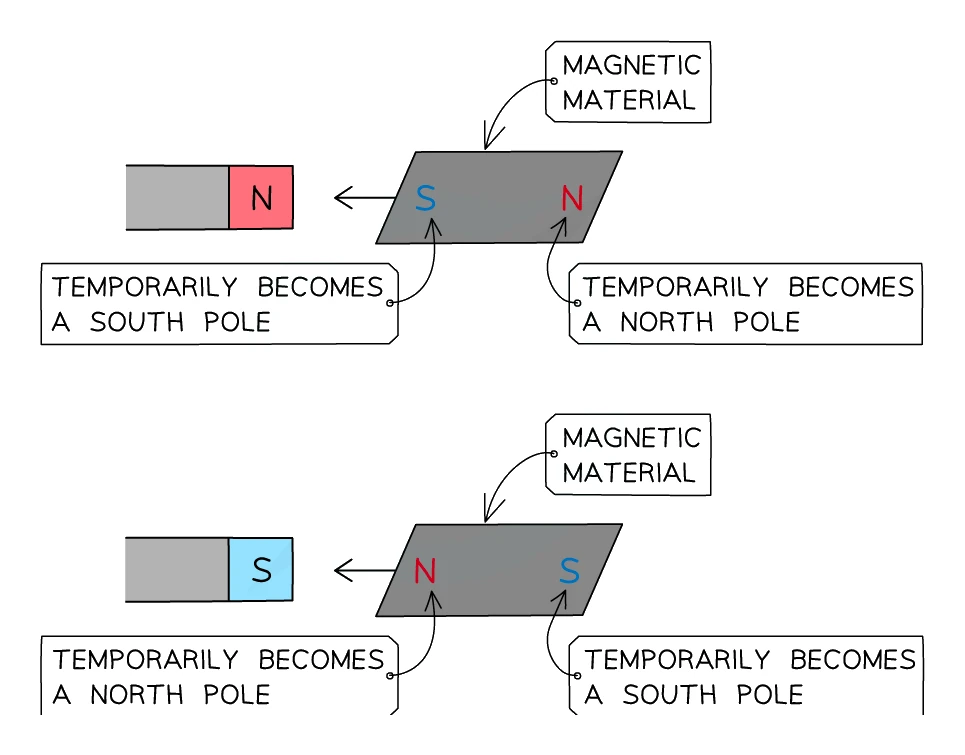
- An induced magnet is a piece of that has been temporarily turned into a magnet by sitting in another magnet's field
- The end of the induced magnet closest to the inducing magnet's pole takes the opposite sign (so the two are attracted)
- The induced magnetism is lost almost as soon as the original magnet is removed, so soft iron releases its magnetism within a fraction of a second
- Induced magnetism is why a paperclip will hang from a bar magnet, and a second paperclip can then hang from the first one, and so on, forming a short chain. Each clip is briefly magnetised by the one above it
Common exam question
Explaining why a piece of iron is pulled towards a magnet
Question: Explain why a piece of iron, or an iron ball, placed in a magnet's field experiences a force towards the magnet (2 marks).
Asked in 2 of the 24 papers. The idea both schemes credit is that the iron becomes magnetised while it sits in the field (one also gives a mark for calling iron a magnetic material), so it is an induced magnet with a pole opposite to the nearby pole on its near side: a north pole faces the magnet's south pole, and opposite poles attract. One scheme accepts the induced pole marked on the diagram, so label N and S on the iron. "The iron is attracted to the magnet" is a mark in one scheme only, and any mention of charge is ignored.
Quick check
4 short questions on this note. See what has stuck, and where to look if something hasn't.