4PH1
Magnetism & Electromagnetism
Magnetism & Electromagnetism · 1 question type
Around a straight wire
- A current flowing in a straight wire produces a in the space around the wire
- The field forms concentric circles around the wire, lying in planes perpendicular to the wire
- Key features:
- the field has no poles, because it is a circular field, not a dipole field
- the field is strongest close to the wire (lines packed densely) and weaker far away (lines spread out)
- increasing the current makes the field stronger; reducing it weakens it
- reversing the current direction reverses the direction of the field circles
The right-hand thumb rule
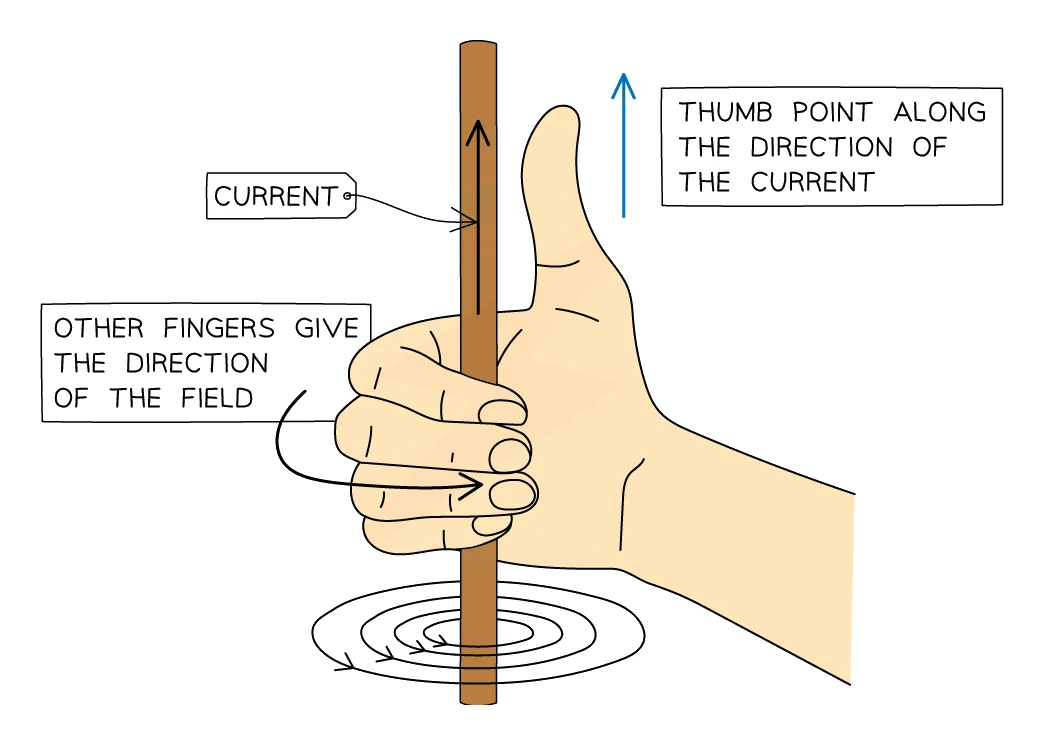
- The direction of the field around a current-carrying wire is given by the right-hand thumb rule:
- Make a thumbs-up gesture with your right hand
- Thumb points in the direction of the conventional current in the wire
- Curl of the fingers shows the direction of the circling round the wire
In a flat coil
- A single loop of wire concentrates the field through the centre of the loop. On one face of the loop the field comes out (north-like); on the other face it goes in (south-like)
In a solenoid
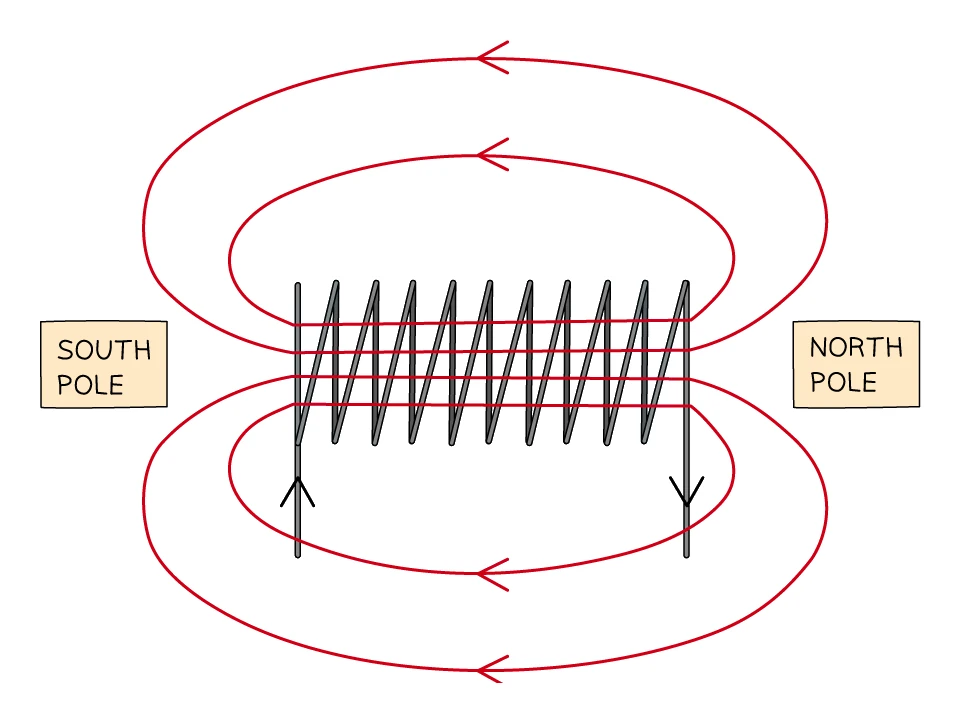
- A solenoid is a long coil with many turns of wire stacked along its length
- Inside the solenoid the individual loops' fields add up to give a strong, almost uniform field along the axis, just like the field inside a bar magnet
- Outside the solenoid, the field comes out of one end and curls round to re-enter the other end, exactly like the field around a bar magnet, with one end behaving as a north pole and the other as a south pole
- To work out which end is which, look at it end-on:
- if the current is travelling anticlockwise when you look at that end, that end is the north pole
- if the current is travelling clockwise when you look at that end, that end is the south pole
- Increasing any of the following makes the solenoid's field stronger:
- the current in the wire
- the number of turns per unit length of the coil
- placing a soft iron core inside the coil (the iron becomes an induced magnet and adds its own field on top)
Exam tip
Describing the construction of an electromagnet
What comes up: describe or draw the construction of a simple electromagnet, or state what features it must have.
Write (three marks): (1) A solenoid: a coil of wire with many turns. (2) A direct (d.c.) current flowing through the wire. (3) A soft iron core placed inside the coil.
Watch out: the mark scheme accepts "magnetically soft material" for the core but explicitly rejects "steel" — steel stays magnetised after the current is switched off, which defeats the purpose. Also reject: describing the core as a complete iron loop around the outside of the coil.