Electromagnetic Induction
Magnetism & Electromagnetism · 1 question type
Electromagnetic Induction
The generator effect
- Electromagnetic induction is the production of a voltage (and hence a current, if there is a complete circuit) in a conductor whenever the conductor experiences a changing magnetic field
- This is sometimes called the . It is the reverse of the motor effect:
- For the , a current must already be running in the conductor; the magnetic field then pushes the wire sideways
- For the generator effect, no current is needed to start with; the voltage appears spontaneously when the conductor cuts through magnetic field lines
Two ways to get a changing field
There are two equally good ways to set up the changing field that produces induction. The physics is the same in both:
- Move a conductor through a stationary magnetic field. A wire pushed between the poles of a magnet sweeps through the field lines and a voltage is induced along its length
- Move a magnet relative to a stationary conductor. A bar magnet pushed in and out of a coil of wire makes the magnetic field inside the coil change, inducing a voltage across the ends of the coil
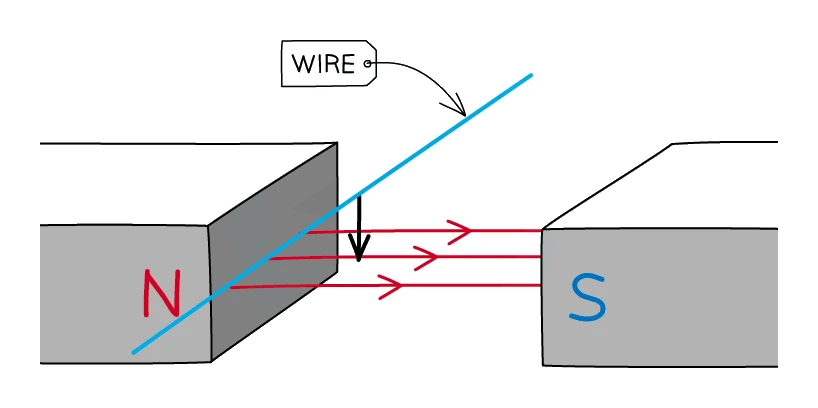
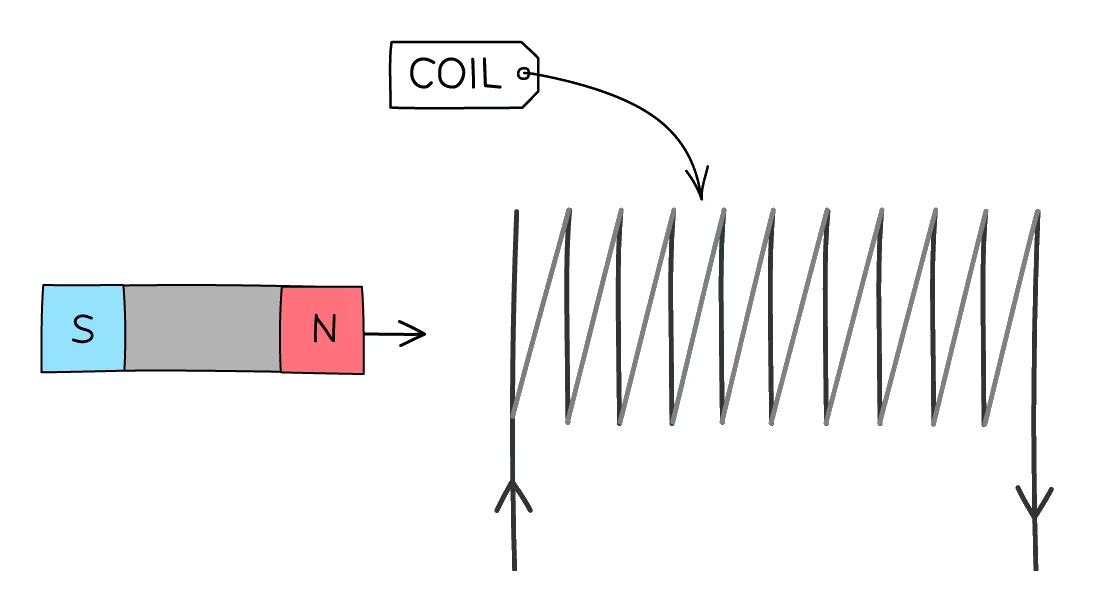
Factors that change the size of the induced p.d.
- The induced voltage gets bigger when:
- the speed of relative motion between magnet and coil is faster (faster sweep through the field lines means more field lines cut per second)
- the number of turns on the coil is larger (every turn picks up its own contribution; they add together)
- the strength of the magnet is greater (a stronger field means more field lines for the same volume, so more get cut per second)
- the cross-sectional area of the coil is larger (more wire is moving through the field)
Factors that change the direction of the induced p.d.
- The induced voltage reverses direction when:
- the direction of motion is reversed (pulling out instead of pushing in)
- the magnet is flipped (N pole leading instead of S)
- Both of these "flip" the way field lines are being cut, and so flip the polarity of the induced p.d. The size of the p.d. is not affected; only its sign
Exam-language reminders
- Use "add more turns to the coil", not "add more coils". A coil is the whole component, and the loops in it are turns
- Use "a stronger magnet", not "a bigger magnet". Magnet size and magnet strength are not the same thing
- Always say the conductor must cut magnetic field lines to induce a p.d. If the wire is moved parallel to the field, no lines are cut and no voltage is induced
Why a voltage is induced as a wire moves through a magnetic field
What comes up: a one-mark question asking you to give a reason why moving a wire between two magnets induces a voltage.
Write: the wire cuts (through) the magnetic field lines.
Watch out: saying the wire "interacts with" the field lines does not earn the mark. The credited idea is specifically that the wire cuts (or passes through) the field lines.
How to increase the size of an induced voltage
What comes up: a two-mark question asking you to state two changes that would increase the magnitude of the induced voltage.
Write (two marks): any two of: (1) move the wire faster (or move the magnet faster); (2) use a stronger magnet; (3) use more turns on the coil (wrap the wire into a coil).
Watch out: writing "use a bigger magnet" does not score the mark. The credited phrase is "stronger magnet". Similarly, "more coils" is not accepted — the correct term is more turns.