Electromagnetic Induction
Magnetism & Electromagnetism · 1 question type
The generator effect put to work
- A continuous voltage can be produced by rotating a coil of wire in a magnetic field: as the coil spins, the two long sides sweep through the field at every angle in turn, inducing a constantly changing voltage
- The same physics powers two related devices that differ only in how they connect the rotating coil to the external circuit:
- The (alternator) uses slip rings and produces an
- The (dynamo) uses a and produces a that pulses but never reverses
The a.c. generator (alternator)
- A rectangular wire loop is driven round and round inside a uniform magnetic field by some external mechanical input (a steam turbine, a wind turbine, or the pedals of a bicycle dynamo)
- The two ends of the coil are connected to two separate slip rings, which are full circular metal bands attached to the coil's shaft, one at each end. The rings stay in continuous contact with two carbon brushes that feed the induced current out to the external circuit
- Because the slip rings are full rings (no breaks), the same end of the coil is always connected to the same terminal of the external circuit. Whichever way the current is going inside the coil is mirrored straight out to the load
- As the coil spins:
- When the coil's flat face is parallel to the field, the long sides are slicing through the field as fast as possible, so induced p.d. is at its maximum
- A quarter turn later, the coil is perpendicular to the field and the long sides momentarily move parallel to the field. No lines are being cut, so induced p.d. is zero
- Another quarter turn flips the direction of the cutting motion, so induced p.d. is at its maximum but now in the opposite polarity
- The cycle repeats every full revolution, giving a sinusoidal alternating voltage
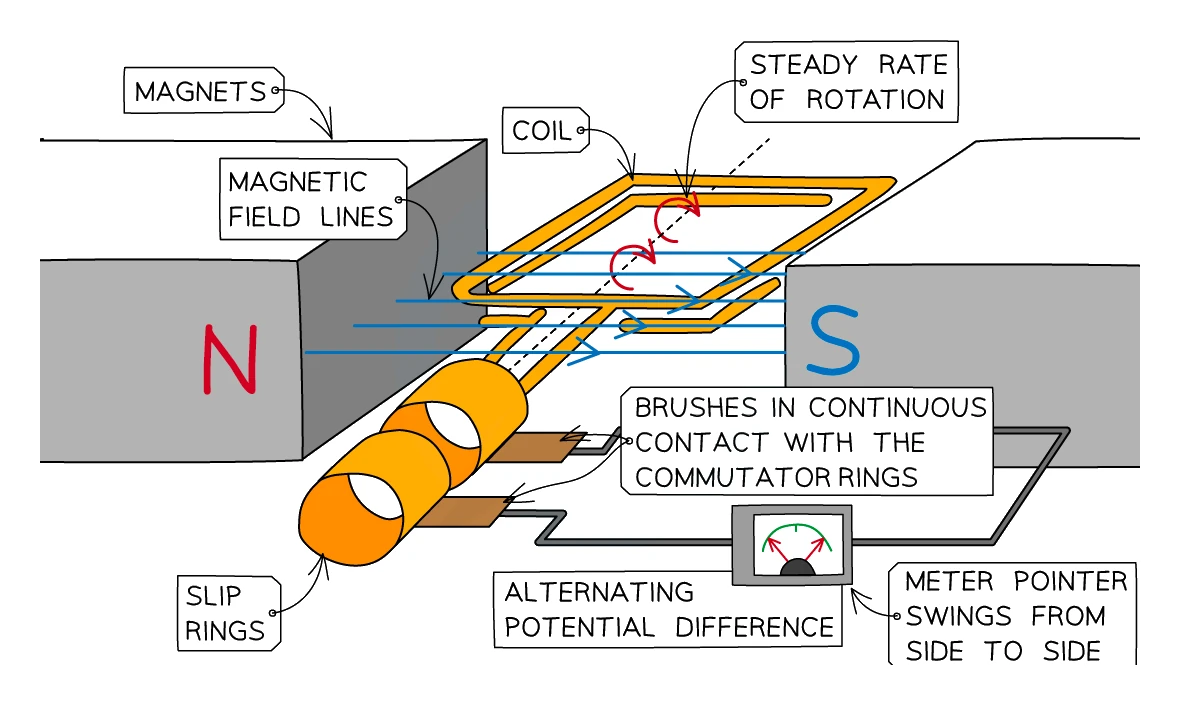
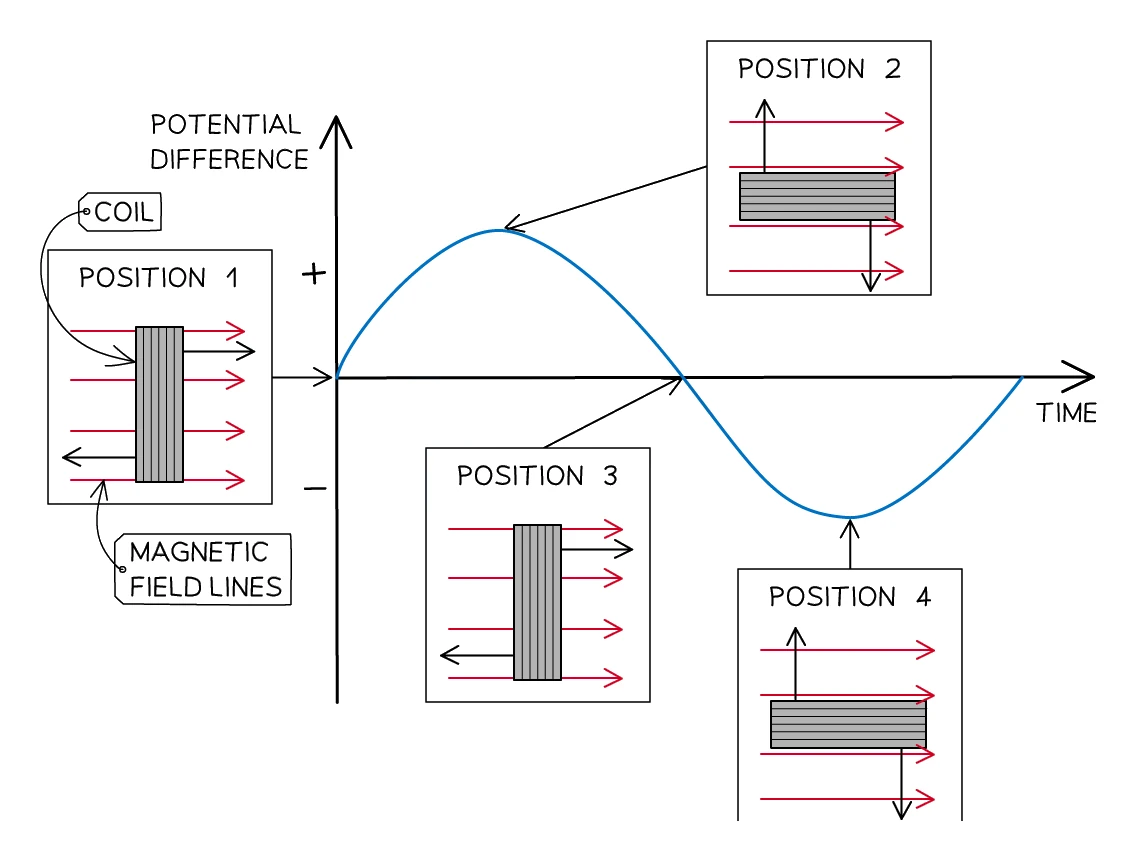
The d.c. generator (dynamo)
- The mechanical layout is identical to the alternator's, but the slip rings are replaced by a split-ring commutator, which is a single ring of metal cut into two semicircular halves, each connected to one end of the coil and pressed against a fixed brush
- Every half turn of the coil, the two halves of the split ring swap which brush they touch. This swap happens at exactly the moment the induced p.d. is reversing inside the coil, so the polarity reaching the external circuit stays the same instead of flipping
- The result on the external circuit is a pulsing direct current: the voltage rises from zero to a peak and falls back to zero, then rises to a peak in the same direction again, then back to zero, and so on. The output is always positive (or always negative), never alternating
- A bicycle dynamo is the everyday example; older cars used dynamos for the same reason, before switching to alternators
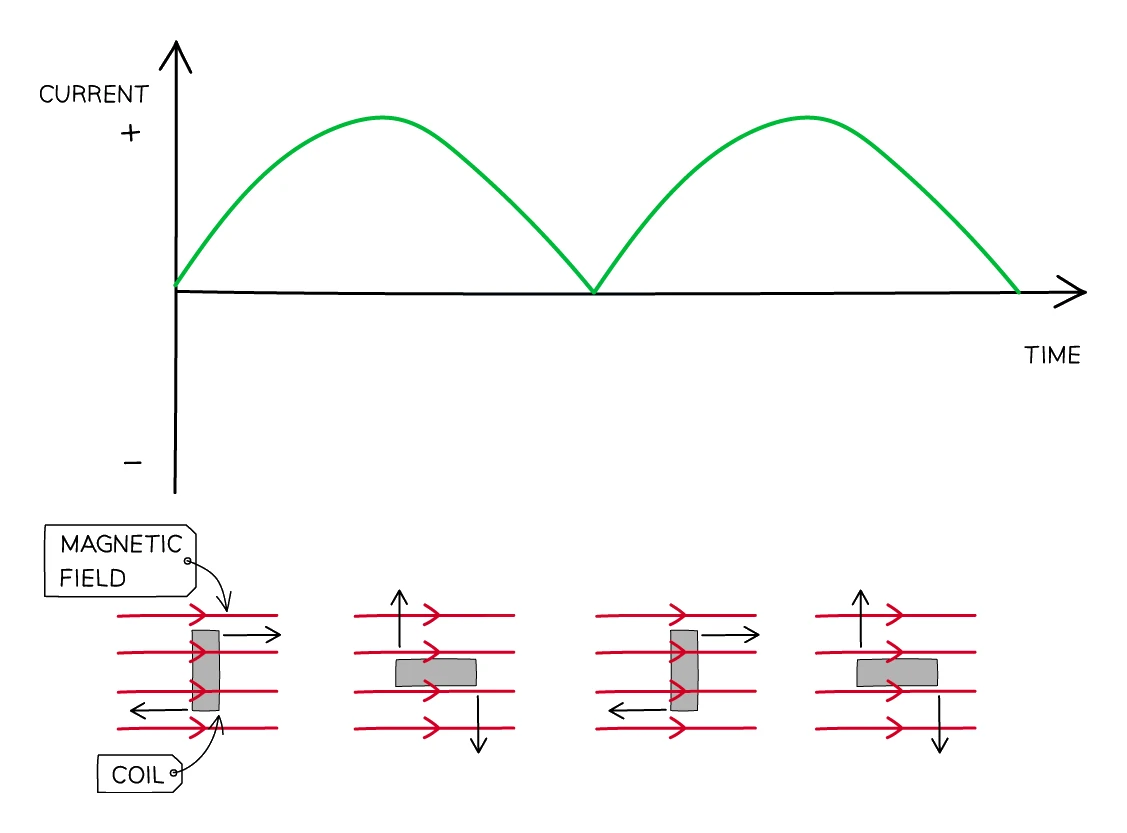
Explain how a generator produces a current
What comes up: a two- or three-mark question asking you to explain how rotating a coil in a magnetic field produces a current.
Write (three marks): (1) the coil rotates through the magnetic field; (2) the coil cuts the magnetic field lines (so the coil experiences a changing magnetic field); (3) a voltage is induced, which drives a current around the circuit.
Watch out: the mark scheme credits "voltage is induced" rather than "current is induced" for the induction step. State the voltage first, then note that current flows because there is a complete circuit. Also note: "cutting" field lines is the credited phrasing — "magnetic fields interact" is not accepted.