Electromagnetic Induction
Magnetism & Electromagnetism · 1 question type
What a transformer does
- A transformer is a device that takes an alternating voltage in and produces a different alternating voltage out, all on the same frequency
- A transformer only works with . A direct current produces a steady magnetic field that doesn't change, so no voltage is induced in the secondary
Structure
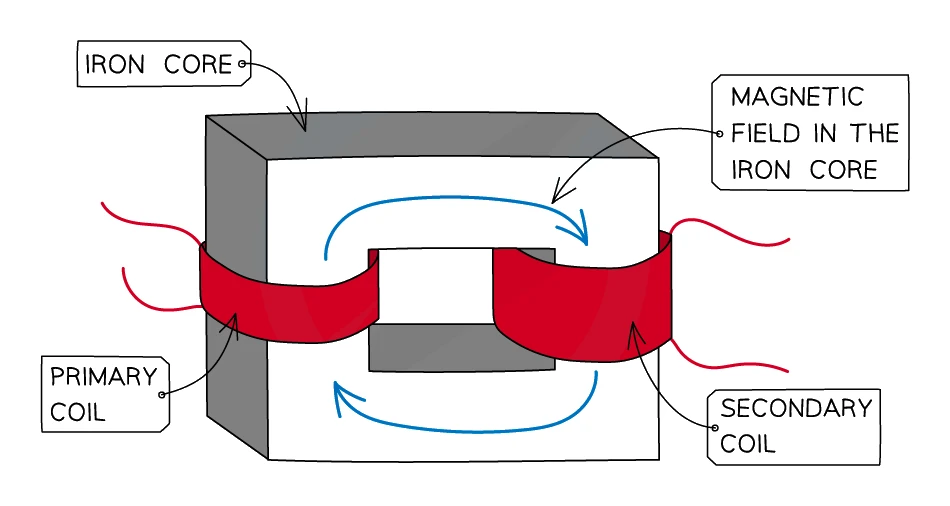
A basic transformer has three parts:
- A primary coil of insulated wire wound around one limb of a soft iron core. The input alternating current goes through this coil
- A secondary coil of insulated wire wound around a different limb of the same iron core. The output is taken from this coil
- A laminated soft-iron core that links the two coils magnetically without letting them touch electrically. Soft iron is used because it magnetises and demagnetises quickly, faithfully tracking the rapidly changing magnetic field
How it works, step by step
- An alternating current in the primary coil sets up a continuously changing magnetic field around the primary
- The iron core channels this changing magnetic field round to the secondary coil, because soft iron concentrates the field very efficiently
- The secondary coil now sits in a continuously changing magnetic field, so a voltage is induced in it by electromagnetic induction
- The induced voltage in the secondary is alternating at the same frequency as the primary current; only the size of the voltage is different
- If the secondary is connected to a complete circuit, an alternating current flows through the load
Step-up and step-down
- A step-up raises the voltage. It has more turns on the secondary than on the primary (Ns > Np)
- A step-down transformer lowers the voltage. It has fewer turns on the secondary than on the primary (Ns < Np)
- The current behaves in the opposite way: a step-up transformer reduces the current; a step-down transformer increases it. This is required by conservation of energy (see the power equation in section 4)
Why a transformer does not work with direct current
What comes up: a three-mark question presenting a scenario where d.c. is supplied to the primary coil instead of a.c., then asking why no voltage is produced in the secondary.
Write (three marks): (1) a constant (direct) current produces a constant (steady) magnetic field in the core; (2) electromagnetic induction requires a changing magnetic field; (3) so no voltage is induced in the secondary coil.
Watch out: do not just write "transformers need a.c." — that restates the question and earns nothing. You must explain the mechanism: it is the constant field (not the type of current itself) that is the problem. The mark scheme explicitly ignores references to a.c. and instead requires the reasoning about why a constant field cannot induce a voltage.
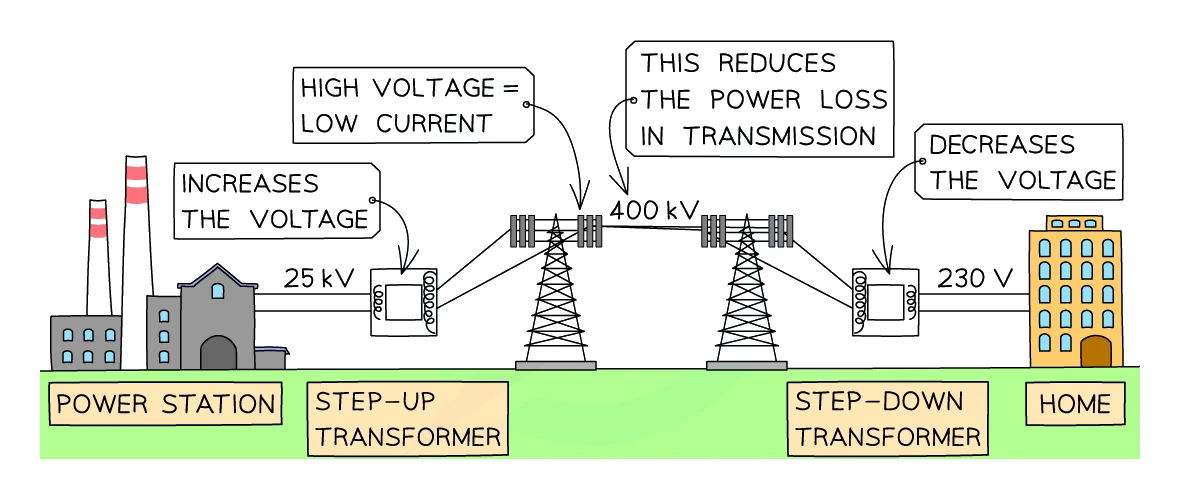
Transformers and the National Grid
- The UK National Grid uses transformers to move electricity efficiently from distant power stations to homes:
- At the power station, a step-up transformer raises the voltage to 400 kV for long-distance transmission
- Pylons carry this high-voltage, low-current electricity across the country
- Local substations use step-down transformers to drop the voltage back to 230 V before the supply enters homes and businesses
- Why bother stepping up at all? Energy loss in the transmission cables comes from the heating effect of the current (I²R loss). Sending the same total power at a higher voltage means a lower current, and the heating loss falls dramatically. A cable carrying 1 GW at 400 kV runs at 2500 A; the same 1 GW at 25 kV would need 40 000 A and the cable would melt
- Additional bonus: lower currents mean thinner, cheaper cables can carry the load