4PH1
Magnetism & Electromagnetism
Magnetism & Electromagnetism · 1 question type
The force on a free charge
- The motor effect doesn't need a wire, because it works on any moving charged particle in a magnetic field. The wire is just a convenient way to keep many charged particles moving in a line
- A single moving charge in a magnetic field feels a force at right angles to both its direction of motion and the field
- The direction of the force is given by Fleming's left-hand rule, with the following adjustment for an electron (or any negative charge):
- conventional current flows in the opposite direction to electron motion
- so to find the force on an electron, point the second finger opposite to the electron's motion (i.e. in the conventional-current direction)
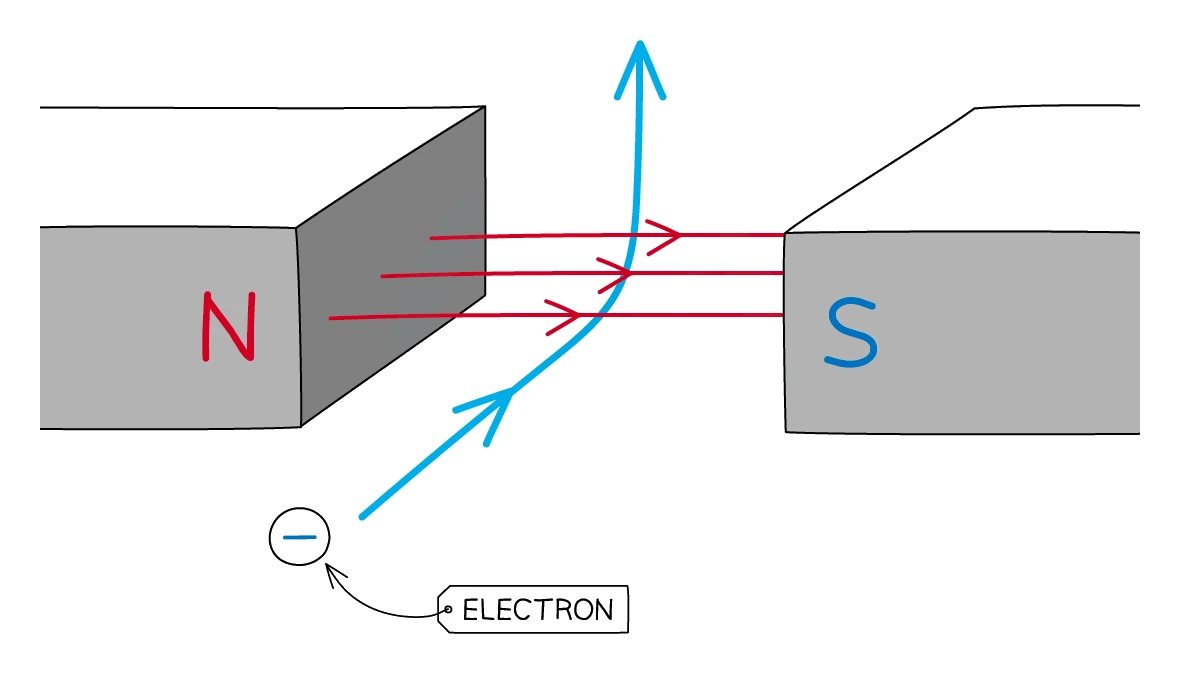
- The size of the force depends on the speed of the charge, the strength of the field, the size of the charge, and the angle between the velocity and the field:
- maximum force when the charge moves perpendicular to the field
- zero force when the charge moves parallel to the field
- intermediate angles give a force somewhere between
Curving paths in a magnetic field
- Because the force is always at right angles to the velocity, a charge moving perpendicular to a uniform magnetic field travels in a circle. The field changes the direction of motion but never its speed (the force does no work, since it is always at 90° to the displacement)
- This is the basis of the electron-beam deflection in old cathode-ray tube televisions, and of particle accelerators (cyclotrons, synchrotrons) where charged particles are steered around a circular path by powerful magnets
- Earth's magnetic field deflects high-speed cosmic-ray particles in much the same way, which is part of why life on the surface is shielded from much of the radiation arriving from space