Magnetism & Electromagnetism
Magnetism & Electromagnetism
What a magnetic field is
- A magnetic field is the region around a magnet in which a force would act on another magnet, or on a piece of magnetic material placed within it
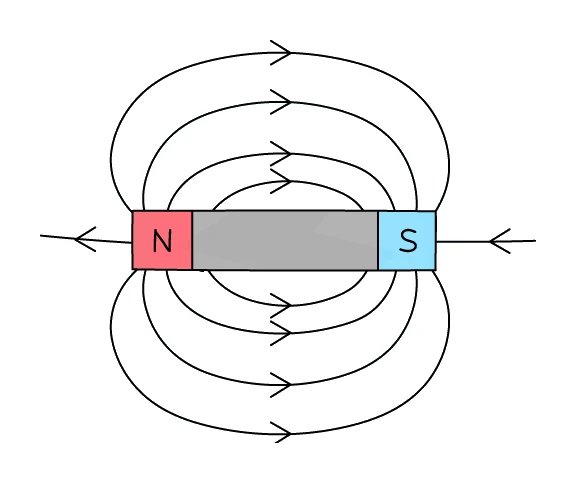
- Magnetic fields are visualised using magnetic field lines:
- The direction of the field at any point is the direction the north pole of a small test compass would point if placed at that point
- The strength of the field is shown by the spacing of the lines: close together where the field is strong, far apart where it is weak
- Two important drawing rules:
- Field lines always run from N to S outside the magnet (and from S to N inside it, completing a closed loop)
- Field lines never cross or touch each other; they only meet at the poles themselves
The field around a bar magnet
- The field is strongest at the poles, so the lines are packed close together there and spread out further from the magnet
- The pattern is symmetric: lines bow outward from the N pole, curve round, and re-enter the S pole
Common exam question
Drawing the field lines around a bar magnet
Question: Draw the magnetic field lines around a bar magnet to show the shape and direction of the field, add arrowheads to given lines, or circle the mistakes in a drawn pattern (1–3 marks).
Asked in 5 of the 24 papers. A three-mark drawing earns: lines that run from one pole round to the other (a small gap at the magnet is allowed), at least two complete loops that never touch or cross (one scheme asks for four lines, with at least one above and one below the magnet), and arrowheads pointing from N to S. One arrow per line is enough for the direction mark, but a single arrow pointing the wrong way negates it, so check every arrowhead. Lines drawn inside the magnet are ignored rather than penalised.
Asked how the lines show the field weakening with distance, answer with spacing: the lines get further apart, and wider spacing means a weaker field.
Uniform fields
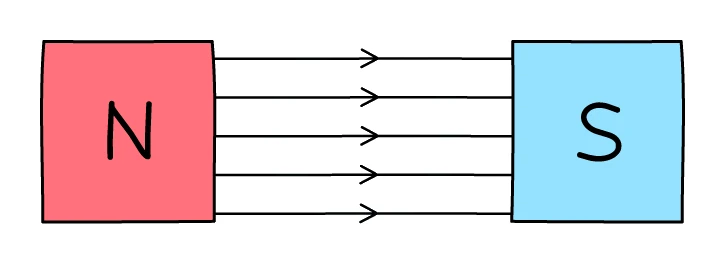
- A uniform magnetic field has the same strength and the same direction at every point. On a diagram it is drawn as a set of equally spaced parallel field lines
- A uniform field can be made by placing two flat magnets with opposite poles facing each other, separated by a few centimetres. Between the poles, the field looks uniform to a good approximation; outside that gap it is curved like a normal two-magnet field
Common exam question
Drawing or describing a uniform magnetic field
Question: Draw the uniform field between two facing poles, explain how a diagram shows that a field is uniform, or describe how to arrange two magnets to produce one (1–3 marks).
Asked in 5 of the 24 papers. The drawing earns its marks for straight, parallel, equally spaced lines running across the gap, plus arrows from N to S (one arrow is enough, but contradictory arrows lose that mark). Explaining why a field is uniform wants two of the same three words: the lines are straight, parallel and evenly spaced. If a pole is unlabelled, label it first: a uniform field only forms between opposite poles facing each other.
To describe the arrangement, give both halves: two magnets with opposite poles facing, and the poles brought close together. A labelled diagram can earn either mark.