Magnetism & Electromagnetism
Magnetism & Electromagnetism · 1 question type
The motor effect
- A current-carrying wire placed in a experiences a force
- This is the motor effect: the field of the magnets and the field around the current-carrying wire interact, and the resulting force pushes the wire sideways out of the field
- Three requirements for there to be a force:
- there must be a current flowing in the wire
- the wire must be in a magnetic field
- the wire must lie at an angle to the field. The force is largest when the wire is at 90° to the field, and zero when the wire is parallel to the field
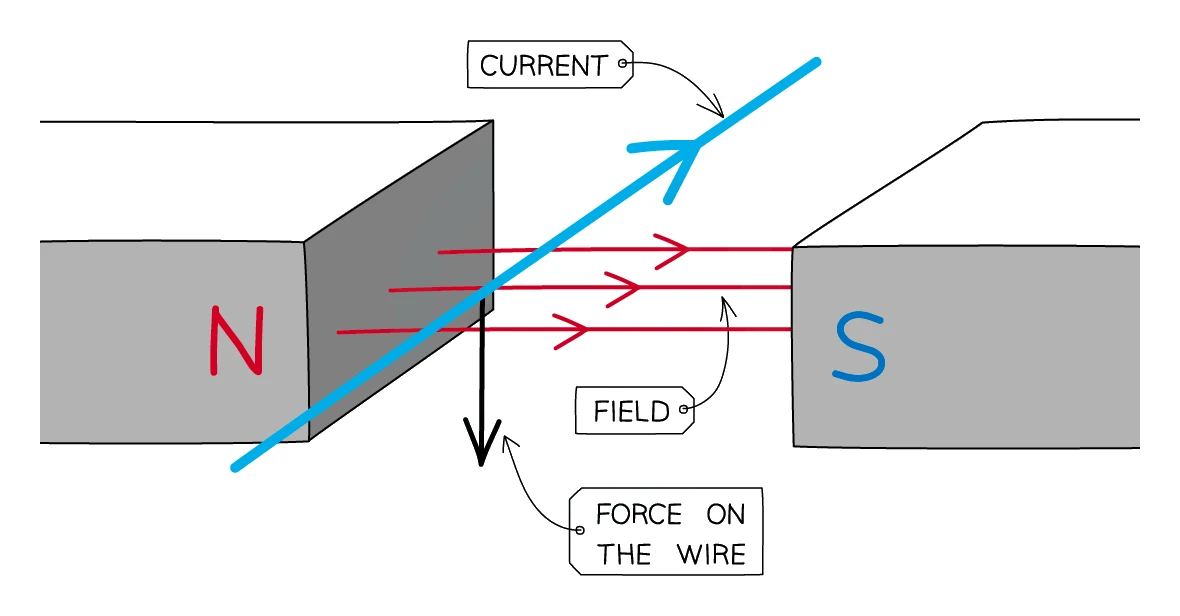
Fleming's left-hand rule
- The directions of the three quantities (current, field and force) are mutually perpendicular. To work out which way the force pushes the wire, use Fleming's left-hand rule:
- First finger → direction of the magnetic Field (N to S)
- seCond finger → direction of the conventional Current (+ to −)
- THumb → direction of the THrust (the force on the wire)
- Hold your left hand with the three digits all at right angles to one another like the corner of a box. Rotate your hand until the first finger lines up with the field and the second finger lines up with the current, and the thumb then automatically points along the force
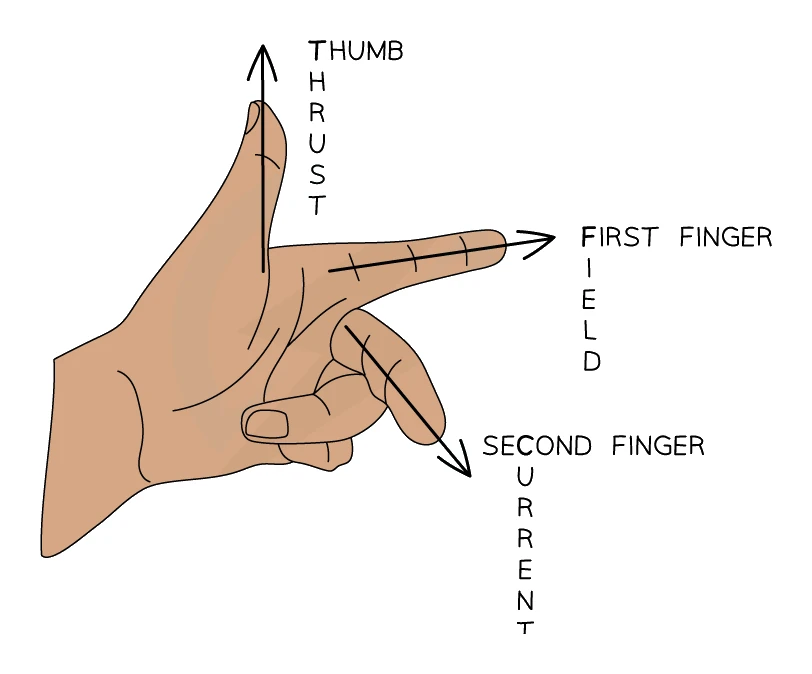
Finding the direction of the force on a wire
Question: Draw an arrow for the direction of the force on a current-carrying wire between two poles, or pick which side of a coil moves upwards (1–2 marks).
Asked in 4 of the 24 papers. Use your left hand: first finger along the field from N to S, second along the conventional current, thumb along the force. The two marks are split: one for an arrow along the correct line (at right angles to both field and current) and one for the correct sense along it, so the right line alone still earns the first. Where the arrow starts is ignored, as are any field lines you add.
In a cross-section the current is a dot (out of the page) or a cross (into it): point your second finger out of or into the paper first. A follow-up may ask for changes that reduce the force: a weaker field (weaker magnets, or magnets further apart) or a smaller current.
Factors that change the size of the force
- The force on a current-carrying wire in a magnetic field is larger when:
- the current is bigger (more charge per second crossing the field)
- the magnetic field is stronger (use a stronger magnet)
- the angle between the wire and the field is closer to 90° (90° gives maximum; parallel gives zero)
- in extended geometry, the length of wire inside the field is longer
The d.c. motor (a practical application)
- A simple d.c. motor uses the motor effect to spin a coil of wire continuously between the poles of two magnets:
- The coil is wired into a circuit through a split-ring commutator at one end. The two halves of the split ring are pressed against two carbon brushes that feed current in
- With the coil horizontal, current flows one way along the front side of the coil and the opposite way along the back side. Each side sits in the same magnetic field, but their currents are opposite, so Fleming's left-hand rule predicts opposite forces: one side is pushed up, the other pushed down. The coil starts to rotate
- When the coil has rotated a quarter turn (vertical), the two halves of the split ring lose contact with the brushes, no current flows, and no force acts; the coil's own momentum carries it past the vertical
- As the coil continues past the vertical, the split-ring swap means that the side now on the right is connected to the same brush as the side that was previously on the right, so the current in each side of the coil reverses relative to the magnets. The forces remain pushing each side the same way they were before, and the coil keeps rotating in the same sense
- The motor's speed can be increased by increasing the current, or by using a stronger magnet, or by adding more turns to the coil
- The direction of rotation can be reversed by reversing the current or by swapping the magnets round
- A loudspeaker runs on the same physics in miniature: an alternating current flows through a small coil sitting in a permanent magnet's field. The coil oscillates back and forth in step with the current, pushing a paper cone that vibrates the air and produces a sound wave
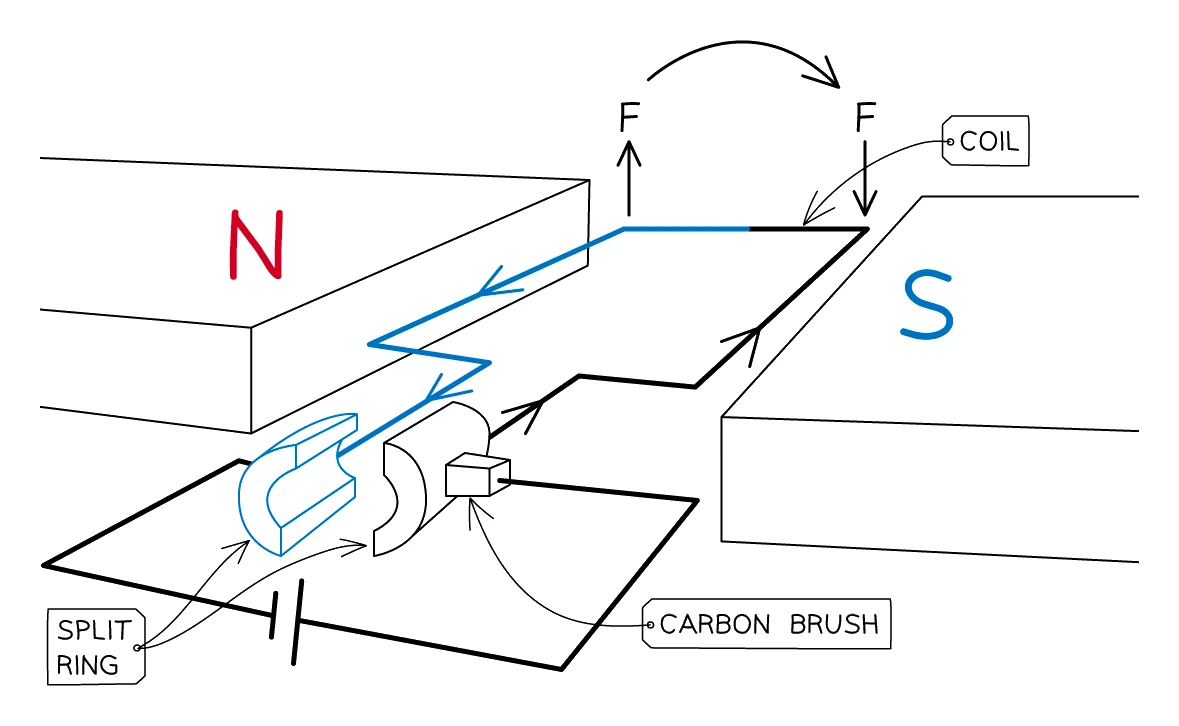
Explaining why a motor coil starts to turn
Question: Explain why a motor coil starts to rotate when a current flows, and sometimes why a loop with no commutator stops once it is vertical (4 marks).
Asked in 2 of the 24 papers. Give a chain of four points: the current in the coil produces a magnetic field; this field interacts with the magnet's field; so there is a force on each side of the coil; and the forces on the two sides are in opposite directions, because the currents in them flow opposite ways. "Attraction and repulsion" and "cutting field lines" are ignored, so write about interacting fields and forces. An upward force on one side and a downward force on the other earns the opposite-forces point.
For the loop that stops when vertical, any three of those plus one more earn the marks: the forces do not change direction (no turning effect when vertical) because the current cannot swap direction without a split-ring commutator.
Describing how a loudspeaker produces sound
Question: Describe or explain how an alternating current in the coil of a loudspeaker produces a sound (4 marks).
Asked in 2 of the 24 papers. Each scheme awards any four links from its own list, and between them they credit this chain: there is an alternating current in the coil; the current gives the coil a magnetic field; this field interacts with the permanent magnet's field; so there is a force on the coil and the cone attached to it; because the current alternates, the force keeps changing direction; so the cone vibrates, making the air vibrate and sending out a longitudinal wave. Only four links are on both lists (the fields interacting, the force, the force changing direction and the cone vibrating), so never leave one of those out. "Fields cutting" and any reference to induction earn nothing: this is the motor effect, not a generator.