Ideal Gases
Solids, Liquids & Gases
Statement
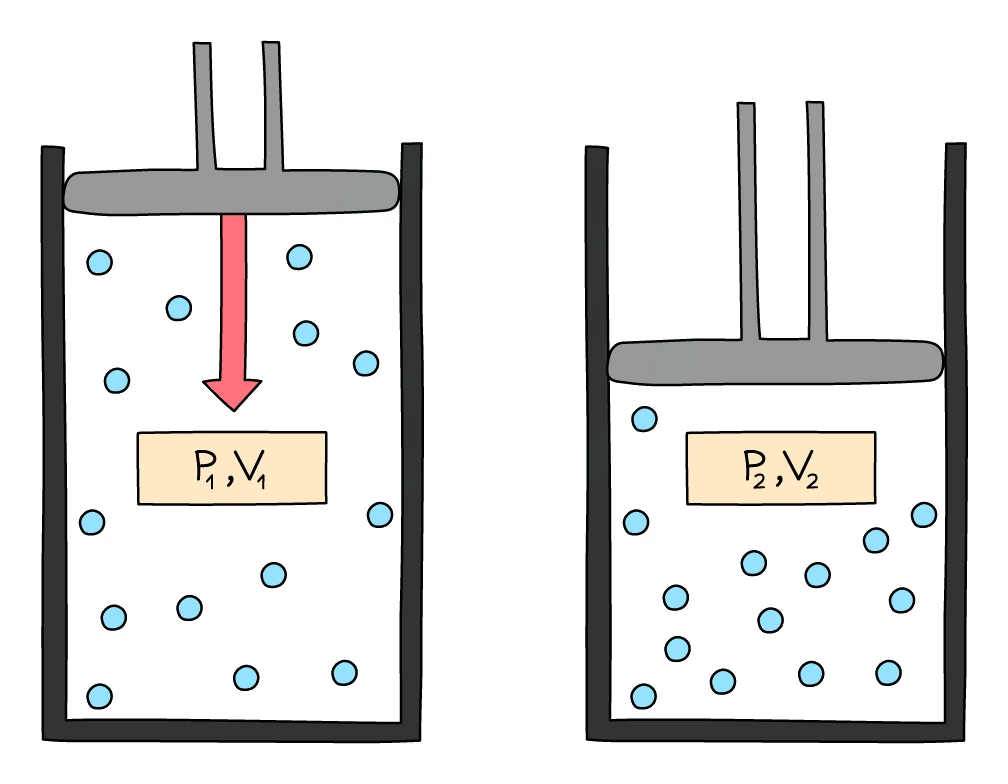
- At constant and for a fixed amount of an ideal gas:
P × V = constant
- Equivalently, between two states:
p₁ × V₁ = p₂ × V₂
- where:
- p₁, p₂ = pressures in Pa
- V₁, V₂ = volumes in m³ (or any consistent unit, as long as both match)
- p and V are inversely proportional: doubling the pressure halves the volume; halving the pressure doubles the volume
Common exam question
Calculating a volume or pressure at constant temperature
Question: Calculate the new volume, or the new pressure, of a fixed mass of gas when it is compressed or allowed to expand at constant temperature (2–4 marks).
Set in 5 of the 24 papers. Substitute into p₁V₁ = p₂V₂, rearrange and evaluate, one mark each (the substitution and rearrangement can come in either order, and two versions merge them into one mark). Any consistent units work, so leave cm³ as cm³, but keep the powers of ten straight: a power-of-ten slip costs a mark. Extra marks are added for the setting: expressing the answer in standard form when asked, or first working out the new volume from the container's dimensions. For a bubble or balloon under water, p is the total pressure, atmospheric plus the water's; a wrong pressure carried from an earlier part still earns the method marks.
A one-mark follow-up may ask for the assumption made: the temperature, or the mass (amount) of gas, stays constant.
Why it works microscopically
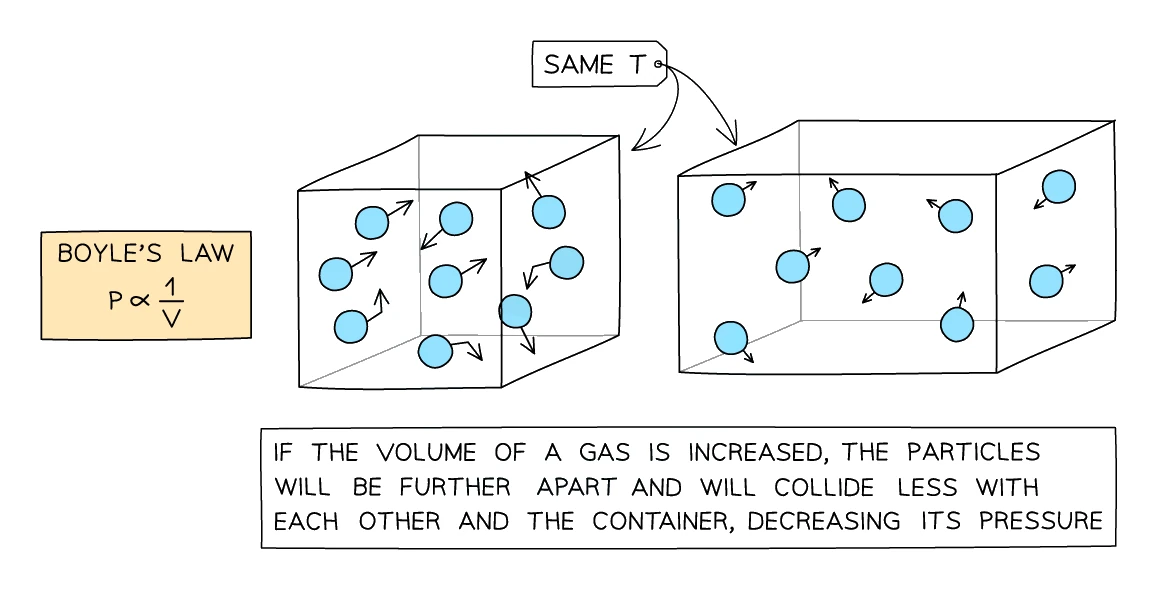
- At constant temperature the molecules have the same average kinetic energy, so each individual collision with the wall carries the same average force
- Shrink the container to half its volume and the molecules have to travel only half as far between wall collisions
- They therefore hit each wall twice as often per second, and the pressure doubles
- The same number of molecules, moving at the same average speed, in half the space, gives twice the pressure
Checking the answer makes sense
- A useful sanity check after any gas-law calculation:
- if the volume has shrunk (compression), expect the new pressure to be larger than the original
- if the gas has been heated at fixed volume, the new pressure should be larger than before
- if you get the opposite trend, you've probably substituted the temperatures the wrong way round, or forgotten to convert °C to K
Worked example
Boyle's law calculation
A gas is compressed from a volume of 0.60 m³ at a pressure of 100 kPa to a new volume of 0.40 m³. The temperature does not change. Calculate the new pressure.
Solution:
- Identify the known values: p₁ = 100 kPa, V₁ = 0.60 m³, V₂ = 0.40 m³
- Substitute into p₁V₁ = p₂V₂: 100 × 0.60 = p₂ × 0.40
- Rearrange: p₂ = (100 × 0.60) / 0.40
- p₂ = 150 kPa
- Sanity check: the volume shrank, so the pressure should be larger, and 150 kPa > 100 kPa. ✓