4PH1
Ideal Gases
Solids, Liquids & Gases · 1 question type
Statement
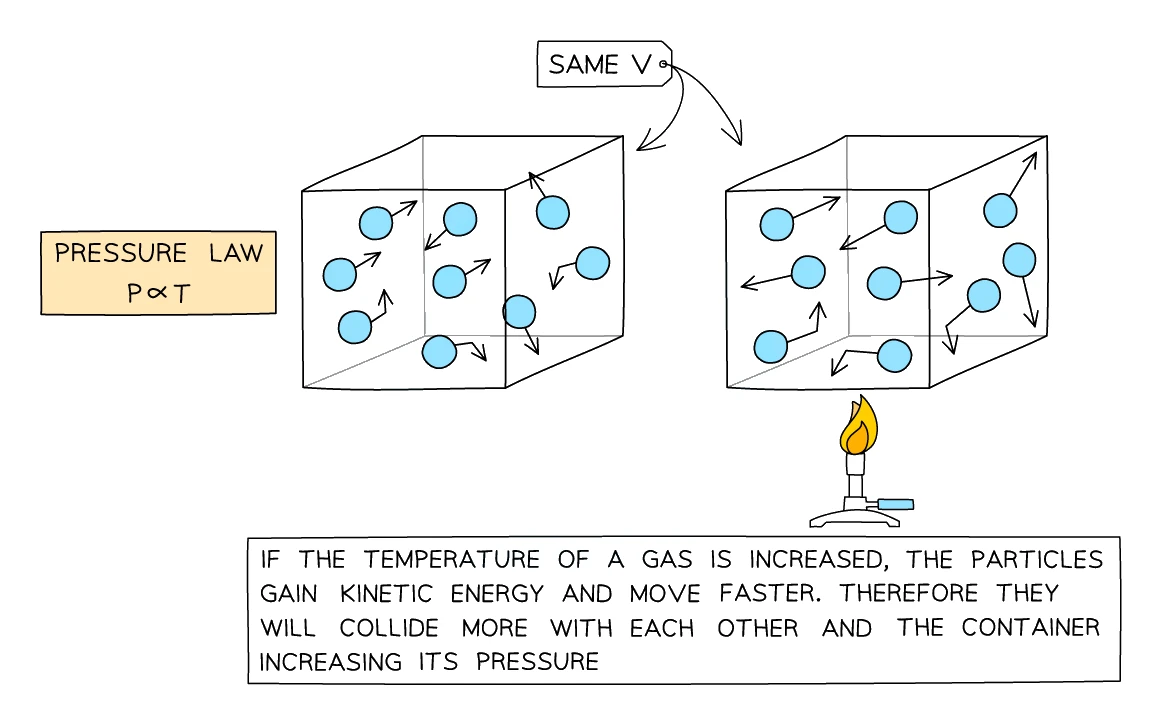
- At constant volume and for a fixed amount of an ideal gas:
P ∝ T (in kelvin)
- Equivalently, if subscript 1 marks the initial state and subscript 2 marks a later state:
p₁ / T₁ = p₂ / T₂
- where:
- p₁, p₂ = pressures in Pa (any consistent unit, as long as both are the same)
- T₁, T₂ = absolute temperatures in kelvin (always, never °C)
Using the equation
- Convert any Celsius readings to kelvin first by adding 273. Forgetting to do this is one of the most common exam mistakes
- Rearranging for p₂: p₂ = p₁ × (T₂ / T₁)
- Rearranging for T₂: T₂ = T₁ × (p₂ / p₁)
Worked example
Pressure law calculation
A gas in a sealed container has a pressure of 80 kPa at a temperature of 27 °C. The container is heated until the temperature reaches 127 °C. Calculate the new pressure. (Volume stays constant.)
Solution:
- Convert both temperatures to kelvin: T₁ = 27 + 273 = 300 K, T₂ = 127 + 273 = 400 K
- Substitute into p₁/T₁ = p₂/T₂: 80/300 = p₂/400
- Rearrange: p₂ = 80 × 400/300
- p₂ = 107 kPa (to 3 s.f.)