4PH1
Ideal Gases
Solids, Liquids & Gases · 1 question type
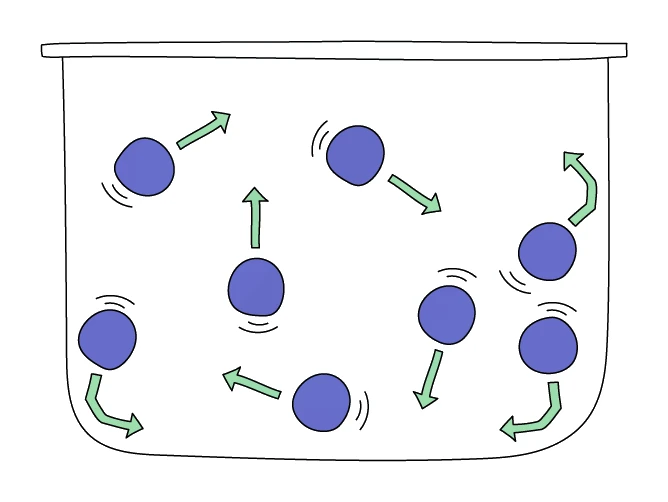
Random motion of gas molecules
- Gas molecules never sit still; they fly about ceaselessly in random directions at high speed
- "Random" means no preferred direction: every molecule is constantly changing direction as it bounces off other molecules and off the walls of the container
- A typical air molecule at room temperature moves at hundreds of metres per second between collisions
How collisions produce pressure
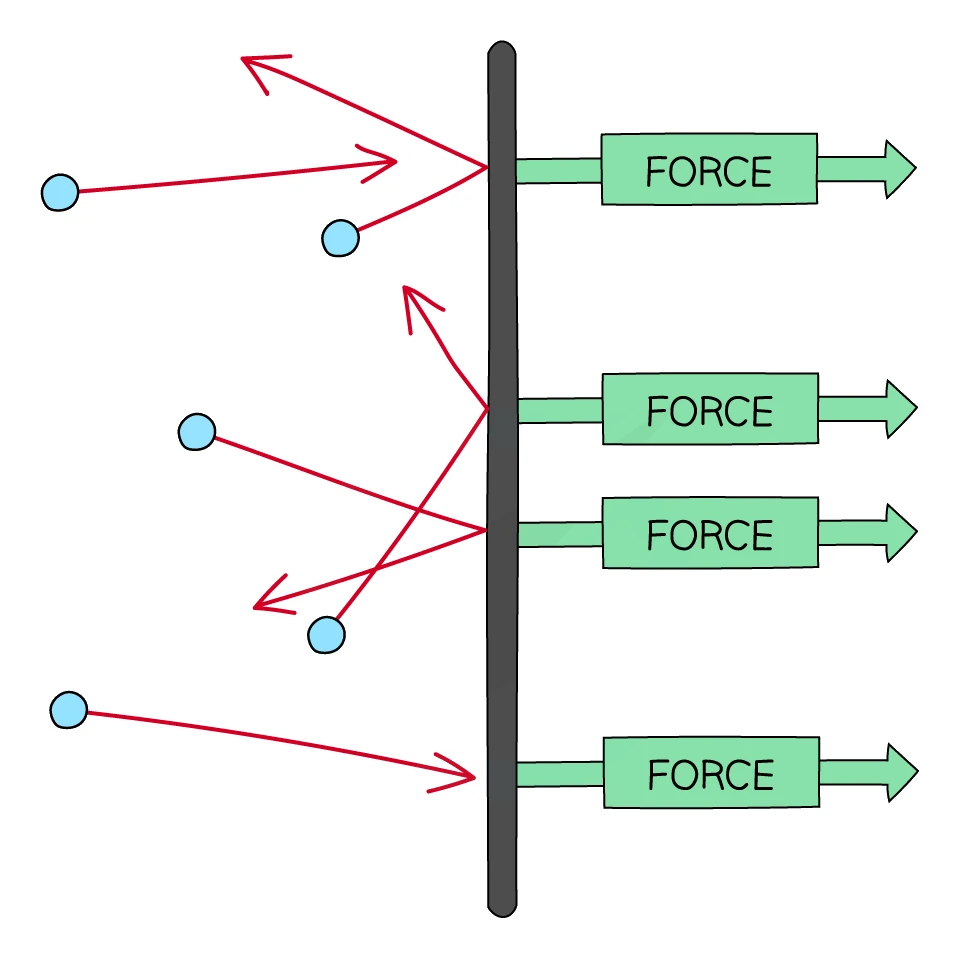
- Each time a gas molecule strikes the wall of its container, it bounces back. By Newton's third law, the wall pushes the molecule back, and the molecule pushes the wall
- Over countless collisions, the millions of tiny pushes add up to a net force on every wall, acting at right angles to the surface
- Pressure is force per unit area:
P = F / A
- Two things control how big the pressure is:
- How often the molecules hit the wall each second (more collisions per second means more force per second)
- How hard each collision is (faster molecules mean a harder impact)
- Anything that changes either factor (heating the gas, compressing it, adding more molecules) changes the pressure
Exam tip
Explaining how gas molecules produce pressure
What comes up: A 3-mark question asking you to explain, in terms of particles, how a gas exerts a pressure on the walls of its container.
Write (three marks): (1) Gas molecules (or particles) collide with the walls of the container. (2) Each collision exerts a force on the wall. (3) Pressure is force per unit area, so the total force acting across the wall area gives the gas pressure.
Watch out: The mark scheme ignores answers where collisions are described between molecules with no mention of the walls. You must explicitly reference the walls at least once. Writing "molecules collide (with each other)" does not score the collision mark.