4PH1
Density & Pressure
Solids, Liquids & Gases
Density
Definition
- Density (ρ) is the mass per unit volume of a material
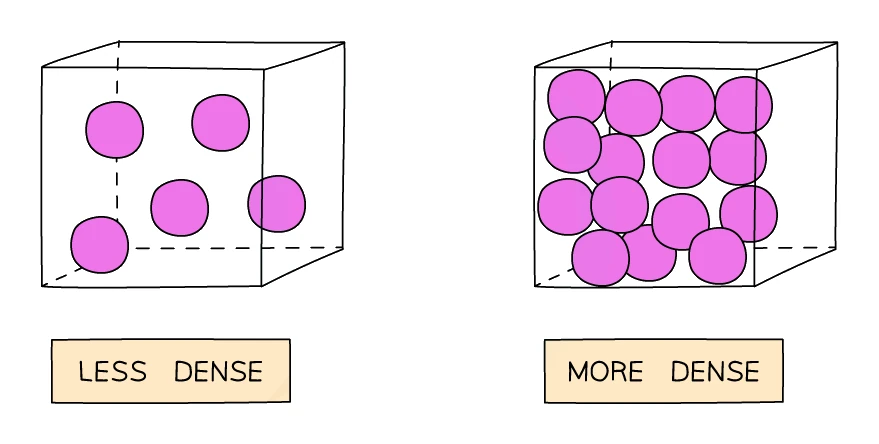
- It tells you how tightly the matter in a substance is packed together. Two objects of identical size made from different materials can have very different masses; the denser one feels heavier
The density equation
ρ = m / V
- where:
- ρ = density (kg/m³ in SI units; sometimes quoted in g/cm³)
- m = mass (kg or g)
- V = volume (m³ or cm³)
- Useful rearrangements:
- m = ρ × V (how much a fixed volume of a known material weighs)
- V = m / ρ (the volume occupied by a known mass of a known material)
Comparing states of matter
- For the same substance, density generally falls as you go from solid → liquid → gas:
- Solid: particles packed tightly in a fixed lattice. Highest density of the three states
- Liquid: particles still touching but free to slide past each other. Slightly less dense than the solid (water is the famous exception: ice floats on water because solid water is less dense than liquid water)
- Gas: particles spread far apart with mostly empty space between them. Density is typically about a thousand times smaller than the liquid or solid forms
Units conversions
- SI density is kg/m³, but g/cm³ is also very common. The conversion:
- 1 g/cm³ = 1000 kg/m³ (water has a density of 1.0 g/cm³ = 1000 kg/m³)
- Useful reference densities:
- air at sea level ≈ 1.2 kg/m³
- water ≈ 1000 kg/m³
- aluminium ≈ 2700 kg/m³
- iron ≈ 7900 kg/m³
- lead ≈ 11 300 kg/m³
Worked example
Calculate the density of a material
A rectangular block has a mass of 240 g and dimensions 8.0 cm × 5.0 cm × 3.0 cm.
Solution:
- Volume = 8.0 × 5.0 × 3.0 = 120 cm³
- ρ = m / V = 240 / 120 = 2.0 g/cm³