Density & Pressure
Solids, Liquids & Gases
Definition
- Pressure is the force per unit area acting normal (at right angles) to a surface
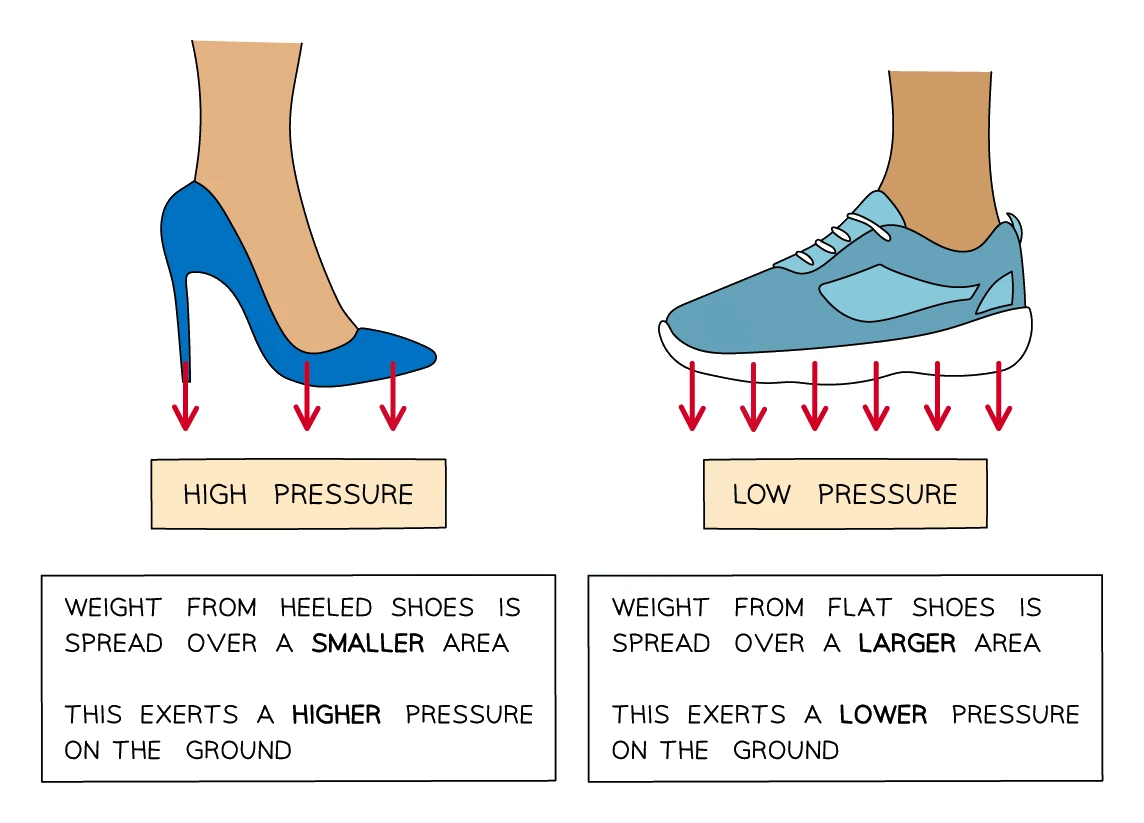
- The same force concentrated into a smaller area produces a higher pressure. That's why a sharp knife slices and a blunt one doesn't, and why a sleeping bag is more comfortable on a wide foam mat than on a single rope
The pressure equation
P = F / A
- where:
- P = pressure (pascals, Pa, where 1 Pa = 1 N/m²)
- F = force acting perpendicular to the surface (N)
- A = area over which the force is applied (m²)
- Rearrangements:
- F = P × A (the total force a fluid pressure exerts on a surface of known area)
- A = F / P
Worked example
Calculate pressure from force and area
A person weighing 600 N stands on a flat tile with a total contact area of 0.030 m².
Solution:
- P = F / A = 600 / 0.030 = 20 000 Pa (20 kPa)
Common exam question
Calculating with pressure = force ÷ area
Question: Calculate the pressure a weight exerts on the ground, the force a pressure produces on a piston or a surface, or the area it acts on, sometimes with a unit (2–4 marks).
Asked in 4 of the 24 papers. One mark is for substituting into p = F ÷ A (the formula alone earns nothing), one for the evaluation; longer versions add one for rearranging to find F or A. The force must be a weight in newtons: given a mass, convert it with W = m × g first, because dividing the mass by the area is capped at two of the three marks. Keep the units consistent: pascals go with m², and an area in cm² gives a pressure in N/cm². A unit asked for is marked separately and must match your numbers: with the pressure left in kPa, writing m² kept three of the four marks and cm² only two. Follow-through is allowed between linked parts.
Everyday consequences
- Small area + ordinary force = high pressure:
- Drawing pins taper to a tiny tip on the wall side. A modest push from a fingertip becomes a huge pressure at the point, driving it into the wood
- Nails and needles work the same way
- Sharp knives cut better than blunt ones because the cutting edge is a much smaller area
- Stiletto heels focus the wearer's weight onto a few square millimetres and can dent wooden floors
- Large area + ordinary force = low pressure:
- Tractor tyres are very wide. The same vehicle weight spread over more rubber gives a lower ground pressure, so the tractor doesn't sink into wet soil
- Caterpillar tracks on tanks and bulldozers do the same thing, distributing the weight over a long track footprint
- Snow shoes and skis stop a person sinking into soft snow by spreading their weight across a much larger area than a pair of boots would
- A camel's foot broadens when it pushes down, spreading the camel's weight on sand