Density & Pressure
Solids, Liquids & Gases
What changes with depth
- A fluid is anything that can flow: both liquids and gases qualify
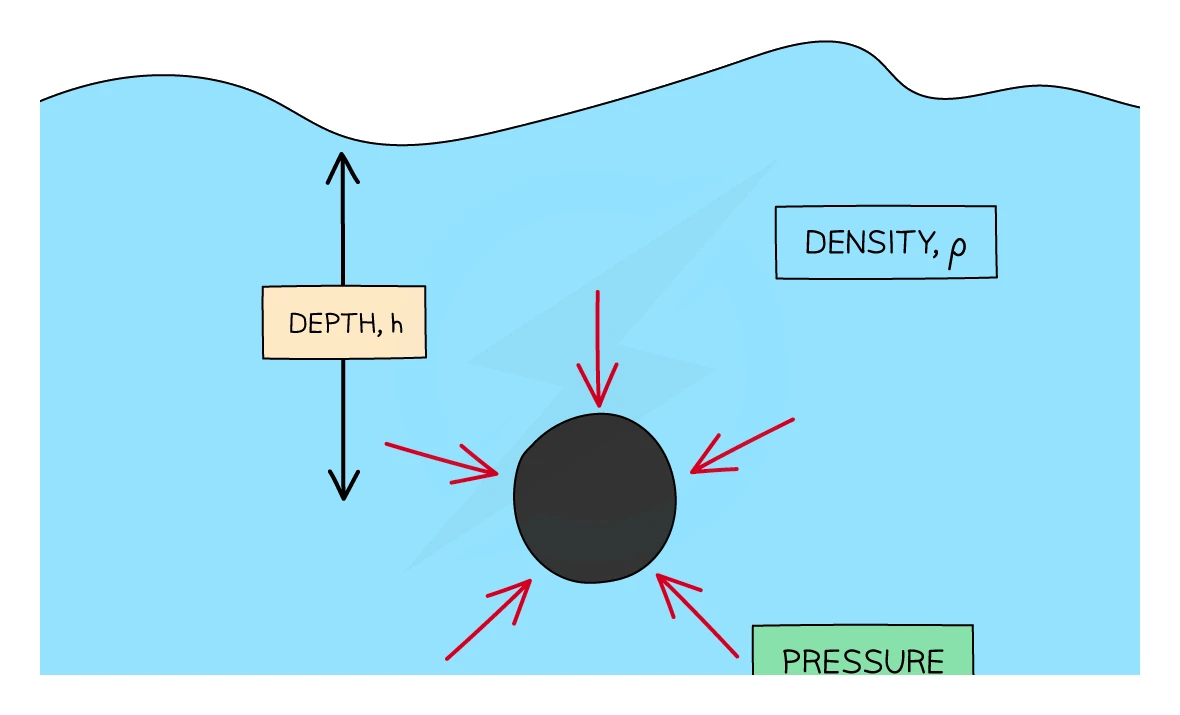
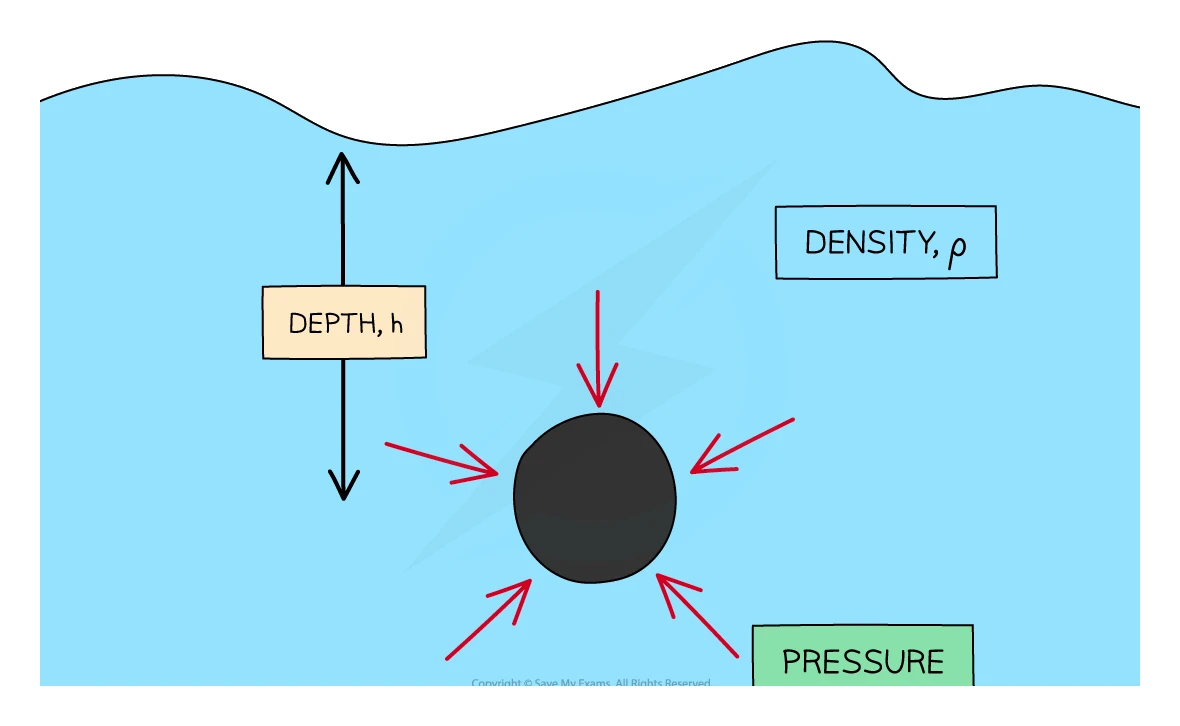
- A stationary fluid exerts pressure on any surface inside it:
- The pressure acts at right angles to the surface, no matter which way the surface is facing
- The pressure increases with depth below the surface of the fluid. The deeper you go, the more fluid is piled above and pressing down
- The pressure is the same at the same depth, regardless of direction or position in the fluid
Common exam question
Explaining effects of pressure increasing with depth
Any question that asks you to explain a design or an observation in terms of pressure changing with depth: how a dam must change to hold sea water, or why a jet from a hole near the top of a bottle lands closer than one from lower down. Set in 2 of the 24 papers. State the pressure comparison first, because it is a mark in both schemes: the pressure at the bottom is greater for the denser water, or the pressure at the higher hole is lower. Then give the consequence: a wider base or stronger material for the dam ("taller" is ignored); a smaller force on the water at the higher hole, so it leaves more slowly. Two holes at the same depth give identical paths because the pressure there is the same, and the pressure acts equally in all directions.
Why depth raises pressure
- Imagine a column of liquid sitting on top of a small horizontal patch of area at some depth h
- The weight of that column is m × g = (ρ × V) × g = ρ × A × h × g
- That weight presses on the patch, contributing a pressure of:
P = (force) / (area) = (ρ × A × h × g) / A = ρ × g × h
- The area cancels out, so the pressure depends only on the depth, the of the and the gravitational field strength
The depth-pressure equation
P = h × ρ × g
- where:
- P = pressure at depth h below the surface (Pa)
- h = depth below the surface (m)
- ρ = density of the fluid (kg/m³)
- g = gravitational field strength (10 N/kg on Earth)
- This is the extra pressure caused by the fluid above. Outside the fluid, atmospheric pressure is also present (about 101 000 Pa at sea level), so the total pressure on something deep underwater is atmospheric + the hydrostatic term above. Most exam questions only ask for the hydrostatic term
Common exam question
Stating the formula for pressure difference
Question: State the formula that links pressure difference to height, density and gravitational field strength, g (1 mark).
Asked in 7 of the 24 papers, always as the lead-in to a calculation with it; two of those papers also ask for the formula linking pressure, force and area in the same way. Words or standard symbols both score: pressure difference = height × density × gravitational field strength, or p = h × ρ × g, and any correct rearrangement is accepted. Choose your symbols carefully. "Depth" for height is accepted; four of the seven schemes let d stand for density but one rejects it, so write ρ. Writing "gravity" for g is rejected by three schemes and ignored by two more, so it never earns the mark; g is the gravitational field strength.
Common exam question
Calculating a pressure, depth or height with p = hρg
Question: Calculate the pressure difference at a stated depth, or the depth of liquid that produces a given pressure difference (2–4 marks).
Asked in 9 of the 24 papers. One mark is for substituting into p = h × ρ × g and one for the evaluation; rearranging to find h earns a third, and one scheme gives a mark for converting cm to m. When the answer line says kPa or cm, the evaluation mark is for the value in that unit. A power-of-ten slip costs one mark, but only when g was used: leaving g out is a physics error, not a slip. g = 9.8 is accepted.
For the total pressure, add atmospheric pressure (about 100 kPa) to the liquid's pressure difference: three of these papers give a mark for that addition, with follow-through from your own value. A barometer question runs backwards: subtract the trapped gas pressure from the total, then rearrange for the liquid's height.
Worked example
Calculate pressure at depth in a liquid
A diver descends to a depth of 25 m in seawater with a density of 1 020 kg/m³ (g = 10 N/kg).
Solution:
- State the formula: P = h × ρ × g
- Substitute: P = 25 × 1 020 × 10
- P = 255 000 Pa (255 kPa)
Note: this is the pressure due to the liquid alone. The total pressure at that depth also includes atmospheric pressure (~100 000 Pa) added on top.
Why dams are built thicker at the base
- The water inside a reservoir exerts a hydrostatic pressure on the dam wall, and that pressure rises linearly with depth
- The pressure on the wall is therefore small near the surface and largest near the bottom
- Engineers make the dam wall much thicker at the base than at the top so that the thicker section can resist the much larger force from the deeper water. The wall's cross-section is roughly triangular, with the wide end at the bottom and the narrow end at the surface
- The same logic explains why submarines have a maximum operating depth: at some depth, the hydrostatic pressure exceeds the design strength of the hull