4PH1
Changes of State
Solids, Liquids & Gases · 2 question types
The three states of matter
- All ordinary matter exists in one of three states at typical temperatures: solid, liquid or gas
- The state determines whether the material has a fixed shape, a fixed volume, and how easily it flows or compresses
Particle behaviour in each state
- Solid
- Particles are packed tightly in a regular pattern (a lattice)
- Each particle vibrates about a fixed position; it cannot move past its neighbours
- The material has a definite shape and a definite volume
- Liquid
- Particles are still in contact but no longer locked into a lattice; they move freely past one another
- The material has no definite shape (it flows to fit the bottom of any container) but still has a definite volume
- Gas
- Particles are far apart with mostly empty space between them
- Particles move rapidly and randomly in all directions
- The material has no definite shape and no definite volume; it expands to fill any container it is placed in
- Gases are easily compressed because the large gaps between particles can be squeezed out
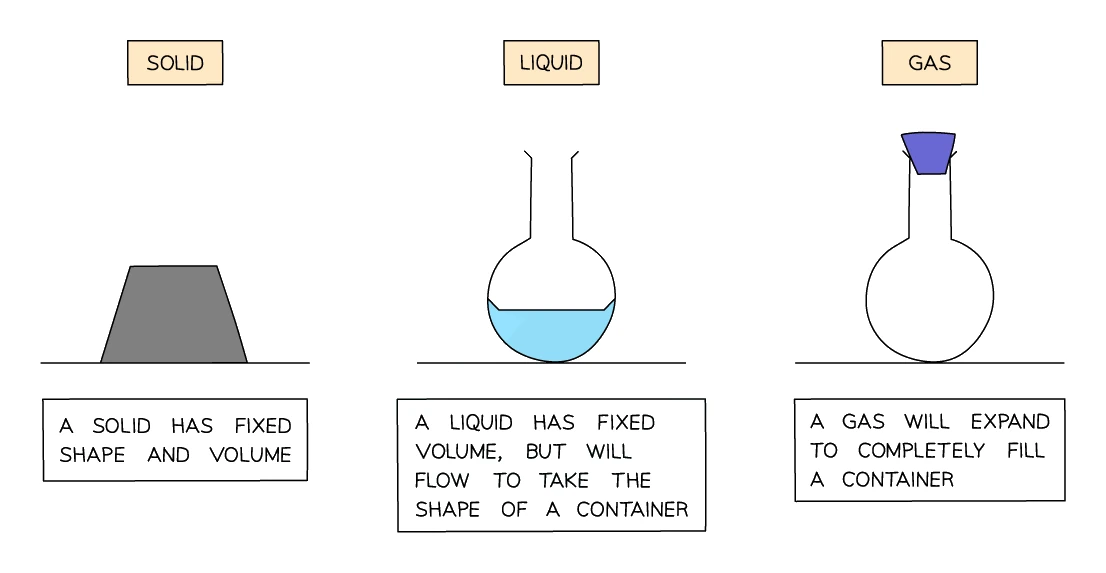
| Property | Solid | Liquid | Gas |
|---|---|---|---|
| Density | High | Slightly lower than solid | Very low |
| Particle arrangement | Regular lattice | Closely packed but disordered | Far apart, randomly arranged |
| Particle motion | Vibrate about fixed positions | Slide past each other | Move rapidly in all directions |
| Particle energy | Low | Higher than solid | Highest |
| Definite shape? | Yes | No | No |
| Definite volume? | Yes | Yes | No |
| Easily compressed? | No | No | Yes |
Exam tip
Describing particle arrangement and motion
What comes up: "describe the arrangement and motion of particles in a solid / liquid / gas".
Watch out: use precise wording — for a liquid, say particles "flow past each other" / "move randomly", not the vague "move freely"; for a solid, state they vibrate about fixed positions (just "fixed positions", with no mention of vibration, misses the motion mark).