Changes of State
Solids, Liquids & Gases
Definition
- The (c) of a substance is the amount of energy needed to raise the temperature of 1 kg of the substance by 1 °C
- The SI unit is joules per kilogram per degree Celsius (J/(kg °C)) (equivalent to J/(kg K) since temperature differences are the same in °C and K)
- Reference values for a feel:
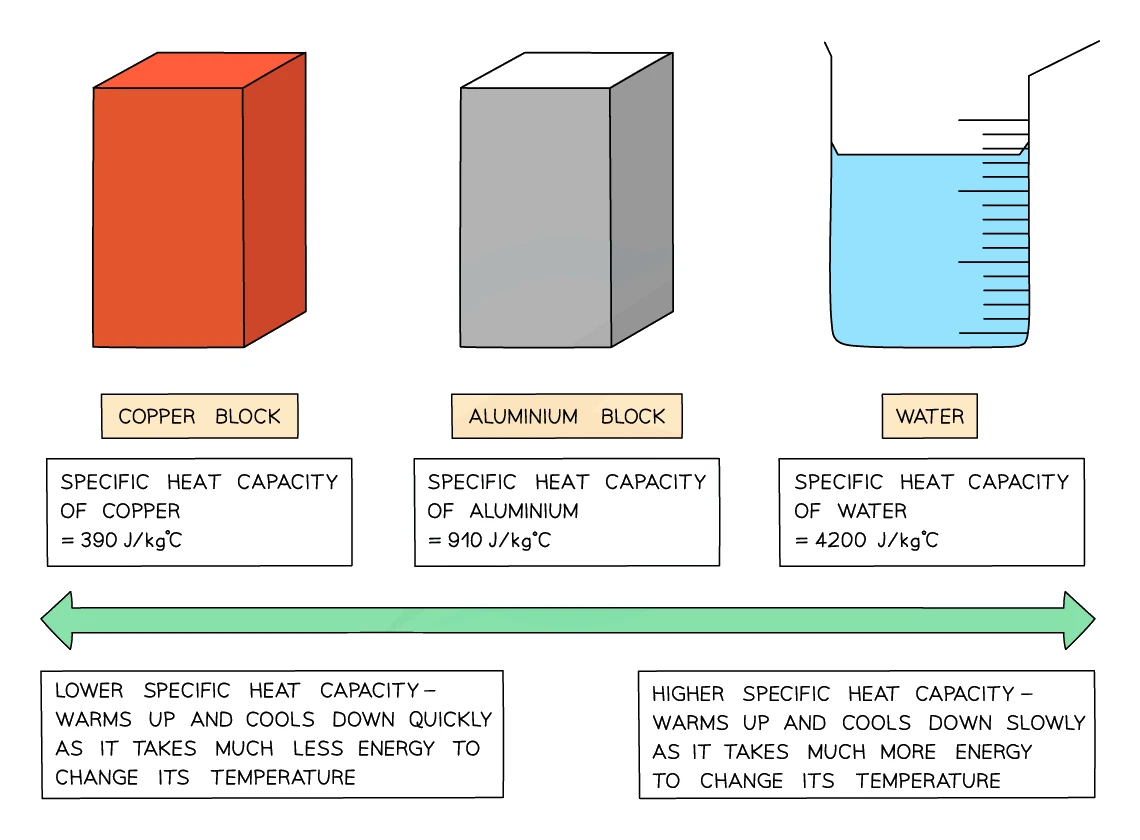
- water: 4200 J/(kg °C), very high, which is why oceans moderate climate and water-cooled radiators work
- aluminium: 900 J/(kg °C)
- copper: 385 J/(kg °C)
- iron: 460 J/(kg °C)
- air: 1000 J/(kg °C)
Common exam question
Defining specific heat capacity
Question: State what is meant by specific heat capacity (2–3 marks).
Set in 2 of the 24 papers. The definition has three parts and the marks follow them: the energy required, per kilogram (per unit mass), to change the temperature by 1 °C (1 K is accepted). When it is worth 2 marks, the energy and the temperature change are one mark and the mass is the other, which is given only if you have earned the first. An equation on its own is ignored, and so is "heat" in place of "energy", so write the word energy. "Raise" or "increase" is accepted in place of "change".
Implications of high vs low c
- A substance with a high specific heat capacity:
- heats up slowly for a given energy input
- cools down slowly when energy is removed
- is good for storage heaters, hot-water bottles and household central-heating systems (water carries lots of heat per kilogram)
- A substance with a low specific heat capacity:
- heats up quickly and cools down quickly
- is good for cooking pans and engine pistons (metals heat fast, conduct fast, cool fast)
Common exam question
Explaining a heating system using specific heat capacity
Question: Explain the advantage of using a material with a high specific heat capacity in a heating system, or why two substances that exchange the same energy change temperature by different amounts (2–3 marks).
Set in 2 of the 24 papers. Argue from the equation. The energy transferred is the same for both substances (what one loses the other gains, apart from some lost to the surroundings), so for equal masses the substance with the smaller specific heat capacity has the larger temperature change. Saying which value is smaller earns a point of its own on top of saying they differ, and a short algebraic comparison with ΔQ = m × c × ΔT can earn another. For a store such as concrete or water, the credited ideas are that it absorbs and releases a lot of energy per kilogram, so it keeps supplying heat, or keeps its temperature, for longer.
The energy equation
ΔQ = m × c × ΔT
- where:
- ΔQ = energy supplied to (or removed from) the substance (J)
- m = mass of the substance (kg)
- c = specific heat capacity (J/(kg °C))
- ΔT = change in temperature (°C)
- This equation only applies while the substance is not changing state. During a change of state, the temperature does not change so ΔT = 0 and the equation gives zero, but real energy is still being delivered (into the potential store)
Common exam question
Calculating with ΔQ = m × c × ΔT
Question: Calculate the energy transferred, the specific heat capacity or the mass from the other quantities, sometimes after first finding the energy supplied by an electric heater (3 marks).
Set in 8 of the 24 papers, always for 3 marks and always on Paper 2. When the energy is the unknown the marks are: the temperature change, the substitution, the evaluation; using the final temperature in place of the change loses the first mark only, as the later marks follow through. When c or the mass is the unknown they are substitution, rearrangement and evaluation, so write the rearranged line even when you could do it in your head. Mass goes in kilograms when c is in J/kg °C; a mass left in grams is a power-of-ten error and costs one mark.
When the heater's power, or its voltage and current, is given, first find the energy supplied (energy = power × time, or E = I × V × t) with the time in seconds; leaving minutes unconverted costs a mark. Evaluate a "show that" answer to at least one more significant figure than the printed value.
Worked example
Calculating thermal energy using ΔQ = m × c × ΔT
A 2.0 kg iron pan is heated from 20 °C to 120 °C. The specific heat capacity of iron is 460 J/(kg °C). Calculate the thermal energy transferred to the pan.
Solution:
- Identify the temperature change: ΔT = 120 − 20 = 100 °C
- Write the equation: ΔQ = m × c × ΔT
- Substitute: ΔQ = 2.0 × 460 × 100
- = 92 000 J
Worked example
Rearranging ΔQ = m × c × ΔT for an unknown
A 2.0 kg block of metal absorbs 90 000 J of energy and its temperature rises from 20 °C to 70 °C. Calculate the specific heat capacity of the metal.
Solution:
- Work out the temperature change first: ΔT = 70 − 20 = 50 °C
- Rearrange ΔQ = m × c × ΔT to make c the subject: c = ΔQ ÷ (m × ΔT)
- Substitute and evaluate: c = 90 000 ÷ (2.0 × 50) = 90 000 ÷ 100 = 900 J/kg °C