4PH1
Changes of State
Solids, Liquids & Gases · 2 question types
Aim
- Measure the of a sample (a metal block, a beaker of water, or both) by heating it electrically and recording the energy supplied alongside the temperature rise
Variables
- Independent variable: time t (s), how long the immersion heater has been running
- Dependent variable: temperature T (°C) of the sample
- Control variables: the same mass of sample, the same supply voltage, the same immersion heater, the same sample container, the same starting room temperature
Apparatus
| Equipment | Purpose |
|---|---|
| Solid block of aluminium with drilled holes (for water variant: a 400 ml beaker of water) | The sample whose c is being measured |
| Immersion heater (low-voltage, 12 V) | Delivers a measurable electrical energy into the sample |
| Variable d.c. power supply (or 12 V battery pack) | Drives the heater |
| Voltmeter (across the heater) | Reads the voltage V |
| Ammeter (in series with the heater) | Reads the current I |
| Thermometer | Reads the sample's temperature |
| Stopwatch | Times the heating |
| Digital balance | Measures the sample's mass |
| Insulation (for metal block: lagging or polystyrene jacket) | Cuts heat loss to the surroundings |
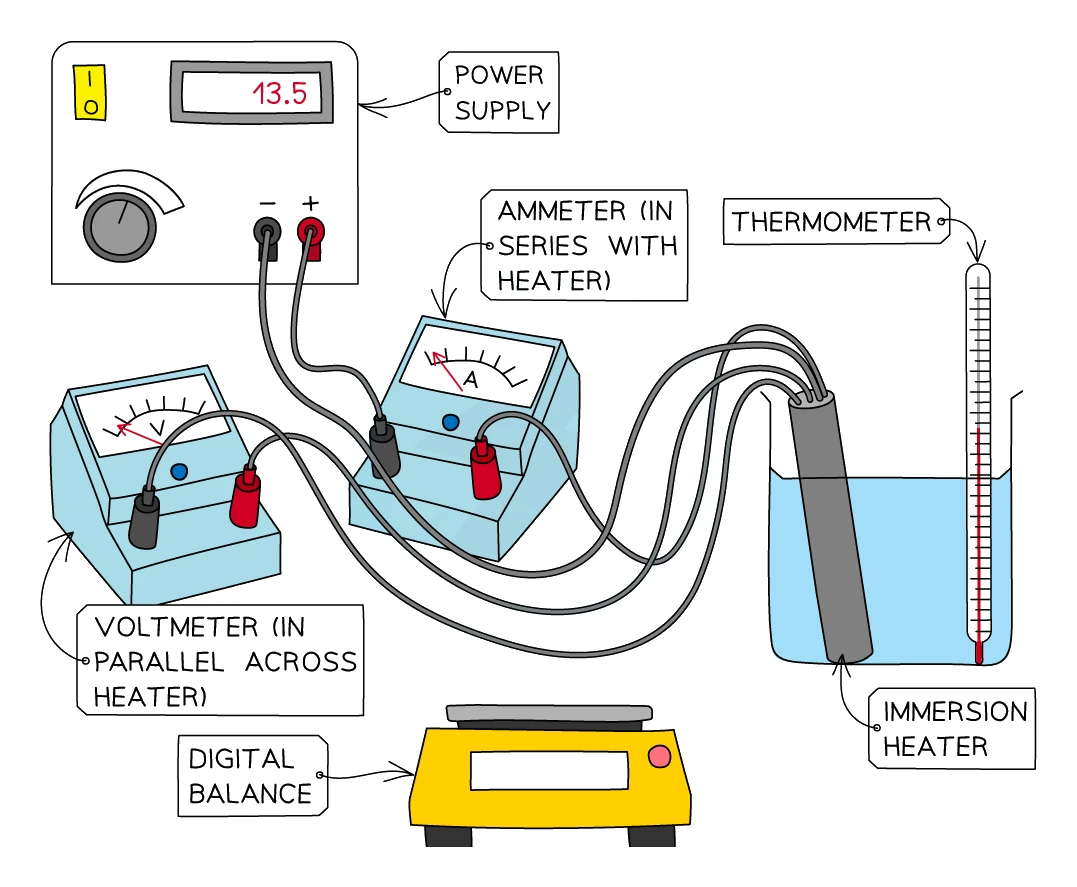
Method (water variant)
- Stand an empty 400 ml beaker on the digital balance and press the tare button to zero the reading; pour in about 250 ml of water and write down the new mass m in kg
- Stand the immersion heater and the thermometer vertically in the water; clamp them so neither touches the bottom of the beaker
- Connect the circuit: power supply → ammeter (in series) → immersion heater. Wire the voltmeter directly across the heater
- Note the starting temperature on the thermometer before any current is switched on; this is the baseline for ΔT
- Switch on the power supply at about 12 V. Start the stopwatch at the same instant
- Record the voltage V, the current I, and the temperature T every 60 s for 10 minutes. Stir the water gently between readings
- Switch off the supply. Allow the water to keep warming for a further minute (the heater is still hot, so there's a lag) and record the maximum temperature reached
Method (solid block variant)
- Identical to the water method, except: the immersion heater goes into a hole drilled in the block; thermometer goes into a separate hole. Pack the block with insulating material to cut heat losses, since solids don't stir themselves
Analysis
- The total electrical energy delivered up to time t is:
ΔQ = V × I × t
- Plot a graph of ΔQ (y-axis) against m × ΔT (x-axis), where ΔT is the rise above the starting temperature
- The graph should be a straight line through the origin once the heater itself has warmed up. The gradient of the linear region is the specific heat capacity:
gradient = ΔQ / (m × ΔT) = c
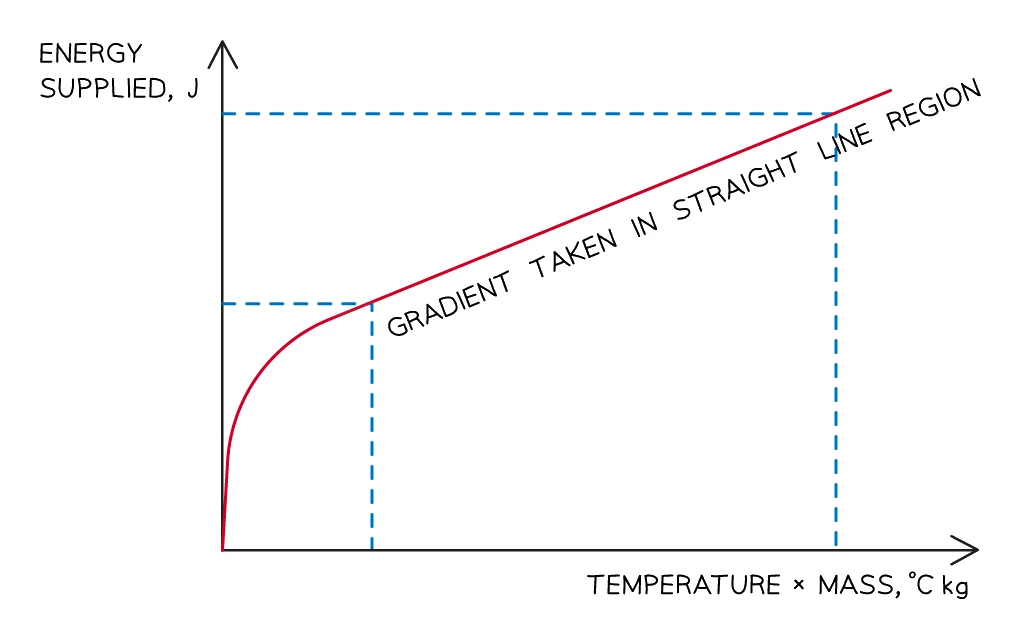
- For pure water you should land near 4200 J/(kg °C); for an aluminium block, near 900 J/(kg °C). A modest discrepancy (typically 5–15 % high) is expected because some energy leaks to the surroundings rather than going into the sample
Sources of error and safety
- Systematic, heat loss to the surroundings. The hot beaker/block warms the room air. Lagging the sample with polystyrene reduces this; using the gradient (which is less affected than a single-point answer) helps too
- Systematic, heater itself absorbing energy. Some of the early electrical energy heats the metal sheath of the immersion heater rather than the sample. Only use the straight-line part of the graph (after the initial dog-leg) when taking the gradient
- Random, temperature gradients across the sample. Stir water samples; insulate solid samples and let them warm slowly so the heat spreads evenly inside
- Safety. Use a low-voltage d.c. supply only, because mains voltage with an immersion heater in water is lethal. The heater becomes very hot; lift it out by the wire, not the metal sheath, and let it cool on a heatproof mat