Ideal Gases
Solids, Liquids & Gases
Kinetic Theory of Gases
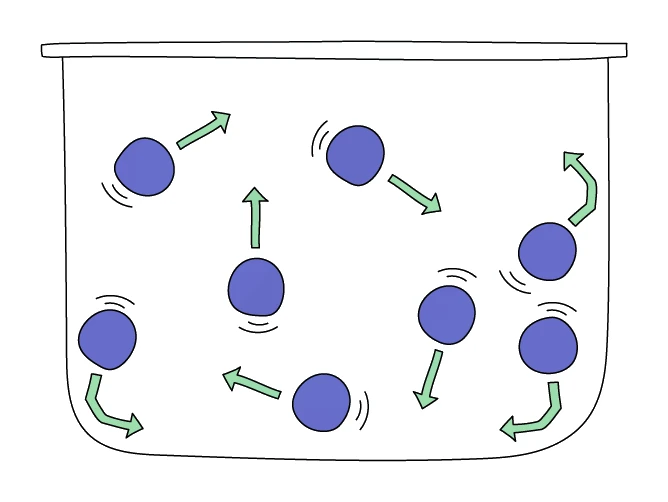
Random motion of gas molecules
- Gas molecules never sit still; they fly about ceaselessly in random directions at high speed
- "Random" means no preferred direction: every molecule is constantly changing direction as it bounces off other molecules and off the walls of the container
- A typical air molecule at room temperature moves at hundreds of metres per second between collisions
How collisions produce pressure
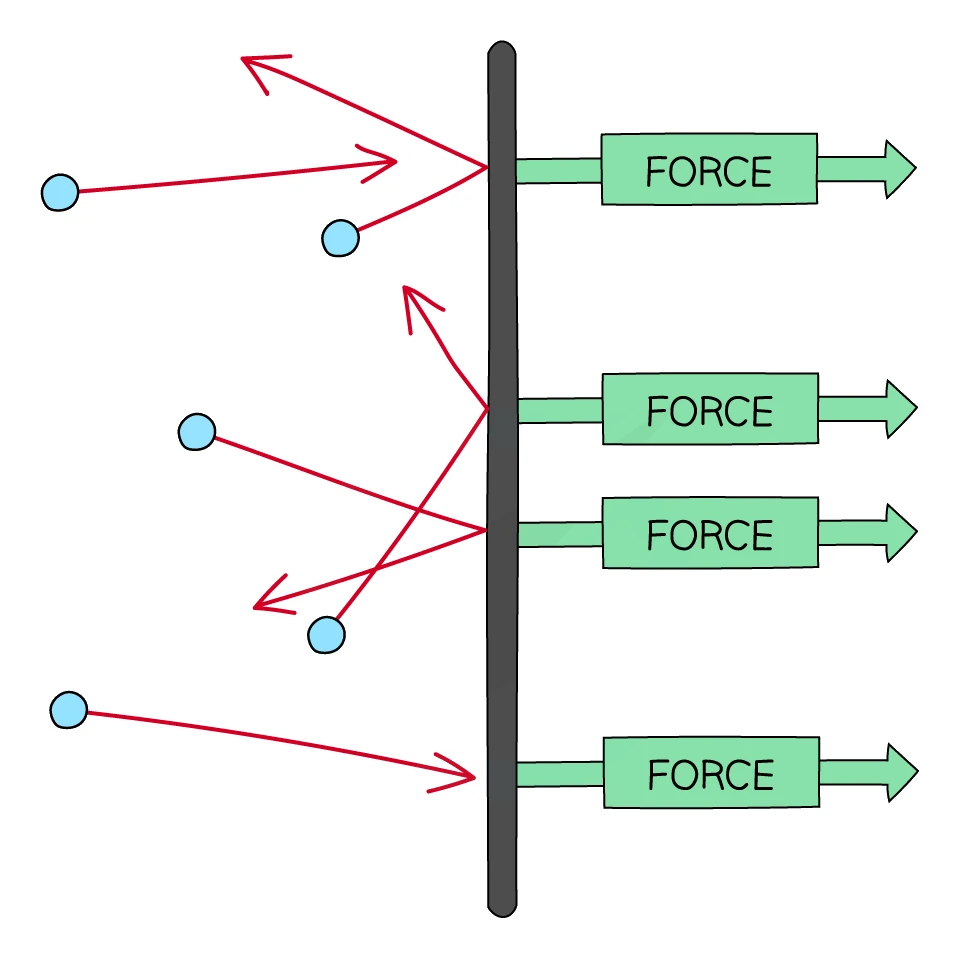
- Each time a gas molecule strikes the wall of its container, it bounces back. By Newton's third law, the wall pushes the molecule back, and the molecule pushes the wall
- Over countless collisions, the millions of tiny pushes add up to a net force on every wall, acting at right angles to the surface
- Pressure is force per unit area:
P = F / A
- Two things control how big the pressure is:
- How often the molecules hit the wall each second (more collisions per second means more force per second)
- How hard each collision is (faster molecules mean a harder impact)
- Anything that changes either factor (heating the gas, compressing it, adding more molecules) changes the pressure
Common exam question
Explaining how a gas exerts pressure on its container
Question: Explain, or describe, how the molecules of a gas produce a pressure on the inside of their container (3 marks).
Asked in 4 of the 24 papers, always for three marks, one per idea: the molecules collide with the walls (or the surface) of the container; each collision exerts a force on the wall; and pressure is force per unit area, so the total force over the wall area is the pressure. p = F/A is accepted for the third point, but one scheme says the formula alone is not enough, so say it in words too.
Name the walls: "the molecules collide with each other" is ignored and earns nothing. Random motion is also credited in one scheme, and when a question asks why the pressure is the same on every wall, the two marks are for that random motion and for an equal rate of collisions in every direction.