4PH1
Ideal Gases
Solids, Liquids & Gases · 1 question type
Why temperatures have a lower limit
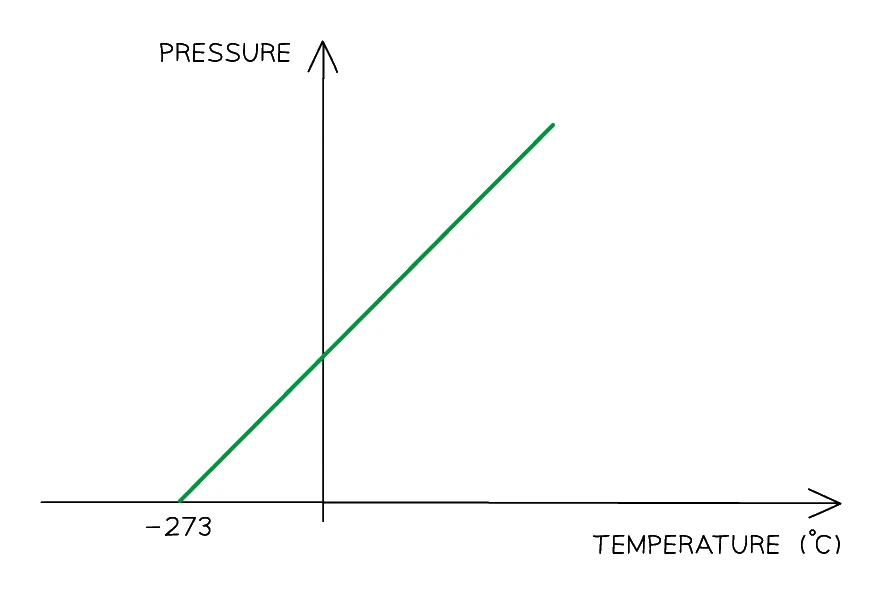
- As a gas is cooled, its molecules slow down and collide with the walls less often and less hard. The pressure drops
- If you could keep cooling, you would eventually reach a temperature at which the molecules have stopped moving completely. There would be no collisions, no pressure, and no kinetic energy at all
- This temperature is called . It is the lowest theoretically possible, because you cannot remove any more energy from a system that already has zero kinetic energy
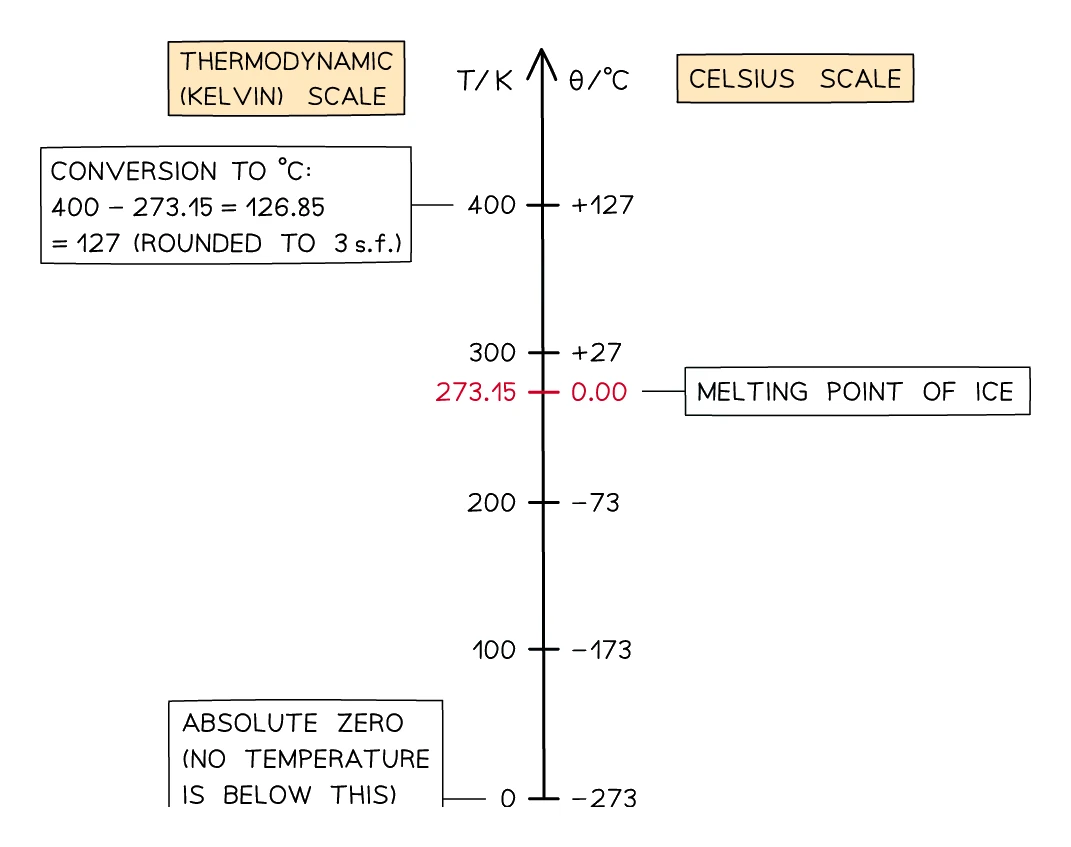
- Absolute zero is exactly 0 K, or −273 °C (more precisely −273.15 °C, but the syllabus uses −273 °C)
The Kelvin scale
- The Kelvin scale (K) is the absolute temperature scale used throughout physics. It starts at absolute zero
- Two essential facts:
- 0 K = −273 °C (the bottom of the scale, the same temperature, just labelled differently)
- A change of 1 K is the same as a change of 1 °C; the scales are stretched out at the same rate; only the zero point is different
- To convert between the two scales:
T (K) = θ (°C) + 273
θ (°C) = T (K) − 273
- Because the Kelvin scale starts at the lowest possible temperature, a Kelvin temperature is never negative