Density & Pressure
Solids, Liquids & Gases
Aim
- Measure the density of three different kinds of sample: a regularly shaped solid, an irregularly shaped solid, and a liquid, using the most suitable technique for each
Apparatus
| Equipment | Purpose | Resolution |
|---|---|---|
| Digital balance | Measures the mass of every sample | 0.01 g |
| 30 cm ruler | Measures lengths of regular solids (≥ a few cm) | 1 mm |
| Vernier calipers | Measures smaller solid samples accurately | 0.01 mm |
| Micrometer screw gauge | Measures the smallest samples (wires, thin discs) | 0.001 mm |
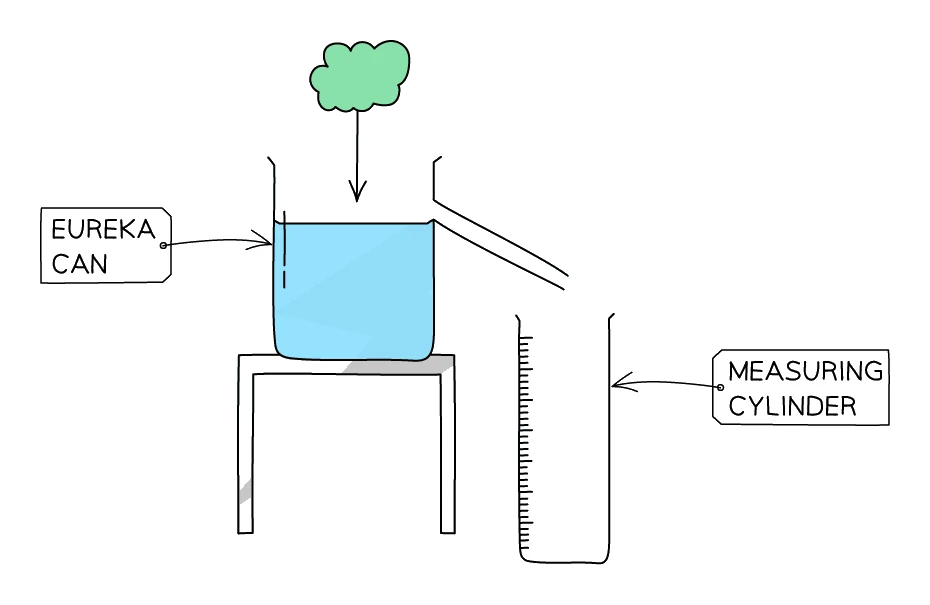
| Eureka (displacement) can with spout | Catches the water displaced by an irregular solid | — |
| Measuring cylinder | Reads the displaced water and the volume of any liquid sample | 1 ml |
| Beaker / sample container | Holds liquid being weighed | — |
Experiment A: density of a regularly shaped solid (a metal cube, a cylinder, a sphere)
- Independent variable: the dimensions you measure (length, breadth, height, radius)
- Dependent variable: derived density value
- Control variables: the same balance and measuring instrument used throughout; samples at room temperature
Method:
- Place the solid on the digital balance and record the mass m in kg
- Choose the right instrument for the size of the sample:
- centimetre ruler for objects bigger than a few centimetres
- Vernier calipers for samples a few millimetres to a few centimetres across
- micrometer for very small or thin samples
- Measure each dimension three times at different points, and take the mean of the three readings for each dimension
- Calculate the volume from the appropriate geometric formula:
- cuboid: V = length × breadth × height
- cylinder: V = π × r² × h
- sphere: V = (4/3) × π × r³
- Calculate the density from ρ = m / V
Experiment B: density of an irregular solid (a stone, a key, a small metal casting)
- Independent variable: the sample being tested
- Dependent variable: the volume of water displaced
- Control variables: the same eureka can, the same measuring cylinder, the same starting water level
Method:
- Find the mass of the sample on the digital balance
- Top the can up with water so that the level reaches the spout and a few drops trickle out; wait until dripping has stopped completely before continuing
- Place an empty, dry measuring cylinder directly beneath the spout
- Lower the sample carefully into the eureka can on a thin thread (or slide it gently down the inside) so it sinks fully below the water without splashing
- The water that has been pushed out runs through the spout into the measuring cylinder. Read off the volume of water collected; this equals the volume of the sample
- Calculate the density from ρ = m / V
Experiment C: density of a liquid
- Independent variable: the volume of liquid added (or the type of liquid)
- Dependent variable: the mass of the liquid
Method:
- Place an empty, dry measuring cylinder on the digital balance and record its mass m₁
- Without removing the cylinder from the balance, pour in a measured volume of liquid (read the volume V off the cylinder's own scale, with your eye level with the meniscus)
- Record the new mass m₂ (cylinder + liquid)
- The mass of the liquid alone is m = m₂ − m₁
- Calculate the density from ρ = m / V
Describe how to find the density of an irregular solid
What comes up: describe the experimental method for measuring the density of an irregular object (such as a stone or small metal casting) using water.
Write (three marks): (1) use a displacement method — submerge the object fully in water and collect or record the displaced volume; (2) measure the volume of water before and after placing the object in the container, and subtract to find the object's volume; (3) measure the mass on a balance, then use ρ = m / V to calculate density.
Watch out: the mark scheme requires that the solid is fully submerged. Stating "place in water" without specifying full submersion can lose the mark. Also, reading the volume by eye without mentioning eye-level alignment risks losing the parallax mark.
Sources of error and safety
- Systematic, un-zeroed balance. Always tare the balance to zero before placing each sample on it
- Systematic, parallax on the measuring cylinder. Read the meniscus at eye level so the volume isn't over- or under-read
- Random, irregular sample dropped instead of lowered. Slamming the sample into the eureka can causes water to splash out, throwing off the volume reading. Lower it gently on a thread instead
- Safety. Eureka cans are typically glass or thin metal, so handle with care; mop up spills immediately to avoid slips and short circuits near the electric balance