4PH1
Energy Stores & Transfers
Energy Resources & Energy Transfers
The store-and-pathway model
- Energy in any physical situation is described as sitting in one of several stores and being moved between those stores by one of a few transfer pathways
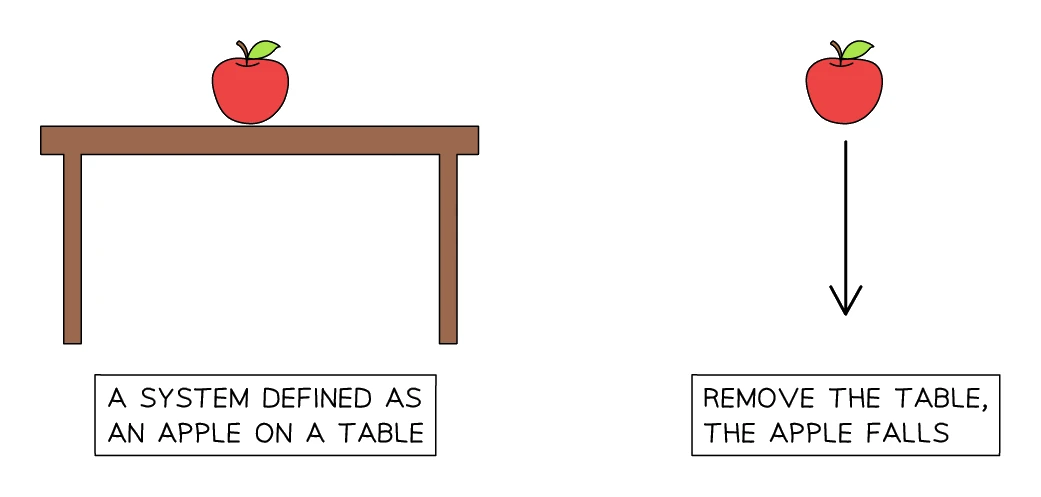
- A system is the object (or group of objects) you have chosen to focus on; defining the system fixes the boundaries of which stores and which transfers count for the question
- When a system is in equilibrium, no stores are changing and nothing happens; when something changes, energy moves between stores
The eight energy stores
| Store | Where it sits |
|---|---|
| Kinetic | Any moving object |
| Gravitational potential | An object raised above the ground in a gravitational field |
| Elastic potential | A material that has been stretched, squashed, bent or twisted |
| Magnetic | Magnetic materials interacting through their fields |
| Electrostatic | Charged particles or objects interacting through their fields |
| Chemical | Chemical bonds inside fuels, foods, batteries and other reactants |
| Nuclear | The bonds holding protons and neutrons together inside the nucleus |
| Thermal (internal) | The random kinetic and potential energy of the particles inside any object above absolute zero |
The four transfer pathways
| Pathway | Mechanism |
|---|---|
| Mechanical | A force acting on an object as the object moves (pushing, pulling, stretching, squashing) |
| Electrical | A current carrying charge through a potential difference |
| Heating | Energy transferred from a hotter object to a colder one by conduction or convection |
| Radiation | Energy carried away from a surface by electromagnetic waves (most commonly infrared) |
Reading an energy transfer
- To describe what happens in a system in store-and-pathway language, answer three questions:
- which store is the energy moving from?
- which store is it moving to?
- which pathway is carrying it?
Example A — a wound-up clockwork toy is released and runs across the floor. Identify the stores and pathway.
- Wound up, the toy holds its energy in the elastic potential store of its coiled spring
- Once the spring unwinds, the gears and wheels carry the toy across the floor, so the energy ends in the kinetic store of the moving toy
- A spring force acting through the gear teeth does the work, so the pathway is mechanical
- A small amount also leaks to the thermal store of the gears as friction warms them, and this is the wasted share
Example B — a stone is dropped from a window ledge. Identify the stores and pathway.
- Before release, all the stone's energy sits in its gravitational potential store, because it has been raised above the ground
- As gravity pulls it downwards and it picks up speed, the energy fills its kinetic store instead
- The pull of weight acting along the fall distance is the work being done, so the pathway is mechanical
- Net effect: a mechanical pathway carries the energy out of the stone's gravitational potential store and into its kinetic store
Exam tip
Describing an energy transfer
Describing an energy transfer comes up (falling ball, braking car, released spring), so you need to name the store it goes from, the store it goes to, and the pathway — mechanically, electrically, by heating, or by radiation. The pathway is the most-dropped mark; naming two stores alone isn't enough.