4PH1
Energy Stores & Transfers
Energy Resources & Energy Transfers
Three sub-experiments
The single Edexcel core practical covers three separate investigations, each one isolating a different mode of thermal energy transfer.
Experiment A: rates of conduction in different metals
- Aim: compare the rate of thermal conduction in several metals (copper, aluminium, brass and iron) by timing how long it takes a wax-attached marker to fall off the cold end of each rod when the hot ends are heated equally
- Independent variable: the metal of the rod
- Dependent variable: the time taken for the wax to melt and the ball bearing (or pin) to fall
- Control variables: identical rod dimensions, identical wax blobs, identical ball bearings, identical heating from the central flame
| Equipment | Purpose |
|---|---|
| Conduction "wheel" of four rods (Cu, Al, brass, Fe) meeting at a central hub | The rods to be compared, all heated symmetrically at one end |
| Bunsen burner and heatproof mat | Heats the central hub equally for every rod |
| Identical balls of wax | Glue an identical ball bearing to the cool end of each rod |
| Four small ball bearings | The marker that falls when the wax melts |
| Stopwatch | Time how long each ball takes to fall once the flame is lit |
| Retort stand | Holds the conduction wheel above the bench |
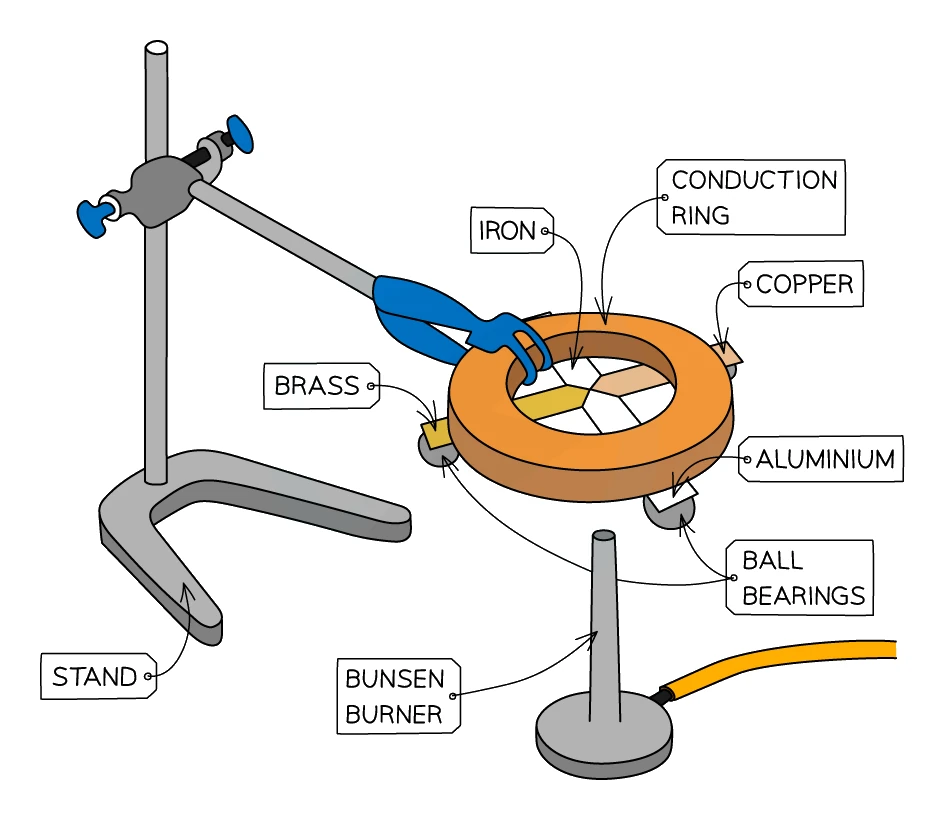
Method:
- Stick an identical small ball bearing to the cold end of each of the four rods using a small piece of wax
- Clamp the conduction wheel to a stand so the central hub sits over a Bunsen burner, with the rods spreading horizontally
- Light the burner so the central hub of all four rods receives the same heat
- Start the stopwatch the moment the flame steadies under the hub
- As the wax on each rod melts, the ball bearing drops; record the time for each rod
- Allow the rods to cool fully before repeating
Analysis:
- The shorter the time before the ball drops, the faster the conduction in that metal
- The expected ranking, fastest first, is copper → aluminium → brass → iron
- Plot a bar chart of mean time against metal to display the ranking
Experiment B: convection in water using potassium permanganate
- Aim: see a convection current set up in water by following the path of a coloured dye crystal that dissolves where the water is heated
| Equipment | Purpose |
|---|---|
| Beaker of water on a gauze and tripod | Holds the water to be heated |
| Bunsen burner, heatproof mat | Provides a localised heat source under one corner of the beaker |
| Potassium permanganate crystal | Releases a deep purple trail as it dissolves, marking the moving water |
| Forceps | Dropping the crystal in without dissolving it on your fingers |
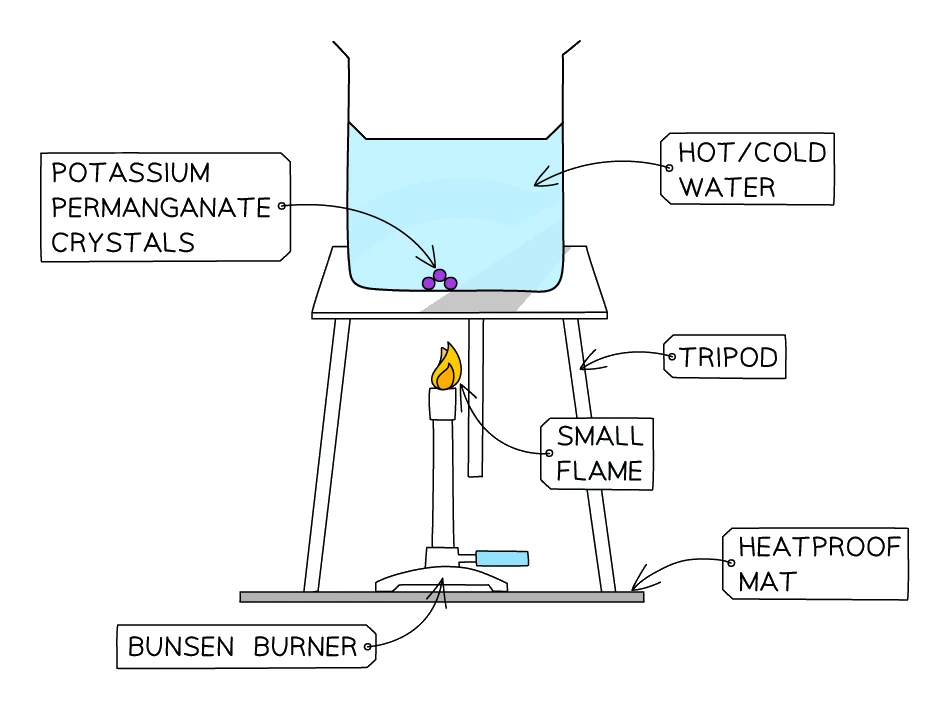
Method:
- Fill the beaker about three-quarters full with cold water and place it on the tripod above the unlit burner
- Carefully pick up a single potassium permanganate crystal with the forceps and drop it gently to the bottom of the beaker, slightly to one side rather than the centre
- Light the Bunsen burner directly below the crystal
- Observe how the purple trail moves through the water
Analysis:
- Where the crystal sits, the water heats, expands, becomes less dense, and rises, carrying the purple dye upwards in a clearly visible plume
- Cooler water from the rest of the beaker flows in to take its place, completing the convection loop
- The visible purple loop is direct evidence that bulk fluid motion (not just particle vibration) is transferring the heat
- Safety: potassium permanganate stains skin, clothing and surfaces; handle only with forceps and rinse spills immediately
Experiment C: thermal radiation from differently coloured surfaces
- Aim: compare how quickly water inside differently coloured but otherwise identical containers cools, and so investigate how surface colour affects emission of infrared radiation
- Independent variable: the colour and finish of the container (matt black, dull grey, matt white, shiny silver)
- Dependent variable: the water temperature recorded at fixed time intervals
- Control variables: identical container shape and size; identical starting volume of water; identical starting temperature; identical room temperature; identical lid arrangement
| Equipment | Purpose |
|---|---|
| Four identical metal cans or flasks painted matt black, dull grey, matt white and polished silver | The varied "surface" variable |
| Kettle of just-boiled water | Source of hot water for the cans |
| Four identical thermometers (or a data logger with four probes) | Read the water temperature in each can |
| Stopwatch | Time the readings |
| Lids with a small thermometer hole for each can | Reduce convection losses out of the top so radiation differences dominate |
Method:
- Set the four cans side by side on the bench at least an arm's length apart so they do not radiate to each other
- Fill each can from the kettle with the same volume of just-boiled water; replace the lid and slot the thermometer through the hole
- Note the starting temperature in each can (all four should match within ~1 °C)
- Take a temperature reading from each can every 30 s for 10 min
- Plot a graph of temperature (y-axis) against time (x-axis) for each can on the same axes
Analysis:
- The cans cooled fastest are the best emitters of infrared radiation
- The expected order, fastest cooling first, is matt black → dull grey → matt white → shiny silver
- All four cans lose roughly the same amount of heat by conduction (through the bench) and convection (out of the lid hole), so any difference between the cooling curves must be due to radiation differences
Sources of error and safety
- Experiment A: ensure all rods are at room temperature before starting; if one rod is still warm from a previous run, its wax will fall too quickly. Avoid handling the wax with your fingers because the heat from your hands also pre-warms the wax
- Experiment B: drop the crystal gently; agitating the beaker will create currents that look like convection but are mechanical. The room should be still
- Experiment C: read each thermometer at eye level to avoid parallax; minimise the size of the lid hole; ideally use a data logger to take all four readings simultaneously
- General safety: wear goggles when using a Bunsen burner; do not lean over hot apparatus; run any burns under cold water for at least five minutes