Energy Stores & Transfers
Energy Resources & Energy Transfers
The three modes of heat transfer
- Three distinct processes carry thermal energy from a hot region to a cold one:
- Conduction: the main heat transfer in solids; energy passes from particle to particle along the material without the particles moving overall
- Convection: the main heat transfer in fluids (liquids and gases); whole regions of hot fluid actually move from one place to another, carrying their energy with them
- Radiation: heat transfer through infrared electromagnetic waves; the only one of the three that can carry energy through a vacuum, because no medium is needed
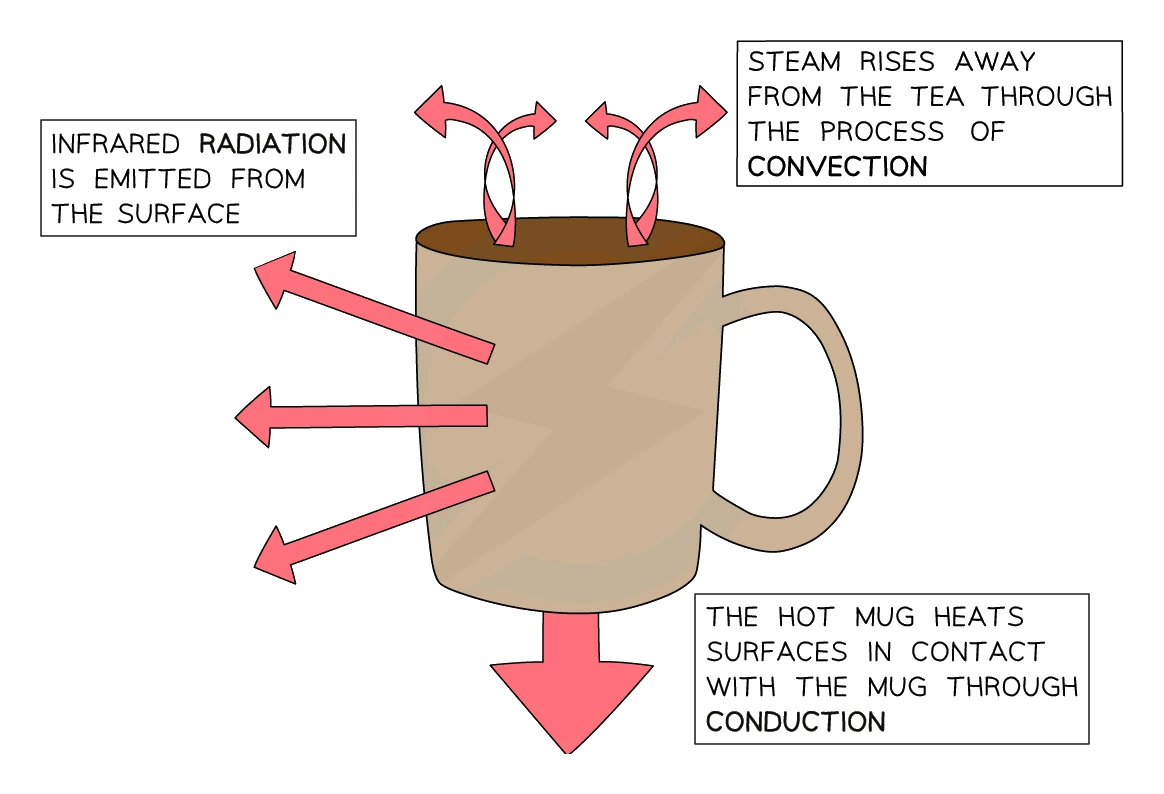
- A real-world example often uses all three at once. A hot mug of coffee: conducts into the table beneath it, sets up a convection current in the steam rising above the surface, and radiates infrared from the outside of the mug
Conduction in detail
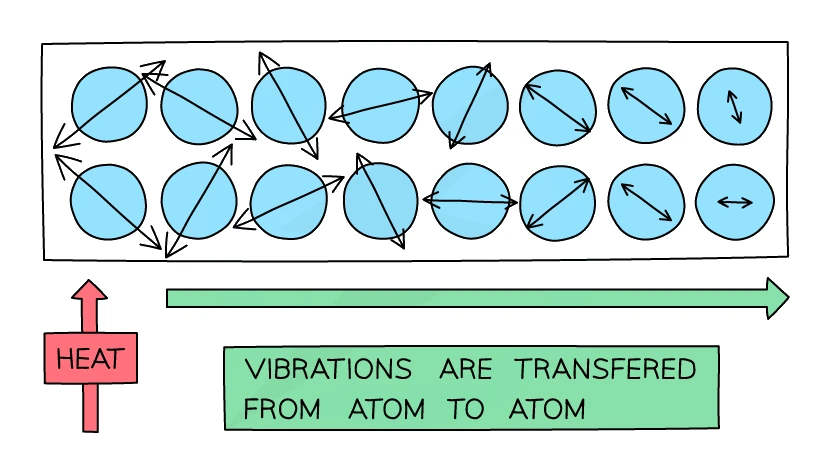
- In any solid, the particles vibrate about fixed positions; the hotter the material, the larger the vibrations
- When one end of a solid is heated, the particles at that end vibrate more strongly. They collide with neighbouring particles, passing the extra vibrational energy along the line
- Metals are especially good thermal conductors because they have delocalised electrons that drift freely through the lattice:
- the free electrons collide far more often with the vibrating ions than the ions collide with each other
- they carry energy across the metal much faster than vibration alone
- this is why a stainless-steel teaspoon left in a hot cup of tea quickly becomes too warm to hold, while a wooden stirrer of the same shape stays cool
Why insulators insulate
- A thermal insulator is a material in which conduction happens only slowly
- Common insulators include wood, plastic, rubber, glass, dry paper, and any material with lots of trapped air
- Trapped air is one of the best insulators:
- the air molecules are far apart, so very few collisions pass energy along
- if the air is trapped in pockets (within wool, fibreglass, foam, feathers), it cannot move as a convection current either, so the convection pathway is also shut down
Convection in detail
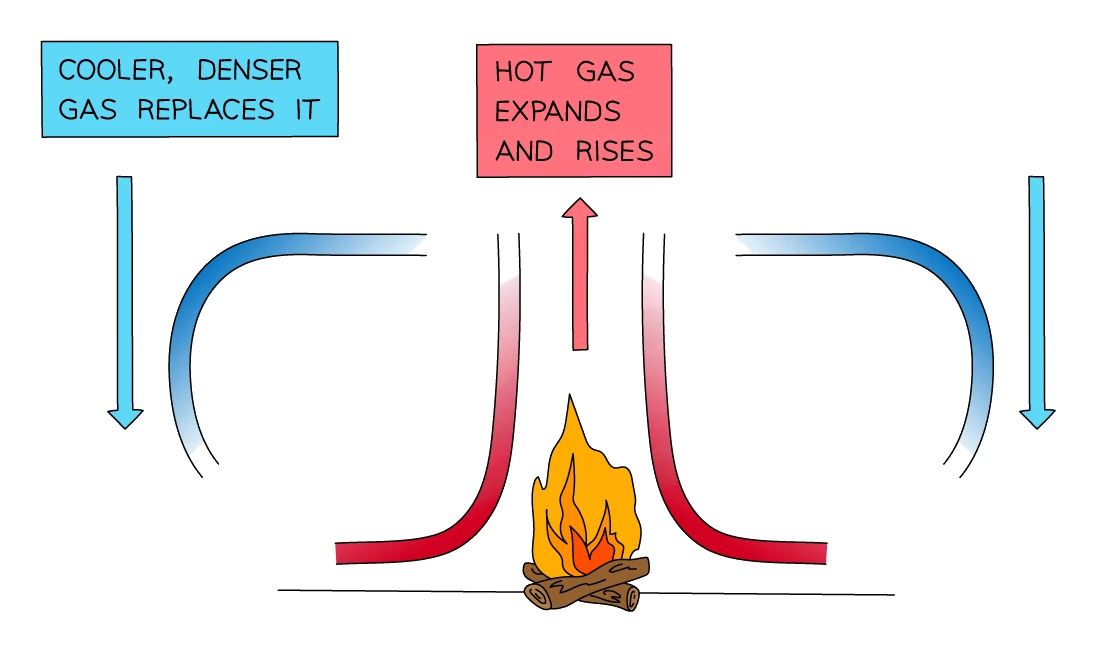
- When a region of a fluid is heated:
- the particles in that region gain kinetic energy and push each other further apart
- the fluid in that region expands and becomes less dense than the cooler fluid around it
- the less-dense hot fluid rises, while the cooler, denser fluid sinks to take its place
- The rising and sinking sets up a closed loop of moving fluid called a current
- Convection currents drive everyday heating: radiators warm rooms by setting up a current of air around the room; the sun warms the atmosphere by setting up large convection cells; ocean currents move warm and cool water around the globe
Common exam question
Explaining how a convection current forms
Question: Explain how a convection current forms in the air or water near a heater, or how convection lifts or cools something (2–4 marks).
Asked in 4 of the 24 papers. The marks are a chain of separate points, so give them in order: the fluid near the heater is heated; it expands (its particles move further apart); its density decreases; the warm, less dense fluid rises; cooler, denser fluid sinks to replace it; the process repeats. A four-mark question needs four of these and a two-mark question two, so do not stop at "hot air rises".
Say the fluid expands and becomes less dense, never the particles: "the particles expand" and "the particles become less dense" are both rejected, and "heat rises" earns nothing. For something cooling (the air above snow), the point is that warm air rises away, so the coldest air sits nearest the snow and the energy transfer to it slows.
Radiation in detail
- Every object at any temperature above absolute zero emits infrared (thermal) ; the hotter the object, the more it emits per second
- Thermal radiation is a transverse electromagnetic wave, so it carries energy through a vacuum (the way sunlight reaches Earth across 150 million km of empty space) as well as through transparent media
- The colour and finish of a surface strongly affects how well it emits and absorbs thermal radiation:
| Surface | Absorbs infrared | Emits infrared |
|---|---|---|
| Matt black | Excellent absorber | Excellent emitter |
| Dull / dark | Good absorber | Good emitter |
| Matt white | Poor absorber | Poor emitter |
| Polished, shiny silver | Very poor absorber (reflects most) | Very poor emitter |
- Practical consequences:
- solar panels and solar-heating absorbers are painted matt black to absorb as much sunlight as possible
- emergency space blankets are made of shiny silver foil to reflect a person's body-heat radiation back inwards
- houses in hot climates are often painted white to reduce both absorption from the sun and emission of heat back outwards
- vacuum flasks have silvered inner walls to cut radiation losses (alongside the vacuum that blocks conduction and convection)
Common exam question
Explaining a surface colour in terms of infrared
Question: Explain why a black surface warms up faster than a white one, or which colour a surface should be to absorb or emit the least infrared (2–4 marks).
Asked in 8 of the 24 papers. For two marks, give the property then its consequence: a black surface is a better absorber of infrared radiation than white or shiny ones, so more energy is transferred to it in the same time and it warms up faster. The reverse (white is a poor absorber or good reflector, so stays cooler) scores too. On a spinning satellite a dull black bar absorbed faster facing the Sun and emitted faster facing away (four marks), with no conduction or convection in space.
Answer the property the question targets: to keep something cool in sunlight, write white or silver as poor absorbers (or good reflectors); for the inner walls of a cold box, the scheme wanted poor emitters. Points about the other property are ignored.