Work, Power & Energy Resources
Energy Resources & Energy Transfers
Work Done
What it means to "do work"
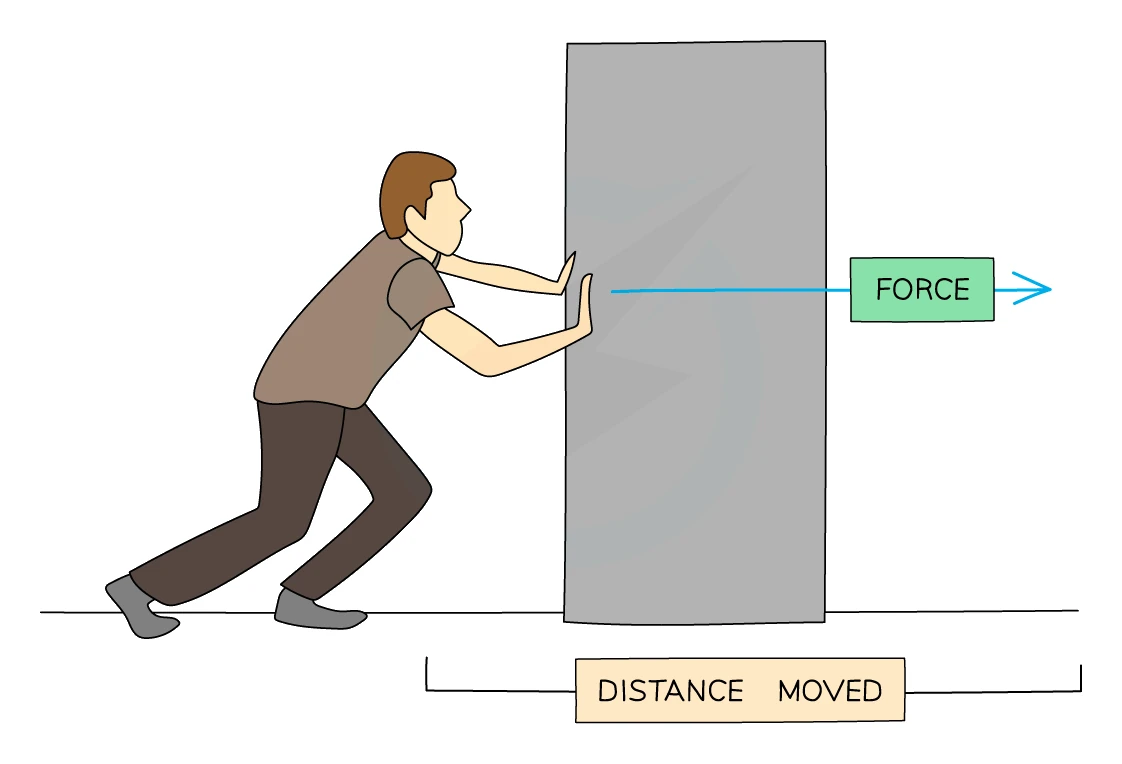
- Work is done whenever a force moves the object it is acting on through a distance in the direction of that force
- If the force does not move the object, no work has been done. Pushing on a stationary wall for ten minutes transfers no energy to the wall, no matter how tired your arms feel
- "Doing work" is just the mechanical pathway in different language. The amount of work done equals the amount of energy transferred between stores:
energy transferred = work done
- Both quantities are measured in joules (J); 1 J = 1 N m (one newton acting through one metre)
Sign of the energy transfer
- If a force acts in the same direction as the motion, the object gains energy (usually into its kinetic store, sometimes into gravitational potential if it is being lifted)
- If a force acts in the opposite direction to the motion, the object loses energy; in everyday cases this is friction or drag dissipating energy as heat into the surroundings
- Lifting a 5 kg sack of flour onto a kitchen shelf does work against gravity and fills the sack's gravitational potential store; sliding a box across a carpet does work against friction and dumps that energy into the thermal stores of the carpet and the box
The work-done equation
W = F × d
- where:
- W = work done (J or N m)
- F = force acting on the object (N)
- d = distance the object moves in the direction of the force (m)
- Use SI units throughout (newtons and metres); the result then comes out in joules
Common exam question
Calculating work done, or the force from it
Question: State the formula connecting work done, force and distance moved, then calculate the work done or the force (1 mark for the formula, 2–3 for the working).
Set in 4 of the 24 papers. The formula mark is separate and takes words or standard symbols: work done = force × distance moved, or W = F × d. The calculation is marked in steps, substitution, rearrangement when the force is the unknown, then evaluation, and a powers-of-ten slip (a kilojoule value left unconverted, a distance left in centimetres) loses one mark. One scheme gives its first mark just for turning centimetres into metres. In a "show that" part, write the unrounded value before rounding it to the target.
Work done equals energy transferred, so when a later part simply says "state the work done" after an energy has been given or found, the answer is that energy. The schemes credit the earlier value, with no calculation wanted.
Worked example
Calculating force from work done and distance
A motorised winch does 48 000 J of work pulling a crate 20 m along level ground. Calculate the force the cable exerts on the crate.
Solution:
- Write the equation: W = F × d
- Substitute: 48 000 = F × 20
- Rearrange: F = 48 000 ÷ 20
- F = 2400 N