4PH1
Work, Power & Energy Resources
Energy Resources & Energy Transfers
Definition
- Gravitational potential energy (GPE) is the energy an object holds because of its position in a gravitational field, specifically its height above some chosen reference level (usually the ground or floor)
- Lifting an object pushes energy into its gravitational store; letting an object fall pulls energy out
The GPE equation
GPE = m × g × h
- where:
- GPE = energy in the gravitational potential store (J)
- m = mass of the object (kg)
- g is the gravitational field strength of the planet (N/kg). On Earth's surface, g ≈ 10 N/kg
- h = height above the chosen reference level (m)
- g is given on the exam equation sheet; the Moon's g is about 1.6 N/kg, Jupiter's surface (where there is one) feels about 25 N/kg
Why GPE is linear in h
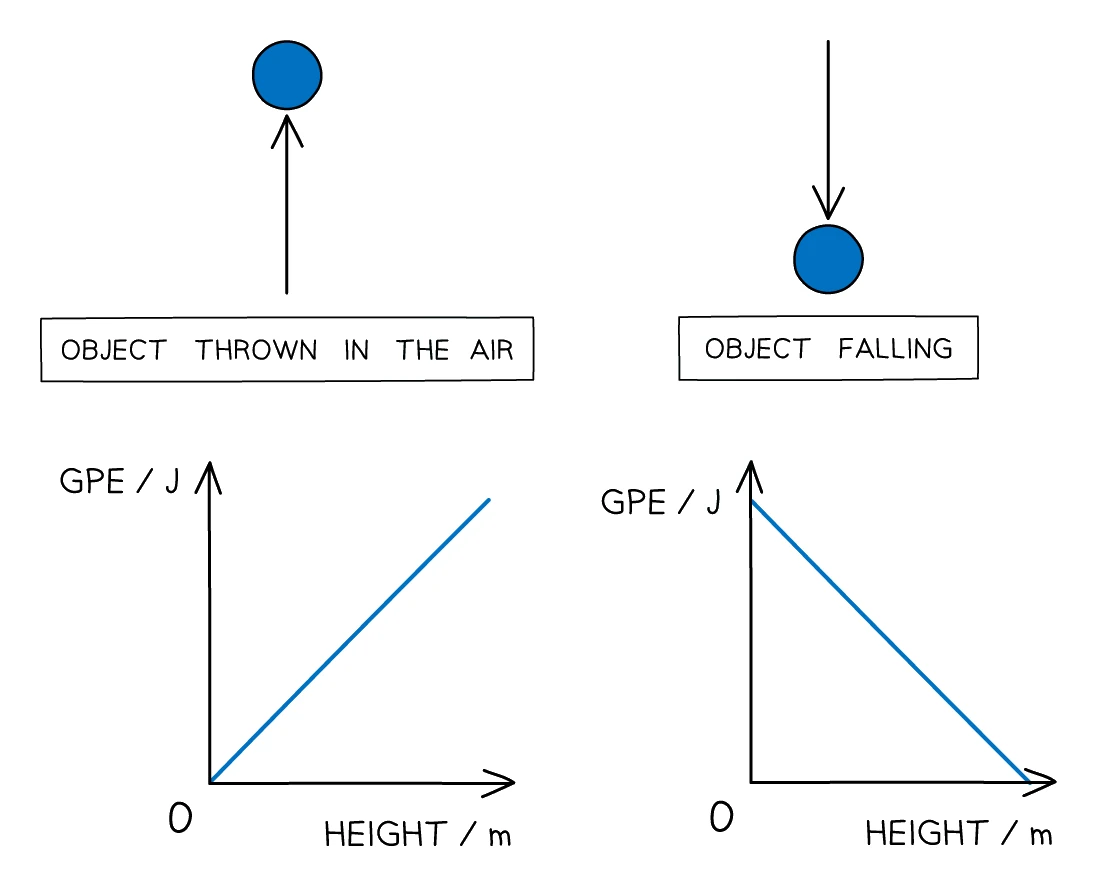
- For a fixed mass on a given planet, both m and g are constants, so the GPE rises linearly with the height h
- Doubling the height doubles the GPE; halving the height halves the GPE
- A graph of GPE against height is a straight line passing through the origin