Work, Power & Energy Resources
Energy Resources & Energy Transfers
What an energy resource is
- An energy resource is a large natural store of energy that humans can tap to do useful work, most commonly generating electricity for the National Grid or heating homes and businesses
- The Edexcel syllabus splits energy resources into two camps based on whether they can be replenished
Renewable vs non-renewable
- A energy resource is one that is replenished at least as quickly as it is being used up, so it will not run out as long as the underlying natural process keeps going
- A energy resource is one that is being used faster than it is being replenished; the stockpile is finite, so eventually it will be exhausted
| Renewable | Non-renewable |
|---|---|
| Solar (heating panels and photovoltaic cells) | Coal |
| Wind | Oil |
| Hydroelectric | Natural gas |
| Wave | Nuclear fuel (uranium, plutonium) |
| Tidal | |
| Geothermal | |
| Biofuels (from short-cycle crops) |
The shared electricity-generating chain
- Almost every large-scale electricity source uses the same final two stages: spin a turbine, which spins a generator, which produces an alternating current via electromagnetic induction (topic 18)
- What differs between resources is how the turbine is spun:
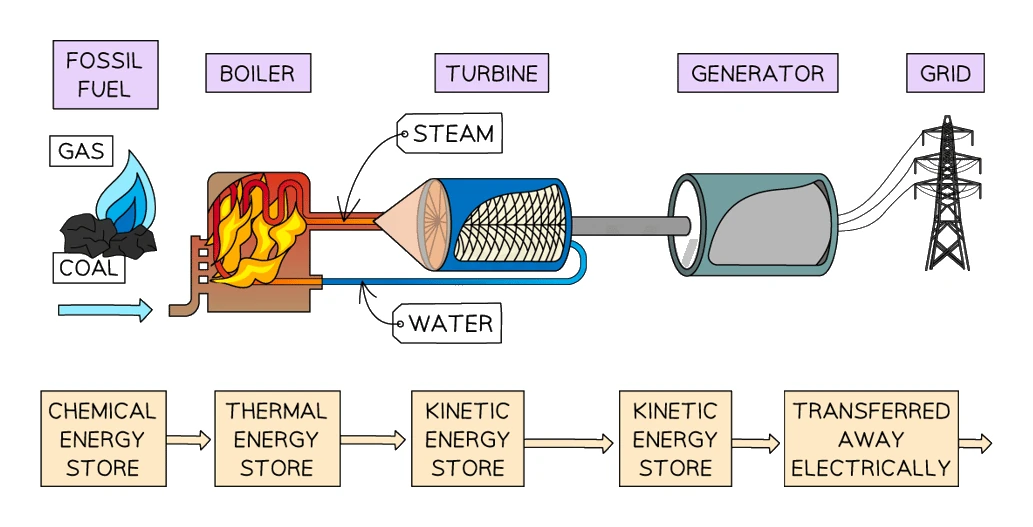
- Steam from boiling water (coal, oil, gas, nuclear, geothermal, solar thermal): chemical or nuclear or thermal store → thermal store of water → kinetic store of steam → kinetic store of turbine → kinetic store of generator → electrical output
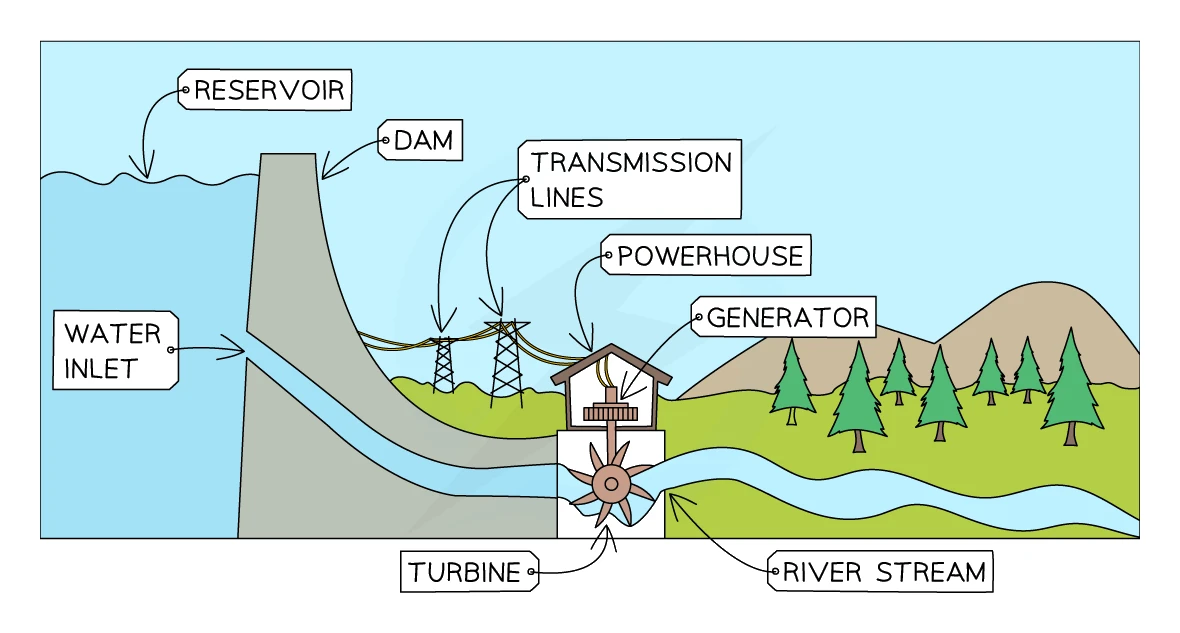
- Moving water directly (hydroelectric, tidal, wave): gravitational potential or kinetic store of water → kinetic store of turbine → kinetic store of generator → electrical output
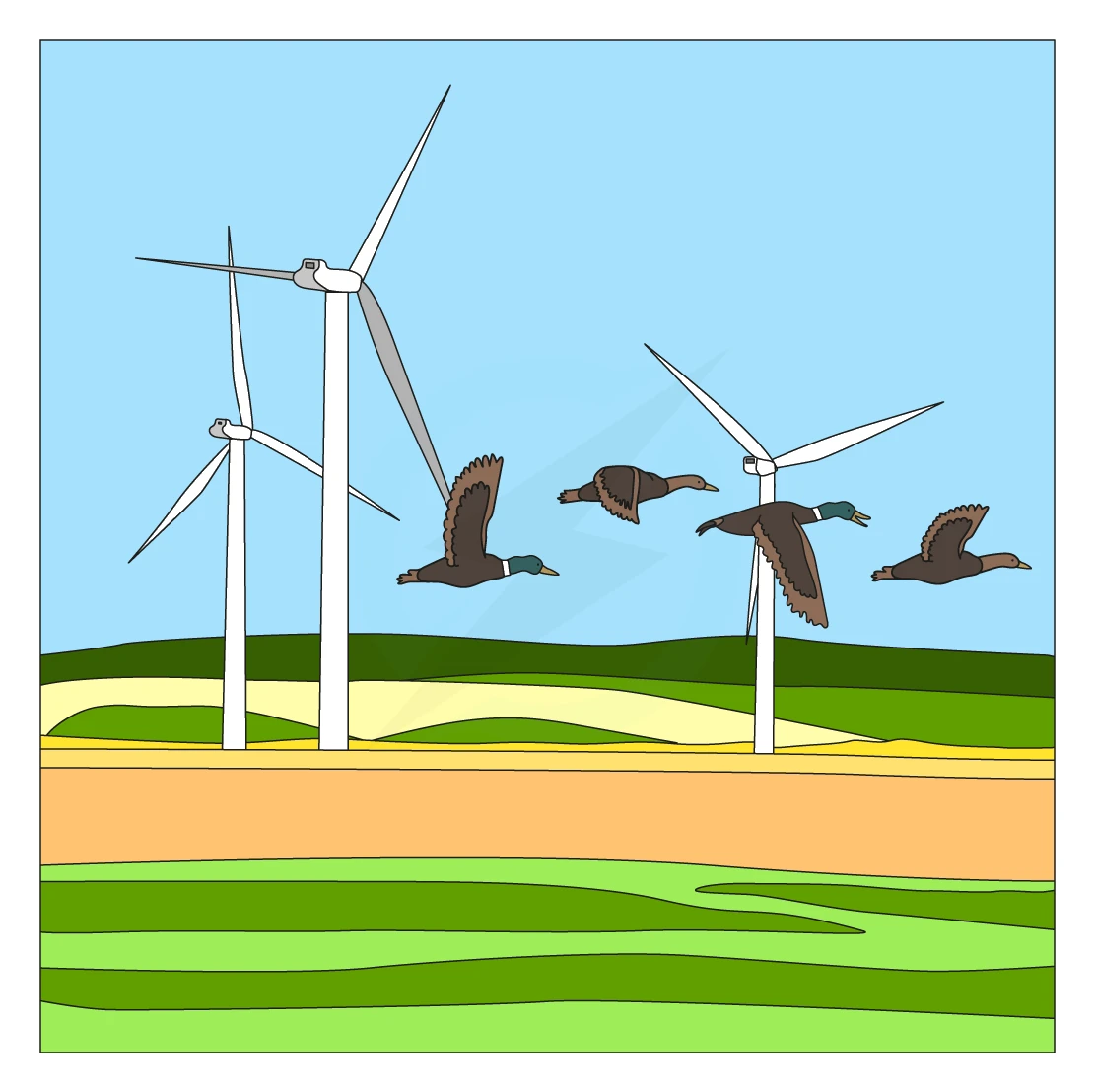
- Moving air directly (wind): kinetic store of wind → kinetic store of turbine → kinetic store of generator → electrical output
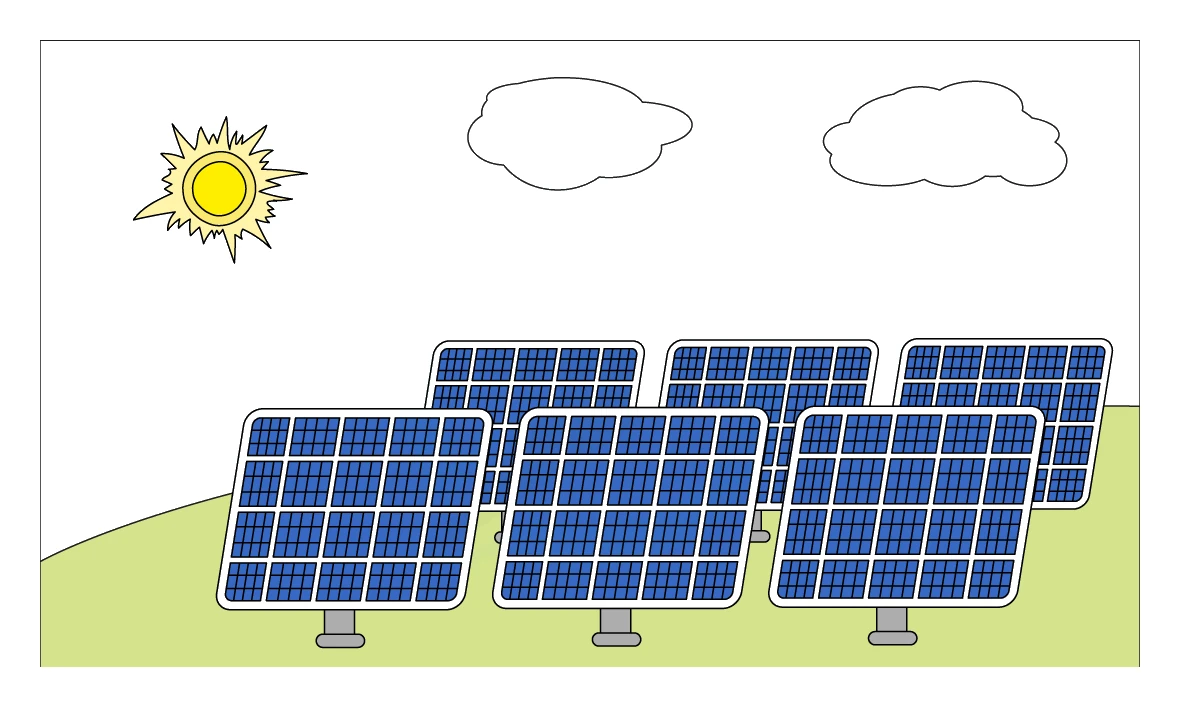
- Photovoltaic cells skip the turbine entirely: radiation from the Sun → directly into electrical output via charge release inside the cell
Resource-by-resource detail
- Wind: wind pushes the blades of large rotor towers; no boiling, no steam. Energy chain: kinetic of wind → kinetic of turbine → kinetic of generator → electrical
- Hydroelectric: water stored in a reservoir behind a dam is released and falls through a turbine in the dam wall. Energy chain: gravitational potential of water → kinetic of falling water → kinetic of turbine → kinetic of generator → electrical
- Tidal: a barrage holds back high tides and releases the water through turbines as the tide ebbs (or fills against turbines as it rises). Same energy chain as hydroelectric, but driven by the Moon's pull on the seas
- Wave: floating or hinged surface devices rock with passing waves, turning a turbine inside. Energy chain: kinetic of waves → kinetic of turbine → kinetic of generator → electrical
- Geothermal: a borehole sunk into hot rock far below the surface heats water into steam, which then drives a steam turbine. Energy chain: thermal of rocks → thermal of water → kinetic of steam → kinetic of turbine → kinetic of generator → electrical
- Solar heating panels: black-painted pipes on a roof absorb sunlight and warm water flowing through them. Energy chain: nuclear of the Sun → radiation through space → thermal of the water in the pipes. This is direct heating, not electricity
- Solar photovoltaic cells: a semiconductor wafer releases electrons when struck by sunlight, producing a direct current. Energy chain: nuclear of the Sun → radiation through space → electrical output (no turbine needed)
- Fossil fuels (coal, oil, gas): the fuel is burned to boil water into steam; the steam drives a turbine. Energy chain: chemical of fuel → thermal of water → kinetic of steam → kinetic of turbine → kinetic of generator → electrical
- Nuclear: heat from controlled fission reactions (topic 21) boils water into steam; the steam drives a turbine. Energy chain: nuclear of fuel → thermal of water → kinetic of steam → kinetic of turbine → kinetic of generator → electrical
- Biofuels: plant material (or biogas) is burned to boil water into steam; the steam drives a turbine. Energy chain: chemical of biofuel → thermal of water → kinetic of steam → kinetic of turbine → kinetic of generator → electrical
Common exam question
Describing the energy transfers in generating electricity
Question: Describe the energy transfers involved when a named resource (falling water, wind, burning gas) is used to generate electricity, or name the store that changes (1–4 marks).
Asked in 3 of the 24 papers, with a mark per stage. In a hydroelectric station, water starts with gravitational potential energy, loses it as it gains kinetic energy, it is transferred mechanically to the turbine and generator, then electrically from the generator, and some is wasted by heating the surroundings. "Turns into" or "becomes" is condoned for "transfers", but name the store at every step. For a wind turbine speeding up, the kinetic store increases; "kinetic energy of the wind to kinetic energy of the turbine" earns both marks. Once it turns at a steady speed the thermal store grows; "heat" is not a store name (rejected or ignored). Burning natural gas empties a chemical store.
Asked what renewable means? Replenished, so it will not run out.