Energy Stores & Transfers
Energy Resources & Energy Transfers
Why bother?
- Real appliances waste energy in three common ways: conduction through casings, convection currents leaving hot regions, and radiation from hot surfaces. The energy is conserved, but the wasted share costs money and adds to greenhouse-gas emissions whenever the source is fossil-fuelled
- Reducing the wasted output raises the of the system: more of the same input ends up in the useful store
Reducing conduction
- Use materials with low thermal conductivity (good thermal insulators) wherever heat needs to stay in (or out)
- Make the insulating layer thicker, because heat takes longer to conduct through a thicker barrier
- Use materials that trap pockets of air, since air is itself a very poor conductor and pockets stop convection currents from forming inside the insulator
- Everyday examples:
- double glazing sandwiches a thin layer of air or argon between two glass panes
- loft insulation made of fibreglass mats placed between the joists
- woolly jumpers and quilted jackets trap air between the fibres
Reducing convection
- Stop the fluid (usually air) from moving and you stop convection currents from forming
- Practical methods:
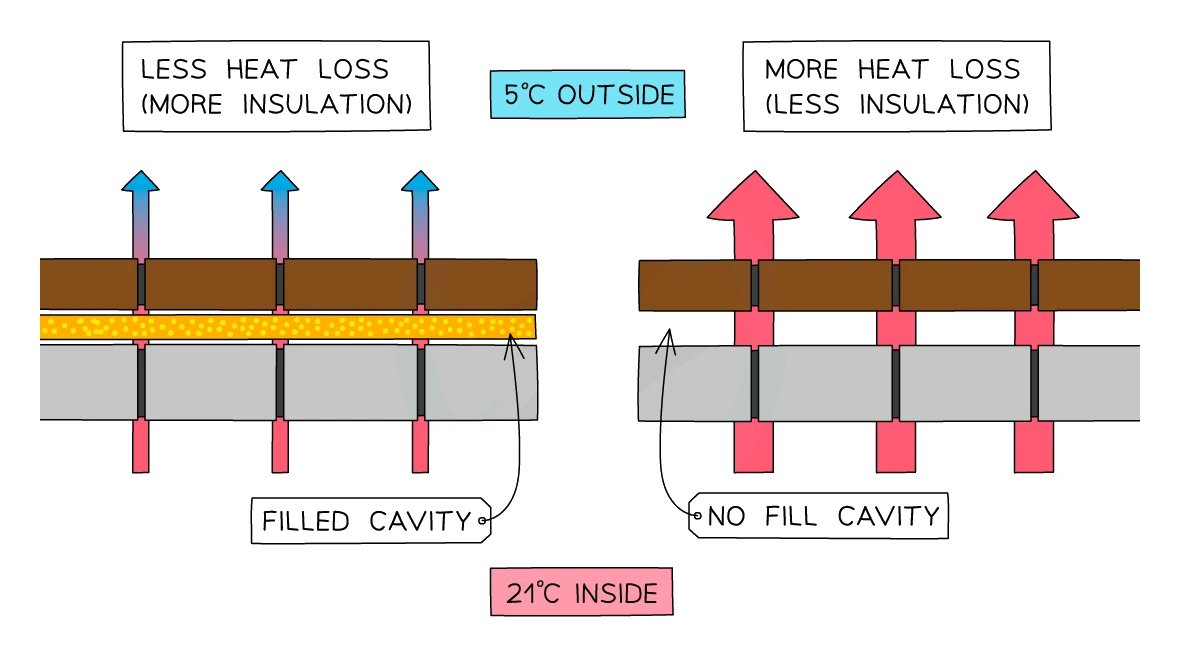
- Cavity wall insulation: foam blown into the gap between the inner and outer walls of a house traps the air that would otherwise circulate as a current
Reducing radiation
- Use surfaces that emit infrared poorly: polished, shiny silver
- Practical methods:
- The inner walls of a vacuum flask are silvered on both sides; the inner silver reflects infrared back inside, the outer silver reflects infrared from outside back out
- Foil-backed loft insulation reflects infrared from a warm room back downwards
- Emergency space blankets wrap a person in shiny silver to retain body heat in a cold environment
A vacuum flask in one sentence per pathway
- A vacuum flask combines all three tricks:
- the double-walled vacuum between the inner and outer flask stops both conduction and convection (no medium for either)
- the silvered surfaces of the inner walls stop radiation
- the insulating stopper at the top stops conduction and convection through what would otherwise be an open neck
Explaining how a design reduces energy transfer
Question: Explain how a design feature (air-filled layers, a lid, a shiny or white surface) reduces energy transfer by conduction, convection or radiation, or suggest changes to cut losses (2 marks per pathway).
Asked in 4 of the 24 papers. One physics reason per mark. Conduction: the material is a poor conductor; air is a gas with particles far apart that rarely collide; a thicker layer conducts more slowly. Convection: the air in the pockets or under the lid cannot move, so no convection current forms. Radiation: white or silver surfaces are poor emitters of infrared.
Explain the pathway named: in a conduction part "trapped air" alone was ignored by one scheme (it is the convection answer): say the air is a poor conductor. A lid on a cooling experiment cuts convection and evaporation, so less energy leaves: higher final temperature, longer cooling time. Improvements score as named changes: insulate the beaker, make the outside shiny.
Common-language traps to avoid
- "Heat rises": what actually rises is hot fluid that has become less dense. Heat itself is not a substance with a direction
- "Shiny things reflect heat": shiny surfaces reflect infrared ; they cannot reflect conduction or convection because neither bounces
- "Black things absorb heat": black surfaces absorb infrared radiation; they do not absorb conduction or convection separately
- A good exam answer almost always mentions more than one of conduction, convection and radiation