4PH1
Energy Stores & Transfers
Energy Resources & Energy Transfers
Definition
- The of a system is the fraction of the energy supplied to it that comes out in the useful form
- Stated as an equation:
efficiency = (useful energy output / total energy input) × 100 %
- Efficiency is a pure ratio and has no units; it may be given as a decimal between 0 and 1 or as a percentage between 0 and 100 %
- A high-efficiency system wastes very little; a low-efficiency system spreads most of its input into the surroundings
Useful and wasted always add to the input
- Because energy is conserved:
total energy input = useful energy output + wasted energy
- This lets you find any one of the three when the other two are known
Worked example
Calculating efficiency
A motor receives 120 J of electrical energy and transfers 90 J as useful kinetic energy. Calculate its efficiency.
Solution:
- Write the formula: efficiency = (useful energy output ÷ total energy input) × 100 %
- Substitute: efficiency = (90 ÷ 120) × 100 %
- efficiency = 0.75 × 100 % = 75 %
Sankey diagrams
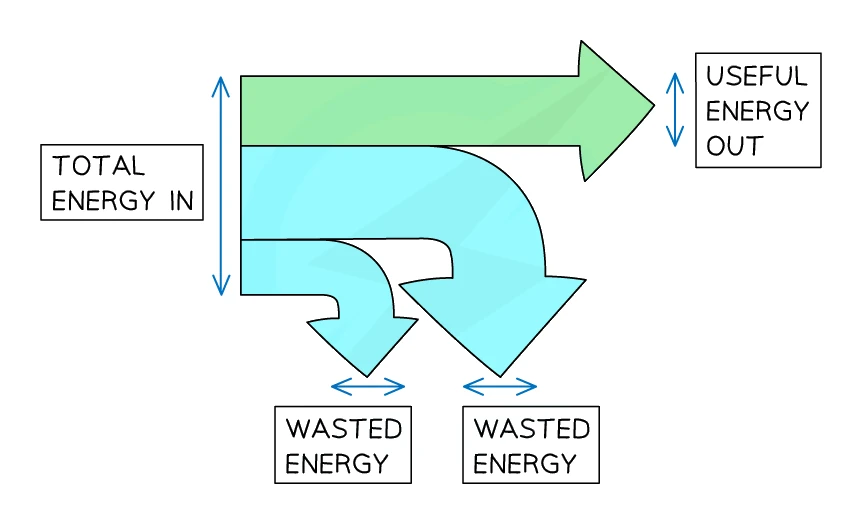
- A Sankey diagram is a visual way to show an energy transfer:
- The width of each arrow is drawn in proportion to the amount of energy it represents
- The left-hand stub is the total input
- The straight horizontal arrow on the right shows the useful output
- The arrows that branch downwards show the wasted outputs (often labelled with the loss mechanism, such as heating, sound, or friction)
- A modern LED bulb has a Sankey diagram with a wide horizontal arrow (light output) and only a thin branch (heat waste); an old filament bulb has the opposite shape, with most of the input wasted as heat