Sound
Waves
The audible range
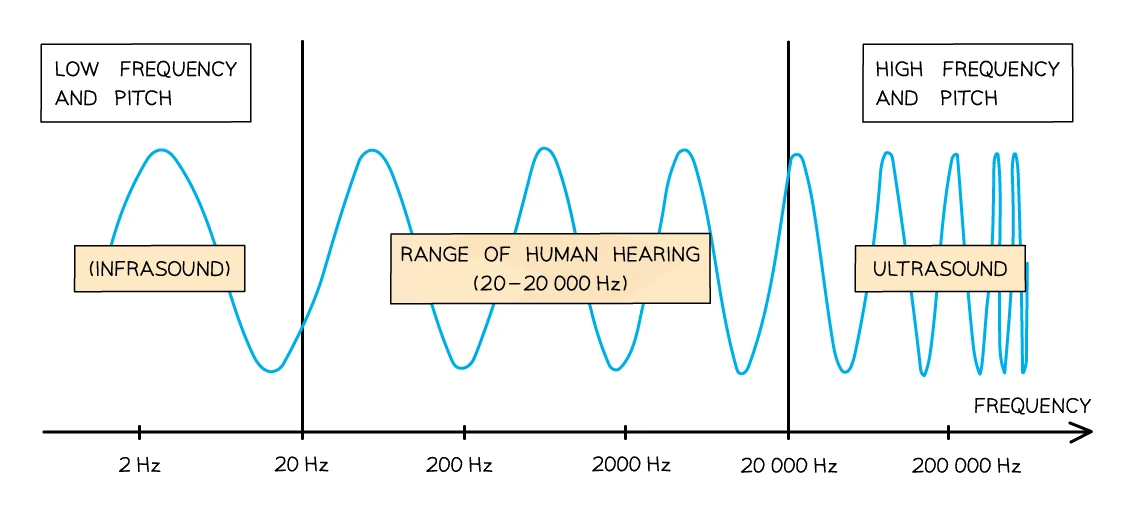
- A healthy young human ear responds to sound waves with frequencies roughly 20 Hz to 20 000 Hz (20 kHz)
- This range narrows with age; older adults often cannot hear above 12–15 kHz, while children may still hear close to the full upper limit
- Many other animals have very different ranges:
- dogs hear up to about 45 kHz (which is why high-frequency dog whistles work)
- bats hear and emit sounds up to roughly 120 kHz for echolocation
- elephants and whales can produce and detect frequencies well below 20 Hz
Common exam question
Stating the range of human hearing
Question: State the frequency range of human hearing, tick the frequencies in a table that a human can hear, or explain which bar of a chart belongs to a human (2 marks).
Asked in 3 of the 24 papers. One mark for each limit: 20 Hz and 20 000 Hz (20 kHz is accepted). Any unit must be a frequency unit matching the number; a non-frequency unit caps the answer at one mark. In a table, ticking only the middle values (500 Hz and 2000 Hz) earns one mark; the second needs 30 Hz and 10 000 Hz ticked as well, and a tick against 10 Hz or 25 000 Hz scores zero. On a bar chart of animals' maximum frequencies, the human is the bar reaching 20 kHz, because humans hear up to 20 kHz; a qualification that the upper limit falls with age or hearing loss is accepted.
Below the range: infrasound
- Infrasound is sound with a frequency below 20 Hz, too low for the human ear
- Sources of infrasound include earthquakes, volcanic activity, large explosions, and slow-rotating industrial machinery
- The body sometimes detects infrasound as a feeling of vibration in the chest rather than as a heard tone
Above the range: ultrasound
- Ultrasound is sound with a frequency above 20 000 Hz, too high for the human ear
- Common uses of ultrasound include medical scanning (prenatal scans, scans of internal organs), industrial cleaning of delicate parts, sonar in ships and submarines, and animal-distance sensors
- Ultrasound is covered in more detail in later topics
Worked example
Depth of the seabed from a sonar echo time
A sonar emitter on a boat sends out a pulse of sound. The pulse travels down to the seabed and the reflected echo is detected 0.40 s after the pulse was sent. The speed of sound in sea water is 1500 m/s. Calculate the depth of the water.
Solution:
- Total distance travelled by the pulse (there and back): d = speed × time = 1500 × 0.40 = 600 m
- The pulse travels down and back, so depth = 600 ÷ 2 = 300 m
The factor of 2 is a mark of its own. In two four-mark echo questions an answer without it was left with three marks, and in a three-mark speed-of-sound echo question using the one-way distance was left with two; halving the time instead of the distance is accepted.