4PH1
Sound
Waves
Core Practical: Investigating the Speed of Sound
Aim
- Measure the speed of sound in air using two different methods, and compare their accuracy
- The accepted value for the speed of sound in air at ordinary room temperature is about 340 m/s
Method 1: direct timing over a long distance
- Independent variable: the distance d between the source and the listener (m)
- Dependent variable: the time t taken for the sound to travel from source to listener (s)
- Control variables: the same location with no large reflecting walls nearby; the same person doing the clapping; the same person operating the stopwatch
| Equipment | Purpose | Resolution |
|---|---|---|
| Trundle wheel (or 30 m tape measure) | Mark out the distance between source and listener | 0.01 m |
| Two wooden blocks | Snapped together to produce a sharp click | — |
| Stopwatch | Measure the time between seeing the blocks meet and hearing the sound | 0.01 s |
Method:
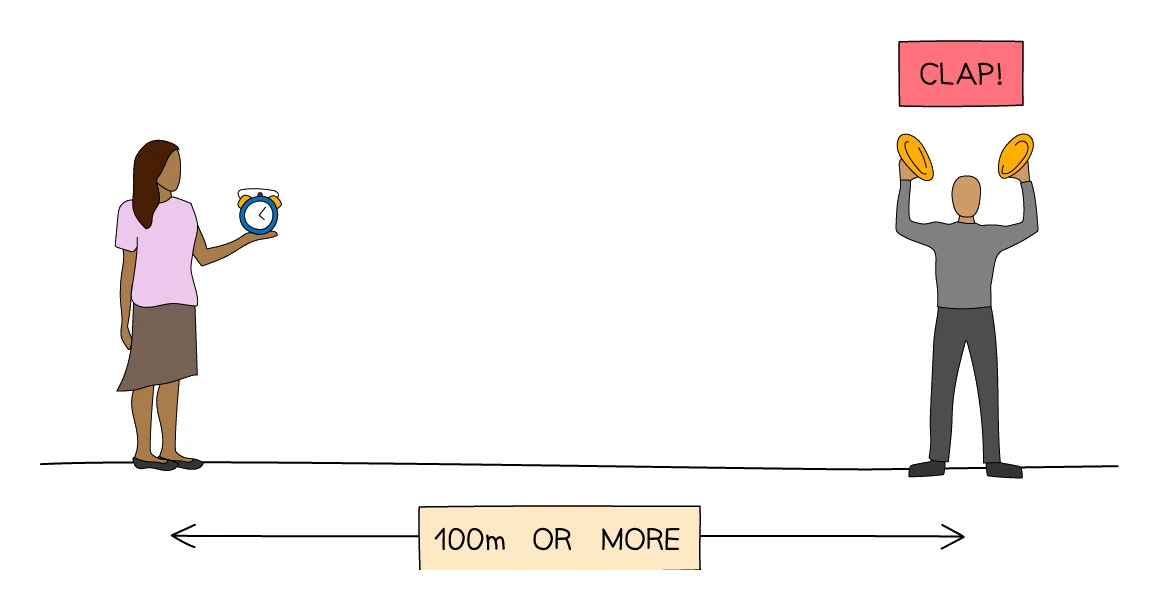
- On open, flat ground with no large walls behind either person, mark out a measured distance (start with about 80 m) between the signaller and the timekeeper
- The signaller raises the two wooden blocks above their head and strikes them together to make a sharp click
- The timekeeper starts the stopwatch the instant they see the blocks meet (light covers 80 m in well under a microsecond, so the sight is effectively immediate) and stops it the moment they hear the click
- Record the time, then repeat the measurement at least three times at the same distance; take the mean
- Move the signaller and timekeeper further apart and repeat the whole procedure for distances of around 110 m, 140 m, 170 m and 200 m
Analysis:
- Calculate the speed of sound from the well-known equation:
speed of sound = distance / mean time
- Compare each distance's result with the accepted value of 340 m/s
Sources of error:
- The main source of inaccuracy is human reaction time, which can be as large as 0.2 s. For sound covering 80 m the travel time is only about 0.24 s, so the reaction time is a serious fraction of the result. Lengthening the distance to 200 m more than doubles the travel time and pushes the reaction error down to a smaller proportion of the total
Method 2: oscilloscope and two microphones
- This method removes the reaction-time error by letting the oscilloscope do the timing
- Independent variable: the distance between the two microphones (m)
- Dependent variable: the time delay between the two pulses on the oscilloscope screen (s)
- Control variables: the same two microphones, the same oscilloscope settings, the same clap-source position
| Equipment | Purpose |
|---|---|
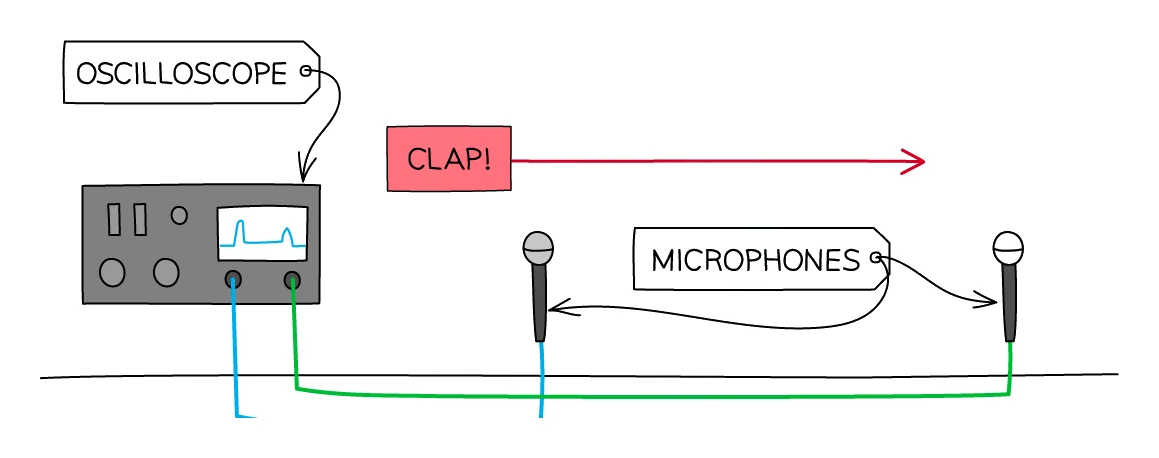
| Two identical microphones | Detect the sound at the two ends of the measured distance |
| Oscilloscope (two-channel) | Display both microphone signals against a shared time base |
| Tape measure | Measure the distance between the two microphones |
| Two wooden blocks | Produce the clap |
Method:
- Connect microphone 1 to channel 1 of the oscilloscope and microphone 2 to channel 2
- Place the two microphones in a straight line, starting about 1.2 m apart on a level surface; measure the separation with the tape
- Set the oscilloscope to trigger from channel 1 and adjust the time base until a single short clap can be seen on both channels with the second pulse a clear distance to the right of the first
- Stand close to microphone 1 (so the time delay starts from a known position) and clap the wooden blocks once
- Freeze the trace, then read off the time gap between the two pulses from the oscilloscope's time base
- Repeat steps 3–5 a further two times at the same separation and take the mean
- Increase the microphone separation to about 1.7, 2.2, 2.7 and 3.2 m and repeat
Analysis:
- For each separation, calculate the speed of sound from:
speed of sound = microphone separation / mean time delay
- Results should cluster around 340 m/s