Reflection & Refraction
Waves
When refraction stops working
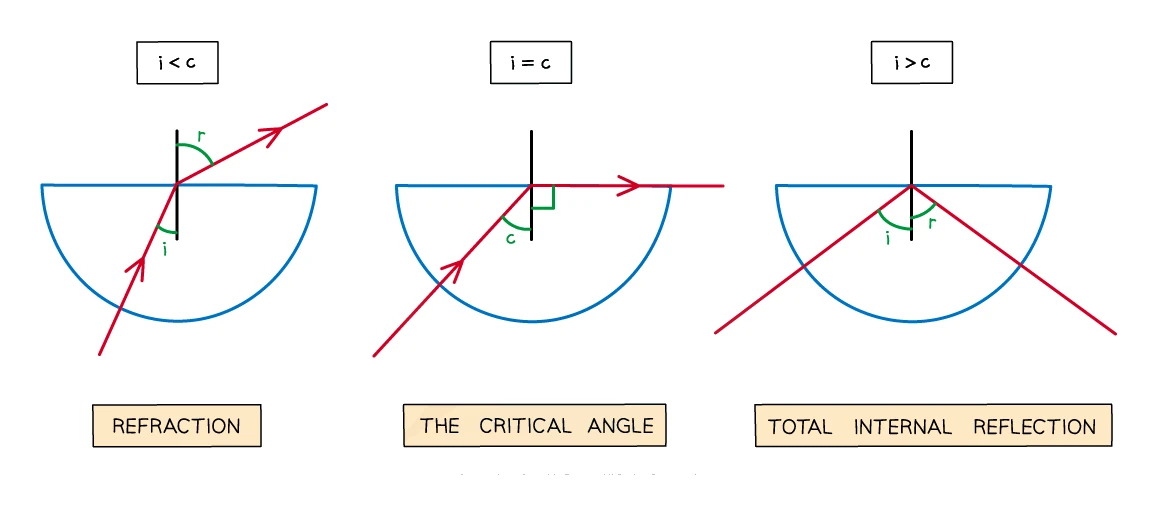
- As the angle of incidence inside a dense medium is gradually increased, the angle of refraction in the surrounding less-dense medium also increases, but it grows faster than i, because the ray is bending away from the normal as it leaves
- Eventually, at one particular incident angle, the refracted ray bends right round to lie flat along the boundary (refraction angle = 90°). This incident angle is called the , c
- Any incident angle larger than the critical angle can no longer produce a refracted ray at all; all the light is instead reflected back inside the dense medium
Definition
- Total internal reflection (TIR) is the complete reflection of a wave back into its original medium when:
- the ray is travelling from a denser medium into a less dense one (so refraction would bend it away from the normal), and
- the angle of incidence is greater than the critical angle
- Both conditions are needed; if the light is travelling from less dense to denser, no critical angle exists
Common exam question
Explaining total internal reflection
Question: Explain the path of the ray along an optical fibre or at the inner face of a block, state what happens to a ray that meets the boundary beyond the critical angle, or describe what total internal reflection means (1–3 marks).
Asked in 5 of the 24 papers. Three ideas earn the marks: name total internal reflection ("TIR" is accepted), meaning all the light is reflected back inside the medium rather than refracted out; the light is going from a higher refractive index into a lower one (more to less optically dense, or "the core is denser than the air", is accepted); and the angle of incidence exceeds the critical angle. A three-mark version wants all three, a two-mark version drops the density point, and the one-mark "state what happens" wants the name or the angle condition. One paper asked for two uses: optical fibres and a prism application such as a periscope, binoculars or a cat's eye reflector.
Critical angle and refractive index
sin c = 1 / n
- Rearranges to:
- c = sin⁻¹(1 / n)
- n = 1 / sin c
- A consequence: the larger the refractive index, the smaller the critical angle, and the more easily light gets trapped by TIR. This is exactly why cut diamonds (n = 2.42) sparkle so brightly; most rays striking the diamond's back surfaces have angles bigger than the critical angle and bounce repeatedly inside the gem before emerging
Worked example
Calculating the critical angle from the refractive index
A block of glass has a refractive index of 1.45. Calculate its critical angle.
Solution:
- Write the formula: sin c = 1 / n
- Substitute: sin c = 1 ÷ 1.45 = 0.6897
- Take the inverse sine: c = sin⁻¹(0.6897) = 43.6°
This calculation is set in 4 of the 24 papers, usually after a one-mark part asking for the formula, where a word version or any correct rearrangement scores. The marks are for the substitution or rearrangement and for the evaluation, with a third in one paper for using the formula; a refractive index found in an earlier part is followed through. Give the angle to the nearest degree or to one decimal place; the schemes accept either.
Useful applications of TIR
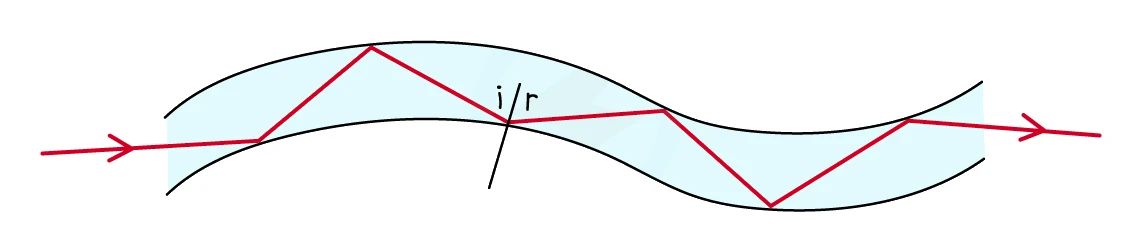
- Optical fibres:
- A long, thin core of high-refractive-index glass (or plastic) is surrounded by a slightly lower-index outer cladding
- Light injected at one end of the fibre keeps striking the core–cladding boundary at angles bigger than the critical angle, so it total-internal-reflects along the entire length, even round bends
- Applications:
- telecommunications: fibre-optic cables carry the world's internet traffic at near-light speed, using infrared pulses
- medical endoscopes: a flexible bundle of fibres carries an image of the inside of a patient's body out through a small incision
- decorative lighting: fibre lamps glow at the tip from a light source at the base
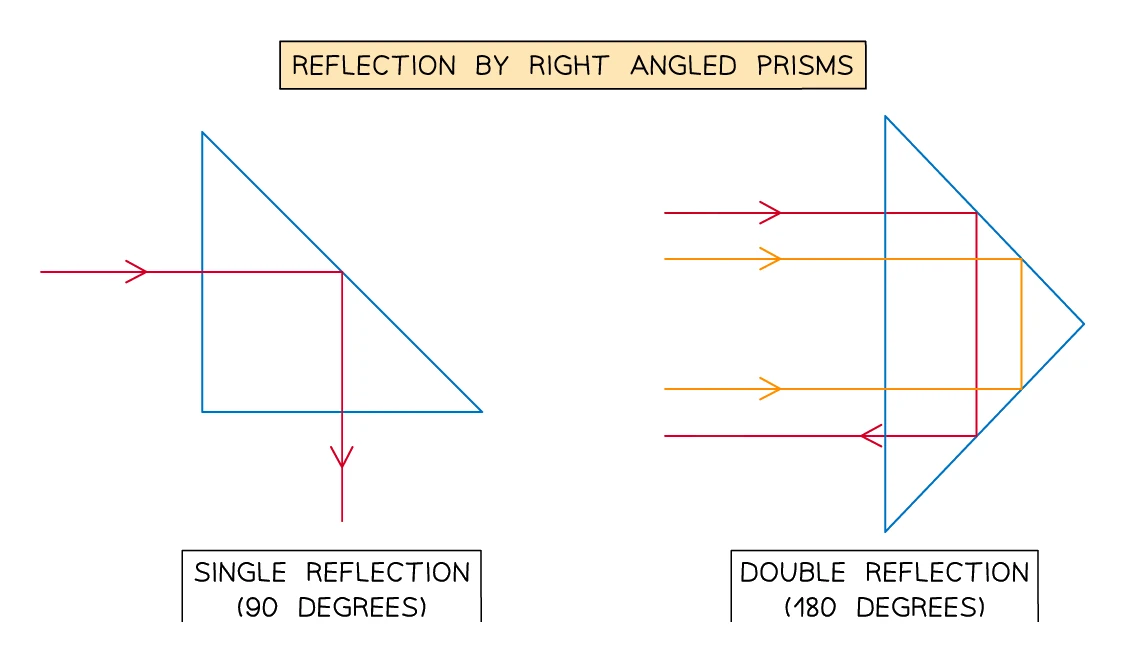
- Right-angled prisms:
- A right-angled prism cut from glass has a critical angle of about 42°; a ray striking its long face at 45° therefore undergoes TIR
- Applications:
- periscopes: a vertical tube with a right-angled prism at the top and another at the bottom turns light through 90° twice, letting a viewer below see what is above the obstruction
- binoculars and telescopes: internal prisms fold the light path so the instrument can be made short and still have a long total path
- bicycle and road safety reflectors: built from tiny corner-cube prisms that bounce headlight light straight back to the source