4PH1
Reflection & Refraction
Waves · 1 question type
Aim
- Measure pairs of angles of incidence and refraction as light passes from air into a rectangular block, plot a graph of sin i against sin r, and use the gradient to find the of the block
- The same investigation can be carried out with other shapes: a semi-circular block lets the ray enter through the curved face along a radius so it meets the flat face along the normal, which is useful for studying refraction and total internal reflection at the flat side, while a triangular prism shows how the ray refracts towards the normal on entry and away on exit, bending the same way at both faces and spreading white light into a spectrum
Variables
- Independent variable: angle of incidence, i (degrees), set by rotating the incoming ray
- Dependent variable: angle of refraction, r (degrees), read off the paper after tracing the ray
- Control variables: the same block (same material, same shape, same orientation); the same narrow beam from the ray box; the same room lighting
Apparatus
| Equipment | Purpose | Resolution |
|---|---|---|
| Ray box with single-slit attachment | Provides a thin, well-defined beam of light | — |
| Rectangular perspex (or glass) block | The material whose refractive index is being measured | — |
| Plain white A3 paper | Provides a flat working surface on which to trace rays | — |
| Sharp pencil and 30 cm ruler | Mark and join the points along each ray | 1 mm |
| Protractor (preferably 360°) | Measures i and r | 1° |
| Set square | Helps draw the normal exactly at 90° to the block's edge | — |
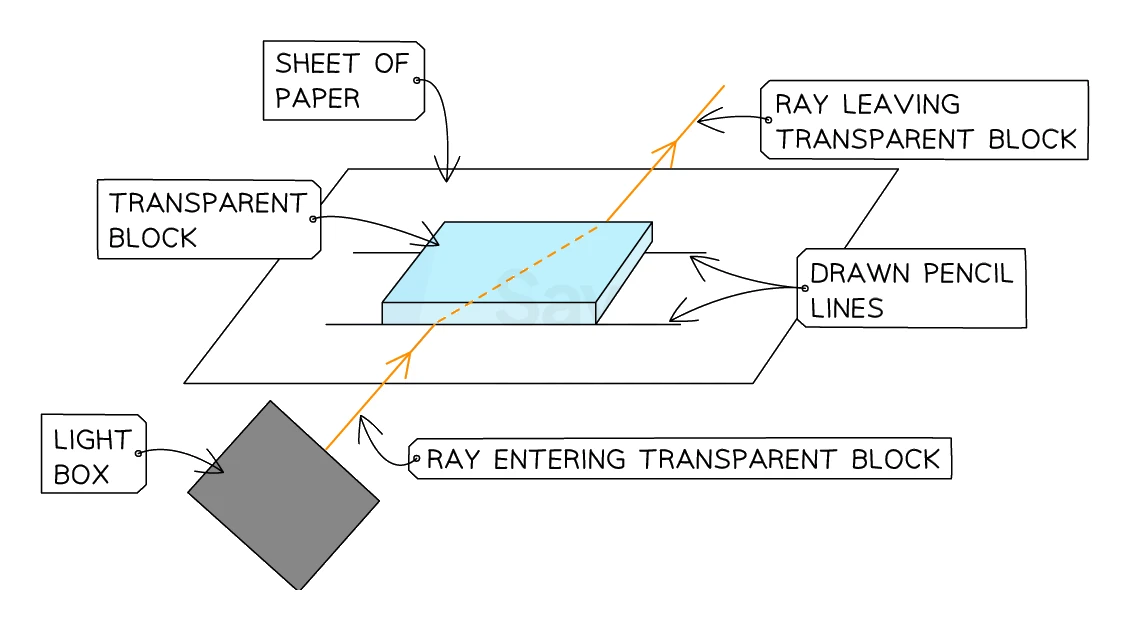
Method
- Lay the paper flat and draw round the outline of the rectangular block with a sharp pencil
- At a chosen point on the long edge of the outline, use the set square to draw a dashed line perpendicular to that edge, extending well into the air outside the outline
- Replace the block exactly within its outline, turn on the ray box, and angle the beam so that it meets the chosen entry point at a sensible angle (begin near i ≈ 20°)
- With the block still in place, mark four pencil dots:
- one along the incident beam, about 5 cm before it reaches the block
- one where the beam enters the block
- one where the beam exits the far side of the block
- one along the emergent beam, about 5 cm beyond the exit point
- Turn the ray box off, remove the block, and use a ruler to join the four dots with two straight lines: the incident ray and the emergent ray (and where they intersect the outline)
- With the protractor, measure the angle of incidence i and the angle of refraction r (the angle the ray makes with the normal inside the block)
- Repeat steps 3–6 for at least six more angles of incidence (sensible values are 25°, 35°, 45°, 55°, 65° and 75°), using a fresh sheet of paper or a clean part of the same sheet each time
Analysis
- For every pair, calculate sin i and sin r on the calculator
- Plot sin i (y-axis) against sin r (x-axis); draw the best straight line through the points and through the origin
- The gradient of the line equals the refractive index of the block:
gradient = sin i / sin r = n
- A reasonable result for perspex is n ≈ 1.49; for crown glass n ≈ 1.50
Sources of error and safety
- Systematic errors:
- the normal not drawn exactly at 90° to the surface (use the set square, not the protractor)
- the ray box positioned slightly above or below the paper, so its beam is at an angle to the surface; keep the ray box level with the paper
- Random errors:
- the beam fades and broadens with distance, so mark each ray near to its endpoints so the dot is in the middle of the visible line
- the protractor only reads to the nearest degree, so repeat each angle three times and average
- Safety:
- the ray box lamp gets hot, so do not touch the front bulb or aperture
- do not stare into the beam, even via a reflection from the block