Reflection & Refraction
Waves
The refractive index
- The (n) of a material is the ratio of the speed of light in a vacuum to the speed of light in the material:
n = (speed of light in a vacuum) / (speed of light in the medium)
- A few key facts about n:
- Light always travels slower in matter than in a vacuum, so n is always greater than 1
- The higher the refractive index, the slower light moves through the material and the more the ray bends when it enters
- Refractive index is a ratio of two speeds, so it has no units
- Typical values for common materials:
- air ≈ 1.00 (effectively the same as vacuum)
- water ≈ 1.33
- perspex / acrylic ≈ 1.49
- crown glass ≈ 1.50
- diamond ≈ 2.42 (one of the largest of any everyday material, which is why cut diamonds sparkle so brightly)
Common exam question
Comparing how two colours refract
Question: Given that glass has a higher refractive index for blue, violet or green light than for red, draw or explain what happens to the other colour's path, or deduce how refractive index depends on wavelength (3 marks).
Asked in 3 of the 24 papers. The colour with the higher refractive index bends more, so it has the smaller angle of refraction on entering the glass. The deduce version's three marks: red refracts less than violet, so red has the lower refractive index, and since red has the longer wavelength, refractive index decreases as wavelength increases. Drawing marks go to a ray with a smaller angle of refraction than the red ray inside the block, bending away from the normal on the way out and leaving parallel to the red ray. When two rays crossed after a block, swapping green for red moved the crossing point further away, because red bends less at each face; "less refraction" was condoned.
Snell's law
n = sin i / sin r
- where:
- n = refractive index of the second medium (taking the first medium as air, where n ≈ 1)
- i = angle of incidence in air (measured from the normal)
- r = angle of refraction in the denser medium (measured from the normal)
- Important details:
- sin i / sin r is not the same as i / r; never just cancel the "sin"
- When solving for r, find sin r first, then take sin⁻¹ to get the angle
Common exam question
Stating and using the refractive index formula
Question: State the equation linking refractive index to the angles of incidence and refraction, then use it to find the refractive index from two angles, or an angle from the index (1 mark, then 2–3 marks).
Asked in 8 of the 24 papers. The equation mark is for n = sin i / sin r in symbols or words; any correct rearrangement scores, and one scheme rejects n = i / r. The calculation gives one mark for substitution and one for evaluation; a three-mark version also credits writing the two sines as decimals. Angles you measured earlier are followed through, so a slightly different reading loses nothing here.
Dividing the angles themselves is rejected. Give a "show that" answer to more significant figures than printed; when two are asked for, that rounding is a separate mark. Round, never truncate: 1.35 written as 1.3 lost the evaluation mark. One scheme gives full credit to a correct answer with no working.
Worked example
Using n = sin i / sin r
Light passes from air into glass of refractive index 1.5, meeting the surface at an angle of incidence of 30°. Calculate the angle of refraction.
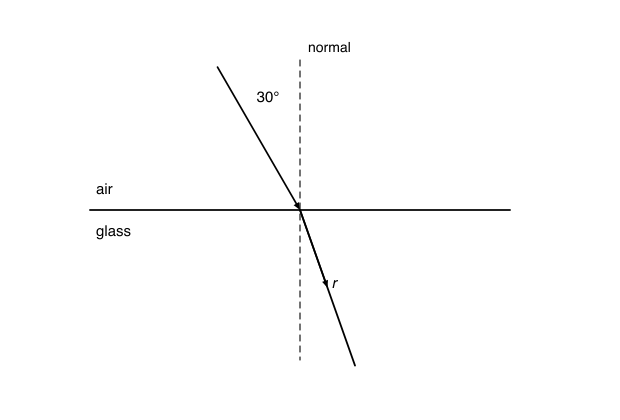
Solution:
- Rearrange n = sin i / sin r to make sin r the subject: sin r = sin i ÷ n
- Substitute, taking the sine of the angle first: sin r = sin 30° ÷ 1.5 = 0.5 ÷ 1.5 = 0.333
- Take the inverse sine to find the angle: r = sin⁻¹(0.333) = 19.5°
Take the sine of each angle before dividing: the schemes reject dividing the angles themselves, so 30 ÷ 1.5 = 20° is wrong. Never treat "sin" as a multiplier that can be cancelled.
Example — a light ray enters a water tank from air. The angle of refraction inside the water is 22°. The refractive index of the water is 1.33. Calculate the angle of incidence.
- Rearrange Snell's law: sin i = n × sin r
- sin i = 1.33 × sin 22° = 1.33 × 0.3746 = 0.4982
- i = sin⁻¹(0.4982) = 29.9°