Reflection & Refraction
Waves
Definitions
- Reflection is what happens when a wave hits the boundary between two media and bounces back into the original medium without crossing the boundary
- Refraction is what happens when a wave passes through a boundary between two transparent media and changes direction as it does so
- The word medium (plural media) means any material that transmits the wave, such as air, glass, water, or perspex
The normal line
- Every ray diagram for reflection or refraction is measured from an imaginary line drawn at 90° to the surface at the exact point the ray hits; this line is called the
- Angles are measured between the ray and the normal, not between the ray and the surface itself
Common exam question
Measuring an angle of incidence or refraction on a diagram
Question: Use a protractor to measure the angle of incidence, the angle of refraction, or both, on the printed ray diagram (1 mark per angle).
Asked in 9 of the 24 papers. Measure between the ray and the normal, never between the ray and the surface, and give a whole number of degrees. The schemes accept a reading within one or two degrees of the true angle, so careful placement of the protractor is all the mark needs. In three papers a one-mark part first asks you to name the instrument: a protractor.
Your reading is then carried into the refractive index calculation by follow-through, so an angle that is slightly out costs this one mark only. In one paper the angle had to be labelled first: marking it between the ray and the mirror lost that mark, although the measurement of the wrongly chosen angle was still followed through.
Law of reflection
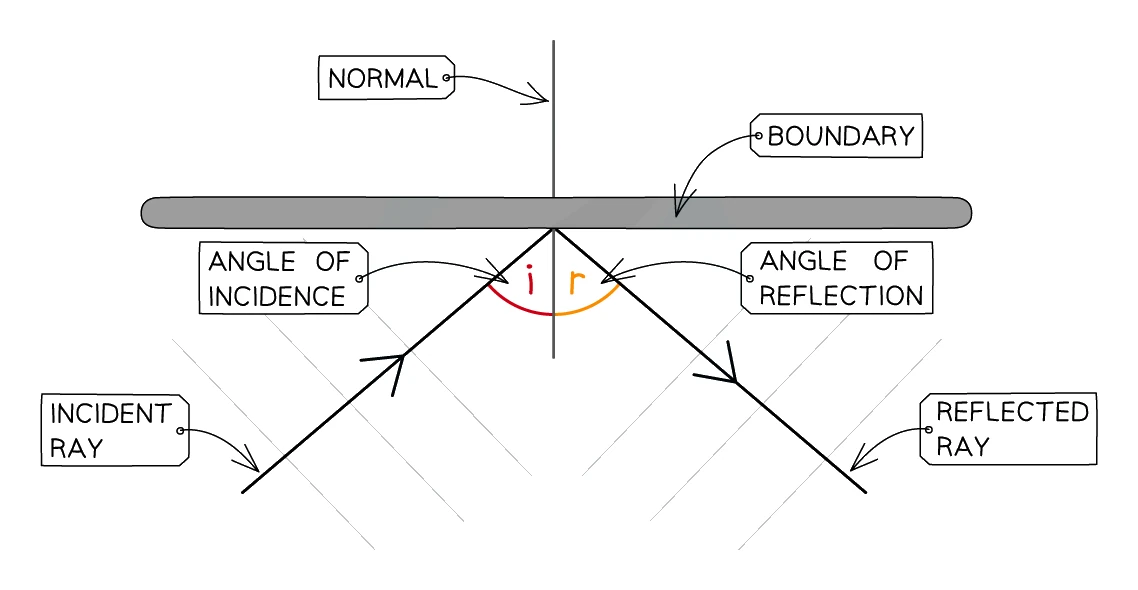
- The states:
angle of incidence (i) = angle of reflection (r)
- where:
- angle of incidence is the angle between the incoming (incident) ray and the normal
- angle of reflection is the angle between the outgoing (reflected) ray and the normal
- On a flat mirror, every ray reflects neatly, which is and produces a clear image. On a rough surface every tiny patch tilts a different way, so reflected rays scatter, which is and produces no image
Common exam question
Drawing the reflected ray or reflected wavefronts
Question: Draw the normal and the reflected ray where a ray meets a mirror or block, or complete a diagram with the wavefronts after reflection (1–3 marks).
Asked in 7 of the 24 papers, once as multiple choice. Rule the normal at 90° to the surface where the ray arrives, even on a curved mirror (not a tangent). The reflected ray starts at the same point, on the other side of the normal, at an angle judged by eye to equal the angle of incidence: one mark for a ray from the point of incidence on the correct side, one for the correct angle. A ray that carries on into the mirror is rejected; dotted or arrowless lines are accepted.
For wavefronts, draw the reflected direction first, then rule the wavefronts at right angles to it, parallel and with the same spacing as the incident ones. One scheme awards the perpendicular and spacing marks only after the direction mark.
Refraction: which way the bend goes
- When a light ray crosses from one transparent medium to another, its speed changes, and that speed change forces the ray to change direction
- The bend depends on which way the speed is changing:
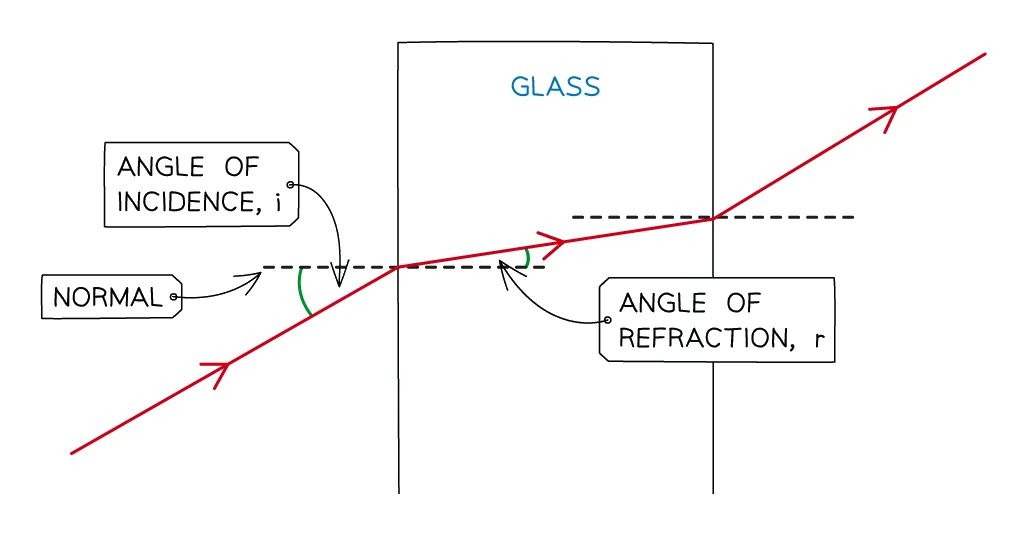
- Entering an optically denser medium (for example, air into glass): the ray slows and tilts towards the normal
- Leaving a denser medium for a thinner one (for example, glass back into air): the ray speeds up and tilts away from the normal
- A ray that strikes the surface along the (perpendicular, 0°) keeps going straight; only its speed changes, never its direction
Common exam question
Completing the path of a ray through a block or prism
Question: Complete the path of the ray as it enters, crosses or leaves a glass block, prism or optical fibre, or draw the ray in air before it reached the boundary (1–3 marks).
Asked in 5 of the 24 papers. The marks are for the direction of each bend, judged by eye: towards the normal going from air into glass, away from the normal coming out, and for a rectangular block the emerging ray parallel to the incoming one. Where a ray leaves a block or prism, one mark is simply for a ray that emerges into the air and the second for it bending away from the normal, so draw the emergent ray even if the angle is uncertain. Dashed lines are allowed, arrows are not required, and any reflected ray you add is ignored. In a six-mark explanation of two rays meeting water, a ray drawn bending the wrong way capped the drawing marks at one.
What changes and what does not
- During refraction, two wave properties change and one stays the same:
- Speed changes (slows in denser medium, speeds up in less dense one)
- Wavelength changes in step with the speed (using v = f × λ)
- Frequency stays the same, because the source still emits the same number of crests per second, so the same number must arrive in the new medium. A red ray of light staying red when it dives into water is the everyday evidence of this
Exam tip
Explaining refraction: say what happens to the speed
When asked why a ray or wave bends at a boundary, or why its wavelength changes, you need more than the direction: the two media have different optical densities, the wave travels more slowly in the denser one, its frequency is unchanged, so by speed = frequency × wavelength the wavelength is shorter and the wavefronts closer together. One scheme accepts "it bends towards the normal" only as a way of saying the second medium is denser. Light entering the denser medium cannot totally internally reflect; do not calculate a critical angle there: one scheme ignored those values as irrelevant.