Waves & The Electromagnetic Spectrum
Waves
Transverse and Longitudinal Waves
What a wave is
- A wave is a disturbance produced by an oscillating source that transfers energy (and information) from place to place without transferring matter
- The particles of the medium oscillate about a fixed position; the wave moves through them, but they do not travel with it
- A toy duck floating on water is the classic visualisation: a passing ripple lifts the duck up and lets it back down, but the duck itself stays roughly where it was
Two ways a wave can vibrate
- All waves fall into one of two categories, set by which direction the medium vibrates relative to the wave's travel:
- Transverse waves: the oscillation is perpendicular to the direction of energy transfer
- Longitudinal waves: the oscillation is parallel to the direction of energy transfer
Transverse waves
- A transverse wave shows alternating peaks (the highest points above the rest position) and troughs (the lowest points below it)
- Transverse waves can travel through solids and along the surface of a liquid, but a mechanical transverse wave cannot travel through the body of a liquid or any gas (the molecules have no lateral spring to vibrate against)
- Electromagnetic waves are transverse and can travel through solids, liquids, gases, and a vacuum; they are the only transverse waves not bound by needing a material medium
- Everyday examples of transverse waves:
- ripples on the surface of a pond
- a flicked rope or skipping line
- the vibrations of a plucked guitar string
- S- in earthquakes (one of the two main seismic wave types)
- all (light, radio, X-rays, microwaves and so on)
Longitudinal waves
- A longitudinal wave shows alternating compressions (particles bunched closer together than average) and rarefactions (particles spread further apart than average)
- The medium's density and pressure rise and fall as the wave passes
- Longitudinal waves travel through solids, liquids and gases because the medium can be compressed and expanded along the line of travel; they cannot travel through a vacuum because there are no particles to compress
- Everyday examples of longitudinal waves:
- sound waves in air, water and steel
- P-waves in earthquakes (the faster of the two main seismic wave types)
- pressure waves in any fluid (a sudden push on a piston of water)
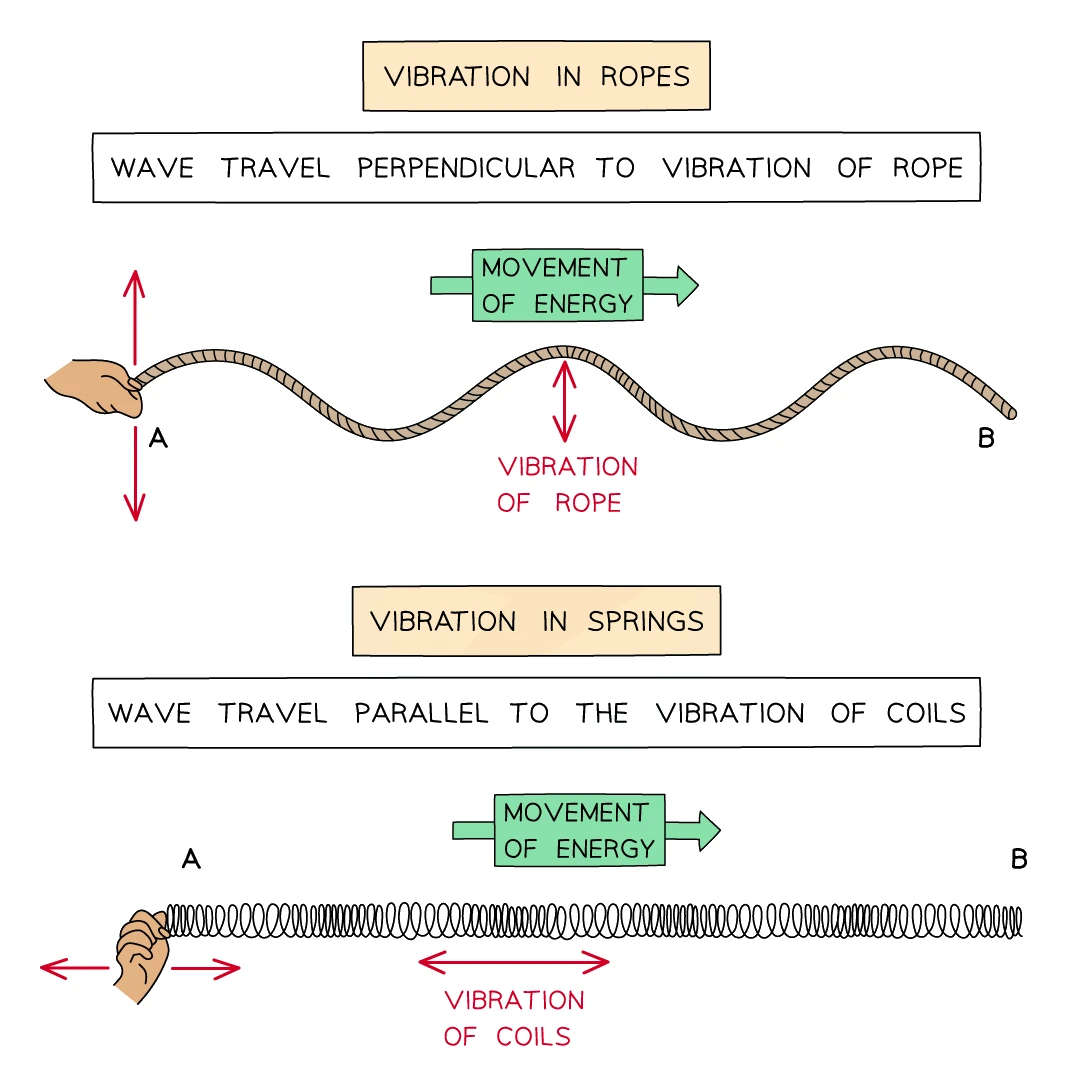
Side-by-side comparison
| Feature | Transverse waves | Longitudinal waves |
|---|---|---|
| Direction of oscillation | Perpendicular to energy transfer | Parallel to energy transfer |
| Visible features | Peaks and troughs | Compressions and rarefactions |
| Density of medium | Stays roughly constant | Rises and falls as wave passes |
| Pressure of medium | Stays roughly constant | Rises and falls as wave passes |
| Travels in solids? | Yes | Yes |
| Travels in liquids? | On the surface only (or as EM through liquid) | Yes (right through) |
| Travels in gases? | EM only | Yes |
| Travels in a vacuum? | EM waves only | No |
| Common examples | Ripples, guitar strings, all EM waves | Sound, P-waves, pressure waves |
Common exam question
The difference between transverse and longitudinal waves
Question: Describe the difference between transverse and longitudinal waves, or between the motion of their particles; a diagram may be used (2–3 marks).
Asked in 4 of the 24 papers. Every scheme wants two ideas: the particles vibrate (oscillate), and the direction of that vibration compared with the direction the wave travels or transfers energy. Write parallel (along the line of travel) for longitudinal and perpendicular (at right angles, 90°) for transverse. In three of the four schemes naming the vibration is a mark on its own and the directions earn the rest, and a clearly labelled diagram of each wave can earn every mark; the fourth scheme gives one mark per wave type.
One scheme ignores "up and down" and "forwards and backwards" for the vibration mark, so use the word vibrate or oscillate, then give each direction relative to the direction the wave travels.