4PH1
Waves & The Electromagnetic Spectrum
Waves · 1 question type
The shared properties
- All electromagnetic (EM) share four key features:
- They are transverse waves
- They all travel through a vacuum (and through air, water, glass, etc.)
- They all travel at the same speed in a vacuum: c = 3.0 × 10⁸ m/s
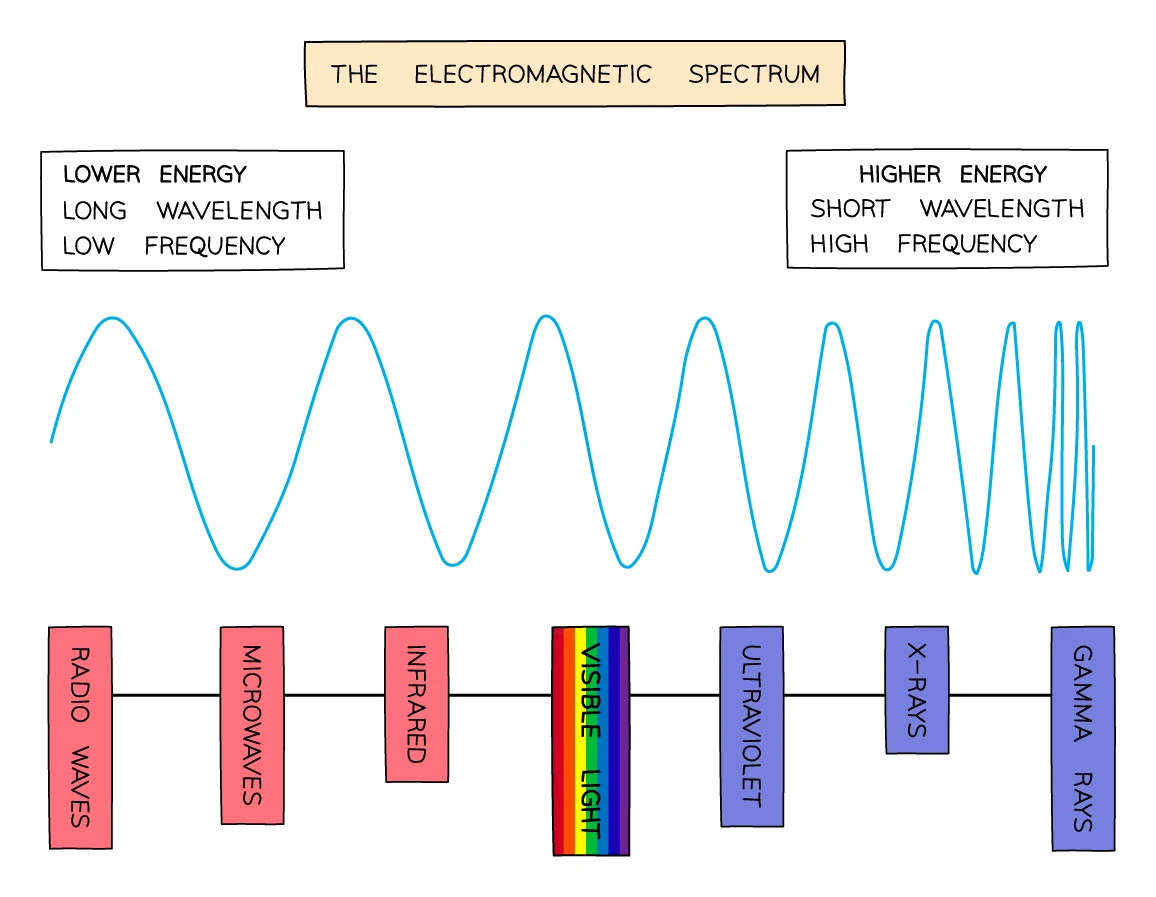
- They all obey the wave equation v = f × λ, so within the spectrum, longer wavelengths come with lower frequencies and vice versa
The seven bands of the spectrum
- The continuous electromagnetic spectrum is divided into seven named bands, listed below from longest / lowest to shortest wavelength / highest frequency:
- Radio waves
- Microwaves
- Infrared
- Visible light
- Ultraviolet
- X-rays
- Gamma rays
- Mnemonics to lock the order in:
- "Rock Musicians Invariably Vote United at X-mas (mostly Guitarists)"
- "Roman Men Invented Very Unusual X-ray Guns"
- The frequency of an EM wave is inversely proportional to its wavelength; longer wavelength means lower frequency
The visible spectrum
- Of all seven bands, only visible light is picked up directly by the human eye, and even that occupies just a sliver of the full electromagnetic spectrum
- Within visible light, the colours run from longest to shortest wavelength as:
- Red → Orange → Yellow → Green → Blue → Indigo → Violet
- mnemonics: "Roy G. Biv" or "Richard Of York Gave Battle In Vain"
- Red has the longest wavelength and lowest frequency in the visible range
- Violet has the shortest wavelength and highest frequency in the visible range
- Other animals see beyond the visible band; bees pick up ultraviolet patterns on flowers, and some snakes detect infrared signatures of warm prey