Waves & The Electromagnetic Spectrum
Waves
Wavefronts and rays
- A wavefront is a line joining all the points of a wave that are currently in step (for example, every point at the top of its peak)
- Wavefronts are usually drawn from above, like contour lines on a map:
- Closely spaced indicate a short
- Widely spaced wavefronts indicate a long wavelength
- A ray is an arrow drawn perpendicular to the wavefronts, showing the direction of travel of the wave
Amplitude
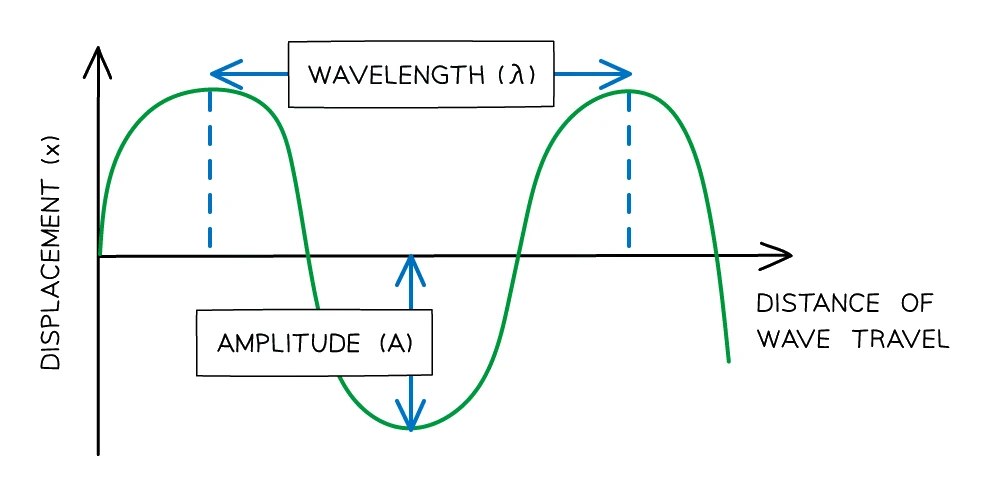
- The (A) of a wave is the distance from the undisturbed (rest) position to either a peak or a trough, not the full peak-to-trough height
- Amplitude is measured in metres (m)
- The amplitude of a wave is a measure of how much energy it carries; a wave with twice the amplitude transfers roughly four times the energy in the same time
Wavelength
- The wavelength (λ) of a wave is the distance from one point on the wave to the same point on the next wave:
- in a transverse wave, peak-to-peak (or trough-to-trough)
- in a longitudinal wave, centre of one compression to centre of the next
- Wavelength is measured in metres (m) and uses the Greek letter lambda (λ)
Common exam question
Reading amplitude and wavelength off a wave diagram
Question: Determine the amplitude or the wavelength of the wave shown in the diagram, by measuring it with a ruler or from the distance scale printed beneath it (1–2 marks).
Asked in 2 of the 24 papers. Amplitude is measured from the rest position to a peak (or to a trough), not from peak to trough. Wavelength is one complete wave: peak to the next peak, or any point to the matching point on the next wave. Each reading was accepted within a small range, and the answer line gave the unit (centimetres in both papers), so measure in the unit printed there.
When a distance scale runs under several complete waves, divide the length of the span by the number of waves rather than estimating one wave by eye: in one paper a value in the right range earned one mark and the exact value earned both.
Frequency
- The (f) of a wave is the number of complete waves that pass a fixed point each second
- Frequency is measured in hertz (Hz); 1 Hz = one per second
- A wave with a higher frequency carries more energy per second (for the same amplitude and medium)
Period
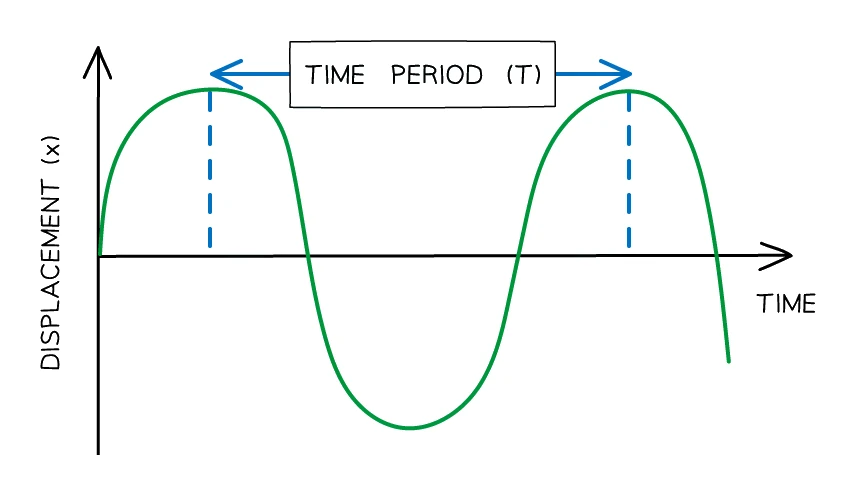
- The (T) of a wave is the time taken for one complete wave to pass a fixed point
- Period is measured in seconds (s)
- Frequency and period are reciprocals of one another:
f = 1 / T and equivalently T = 1 / f