Waves & The Electromagnetic Spectrum
Waves
What the Doppler effect is
- The Doppler effect is the apparent change in the and of a wave heard or seen by an observer, when the source of the wave is moving towards or away from them
- Note the word "apparent": the source itself emits the same wave as always, and it is the relative motion that distorts what the observer detects
Why it happens
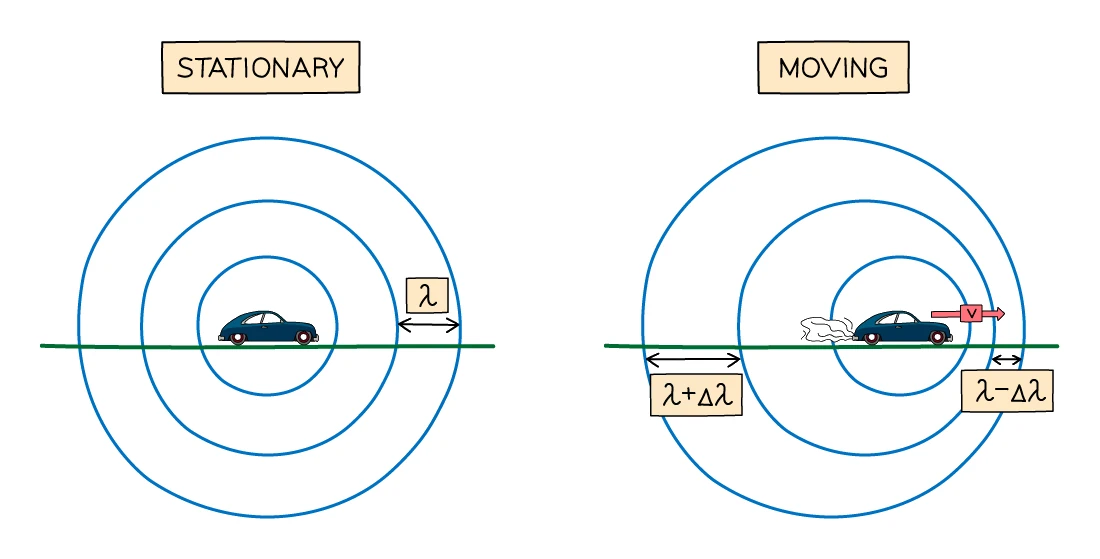
- For a stationary source, each new wavefront is emitted from the same point, and the wavefronts spread out as a series of equally-spaced concentric circles in every direction
- For a source moving along a line:
- Wavefronts emitted in front of the source are emitted from positions that have themselves moved forward, so each new front is closer to the previous one. The waves arrive at an observer ahead of the source with shorter wavelengths and higher frequencies
- Wavefronts emitted behind the source are emitted from positions that have moved away, so each new front is further from the previous one. The waves reach an observer behind the source with longer wavelengths and lower frequencies
- The speed in the medium does not change; only the spacing of the wavefronts. The change in wavelength is therefore balanced by an opposite change in frequency (v = f λ is still obeyed)
Common exam question
Explaining the Doppler effect
Question: Explain why the frequency detected by an observer differs from that emitted by a moving source, or discuss what a driver and a bystander hear from a car horn (3–6 marks).
Asked in 5 of the 24 papers. The source moves, so wavefronts ahead of it are closer together (shorter wavelength) and those behind further apart (longer wavelength). The wave speed stays constant, so by v = f × λ the frequency (pitch) heard is higher in front and lower behind. Say which way it changes and describe the observer's side: for a receding source, one scheme ignored all comment on the approaching side. In one scheme the equation scores only when linked to another point you have made, not merely quoted.
For the driver the frequency does not change: there is no relative motion between driver and horn. Two schemes credit naming the Doppler effect in itself, a third only as a fallback, so name it.
Everyday examples
- An ambulance siren passing you: pitch is high while the vehicle approaches, then drops sharply as it passes and recedes. A spectator near the road hears a sudden change in note as the source crosses
- Red-shift of distant galaxies: light from a galaxy moving away from Earth arrives with longer wavelengths than it left with, shifting the spectrum towards the red end. The greater the recession speed, the larger the red-shift; this is the headline evidence that the universe is expanding (covered in topic 24, Cosmology)
- Police radar guns: a radar pulse aimed at a moving car returns at a slightly different frequency from the one transmitted; the difference reveals the car's speed